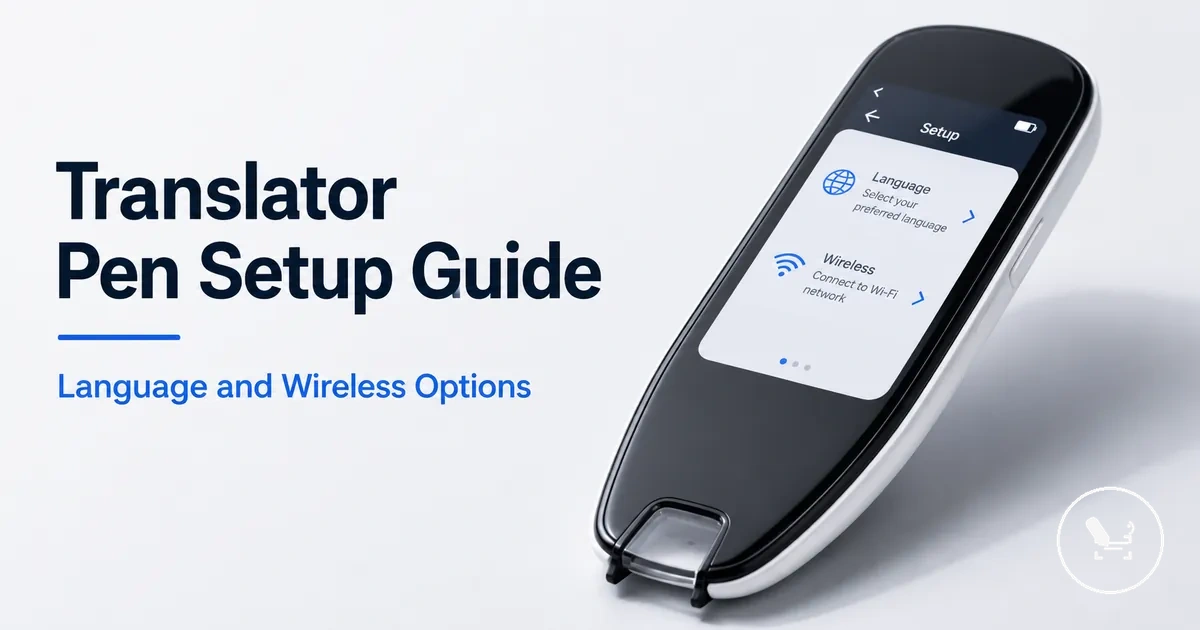
Translator Pen Setup for New Users
Translator pen setup for new users is the first use configuration process that prepares the device for language selection, Wi-Fi connectivity, offline mode access, scan test readiness, and voice translation functionality through the touchscreen interface. It establishes the initial state where the translator pen can correctly interpret printed text and generate on-screen translation outputs. The exact setup steps and menu labels may vary by model, but the goal remains consistent: enabling a ready-to-use configuration for scanning and translation tasks.
When a translator pen is powered on for the first time, users typically navigate the initial setup flow to align language settings and connection preferences before starting a basic scan test, as outlined in the translator pen guide. This stage often includes selecting source and target language options, choosing between Wi-Fi or offline mode depending on availability, and confirming touchscreen responsiveness for setup navigation. Voice translation settings may also be checked at this point to ensure audio output is active where supported.
A complete first use setup depends on a few minimum conditions being in place before moving into real usage. The translator pen should have sufficient battery, accessible language selection menus, and a configured connection mode for either Wi-Fi or offline mode operation. Once these conditions are met, a scan test with printed text can be used to confirm that on-screen translation and voice translation outputs are functioning as expected, indicating the device is ready for regular use.
Translator pen setup requirements before first use
Translator pen setup requirements before first use depend on a small set of readiness checks that confirm whether the device can safely enter initial configuration mode. These setup requirements focus on power availability, control responsiveness, setup menu access, and touchscreen interaction, which together determine whether the translator pen can proceed with configuration or remain in a non-ready state.
Translator pen setup requirements before first use are best verified through a structured check before opening the setup menu. The checklist below helps confirm whether the translator pen can move from power-on into configuration, where each requirement affects whether the setup process can continue or pause depending on device state and model prompt behavior.
Translator pen setup requirements before first use checklist is used to confirm readiness before configuration begins and to identify conditions that may block initial setup.
- Battery level supports stable power-on and prevents setup interruption
- Charging cable is available when power must be restored before configuration
- Power button responds and triggers startup behavior for first use
- Setup menu becomes accessible through the touchscreen interface
- Touchscreen input confirms selection actions during configuration
- Model prompt appears when guided setup instructions are required
When battery level is too low or startup response is delayed, the setup process may not proceed until basic power conditions are met. In such cases, following battery and charging care helps restore readiness before continuing first use configuration. These conditions affect only the ability to begin setup and do not define later device behavior.
Charging cable, battery level, and power-on readiness
Charging cable, battery level, and power-on readiness determine whether the translator pen can reach the setup screen during first setup. If the battery level is too low or the charging cable is not properly connected, the device may delay or fail to respond to the power button. The charging indicator and initial power-on response are the main signals that confirm whether setup can continue without interruption.
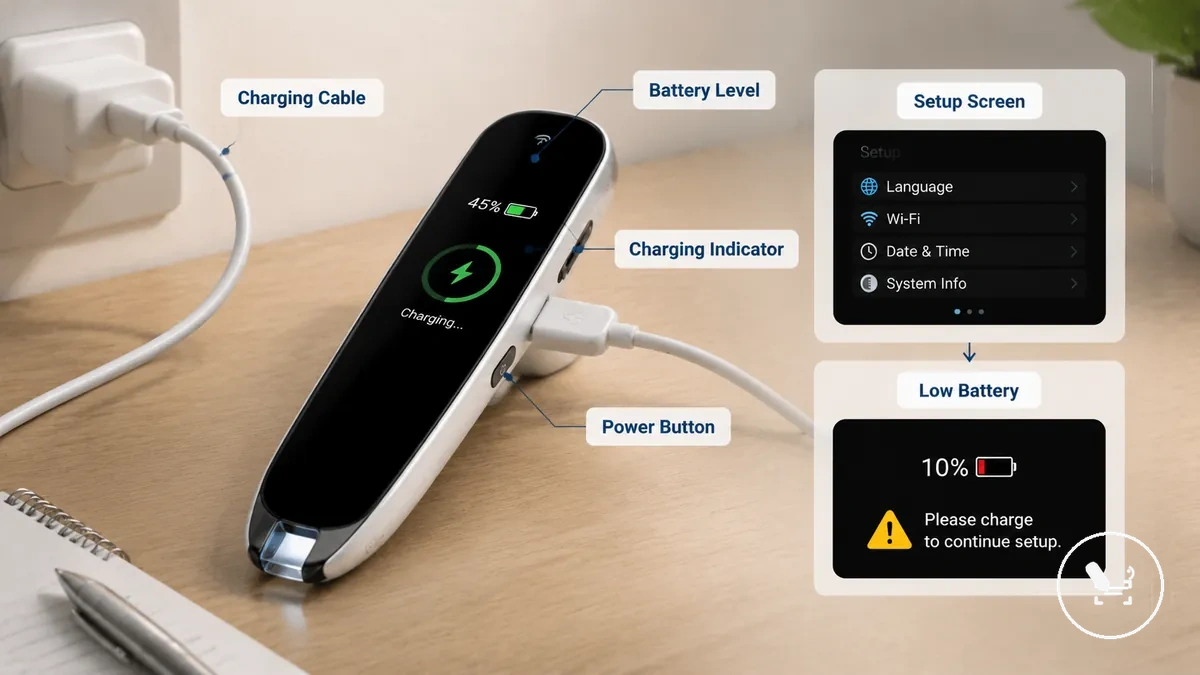
If charging issues appear during first setup, more detailed checks are covered in battery and charging care. The clarification helps separate basic setup power checks from broader handling guidance. The checklist below helps verify whether the translator pen is ready to proceed to the setup screen.
Charging and power readiness checklist: This checklist verifies whether power conditions support access to the setup screen and initial configuration.
- Charging cable is firmly connected to the charging port without looseness
- Battery level shows sufficient charge for powering on
- Charging indicator responds when the cable is connected
- Power button triggers a stable power-on response
- Setup screen appears without repeated restart delay
- Low battery condition is not blocking startup behavior
Touchscreen controls and setup menu access
Touchscreen controls and setup menu access depends on how the translator pen interface is structured, especially when switching between a touchscreen and physical buttons. The setup menu is reached through the home screen or through menu controls that open the settings area. A confirmation prompt may appear before changes are applied, depending on the model interface. The main condition to verify is whether the setup menu can be accessed from the home screen or via buttons using a stable navigation path.
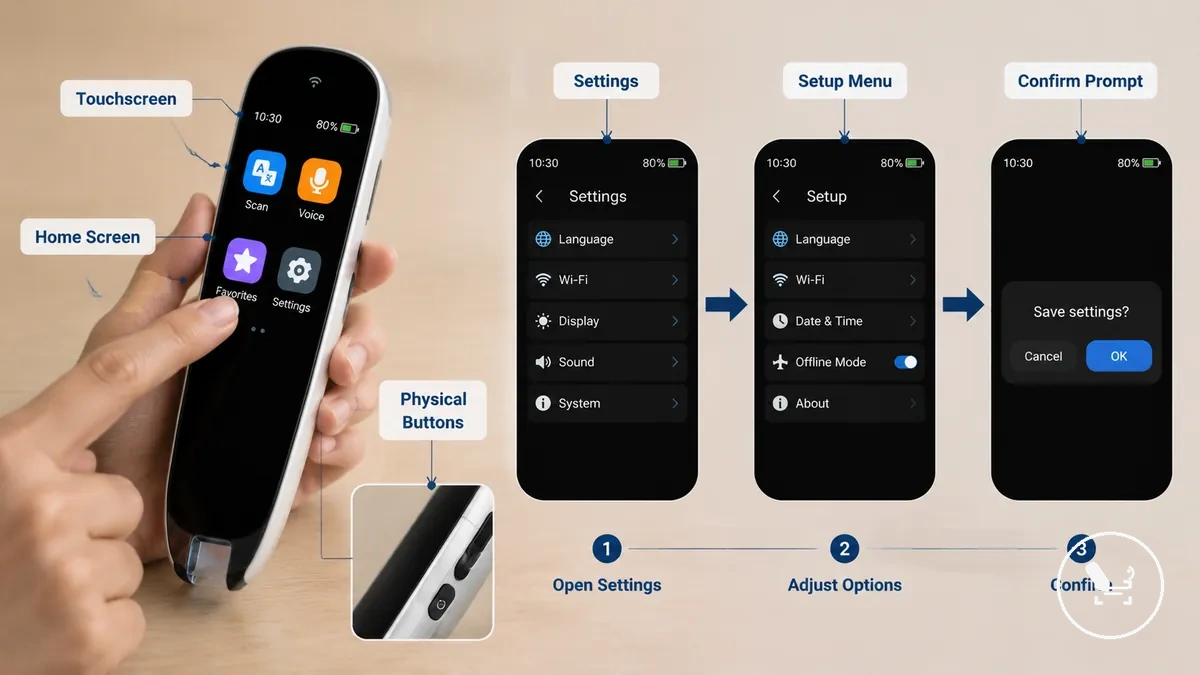
In some model interface designs, physical buttons may support navigation when the touchscreen is unresponsive or partially active. Touch controls and menu controls may follow different paths depending on how the setup action is structured on the device.
Interface access verification steps: These steps verify whether the touchscreen or buttons correctly open the setup menu and respond to confirmation prompts during installation.
- Power on the device and wait for the home screen to load
- Tap the settings icon on the touchscreen if available
- Use physical buttons if touch controls are not responsive
- Select the setup menu from the available interface options
- Confirm any confirmation prompt that appears on screen
Initial language settings on a translator pen
Incorrect language settings on a translator pen can prevent accurate translation between source language and target language during first use. Language settings must align the interface language, reading direction, scan output, and voice output so the device can process input and generate readable output correctly. When these values are misaligned, translation results may appear incomplete or inconsistent. The main condition to verify is whether the selected language pair matches the intended translation direction.
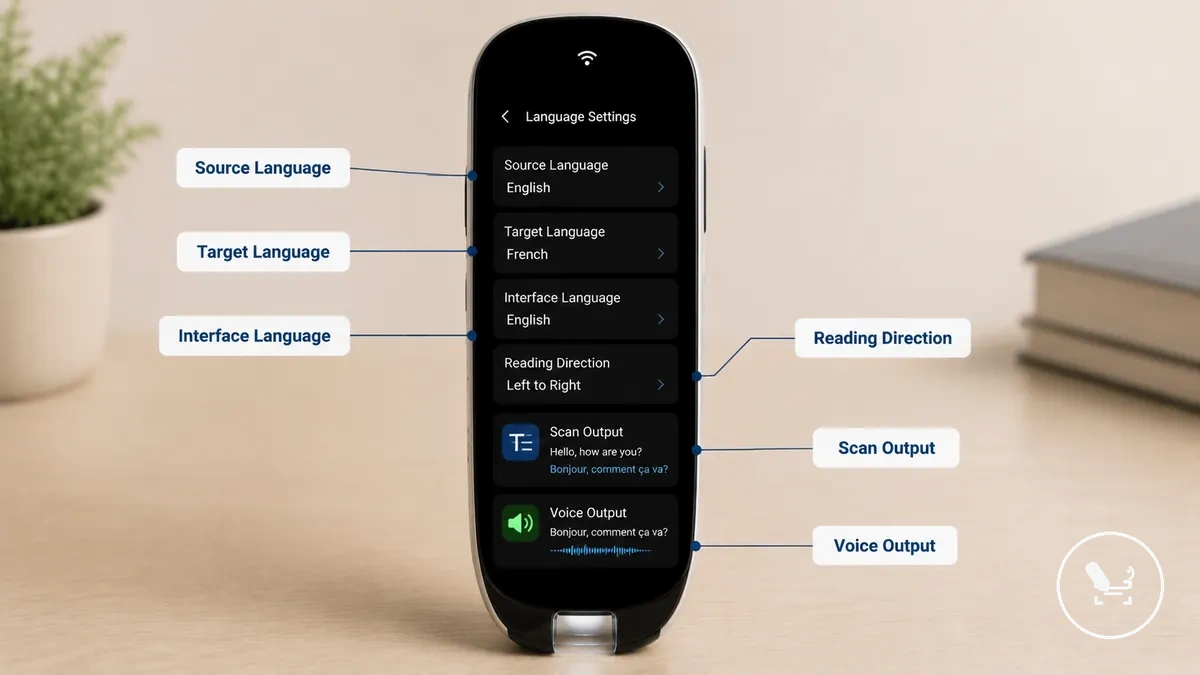
In most setup flows, language configuration begins after powering on the translator pen and accessing the settings menu. The interface language is typically selected first to ensure menu readability, followed by choosing the source language and target language. Reading direction may also be adjusted to align scan output with the correct text orientation. These settings together affect how scan output is interpreted and how voice output is generated. Available options may vary depending on the model interface.
Model language setup path verification: This step verifies how language settings are selected and confirmed before first translation use.
- Open the setup menu from the home screen or interface controls
- Select the interface language for menu readability
- Choose the source language for input text recognition
- Set the target language for translated output
- Adjust reading direction if required and confirm via confirmation prompt
Language configuration behavior and available options depend on the device model and installed language packages. For model-specific details on supported options and setup variations, see language support setup before finalizing language settings.
Source and target language selection
Source and target language selection defines how a translator pen interprets input and produces output during translation. The source language identifies the text that is scanned or spoken, while the target language determines the final output language shown in text or voice form. A correctly configured language pair ensures the output language matches the intended translation direction. The main condition to verify is that the source language and target language are not reversed.
In some cases, translation direction can be affected by auto-detect behavior or previously saved language pair settings that override manual selection. When translation direction is unclear, checking the language support setup can help confirm how the system handles source language and target language selection. Saved language pairs may streamline repeated use, but they can also cause mismatches if not updated for new contexts.
Source and target mapping example: This example clarifies the separation between input and output in a language pair.
| Selection | Meaning |
|---|---|
| Source language | Scanned or spoken input language |
| Target language | Output language for translation result |
Interface language and reading direction checks
Interface language and reading direction control how menus are displayed and how scanned content is aligned on a translator pen. When the interface language is not properly set, menu readability can decrease and make setup harder to follow. Reading direction and script direction affect scan orientation and display output, which determines how translated content appears on screen. The main condition to verify is that menu readability and scan orientation stay aligned with the chosen interface language.
In some configurations, right-to-left scripts or mixed-direction text may change how display output is arranged. These cases can affect scanning direction and require careful checking of reading direction settings, depending on device support and model behavior.
Interface language and reading direction checks: This check separates menu readability from scan behavior to confirm correct setup alignment.
Setting | What to confirm
| Interface language | Menu labels are readable and support clear user control |
| Reading direction | Scan orientation matches display output flow |
| Script direction | Right-to-left or special layout support when available |
Network setup for online and offline translation
Connection mode determines how a translator pen manages Wi-Fi, online translation, and offline translation during setup. When Wi-Fi is active, feature access can include online translation through a saved network, which expands real-time translation availability. When Wi-Fi is not available, the device relies on an offline language package, which separates offline translation from internet-based processing and limits results to installed data.
Network setup depends on the feature being used and the available connection mode. A saved network supports stable Wi-Fi status for online translation, while missing or weak connections reduce feature access. At the same time, offline language package readiness determines whether offline translation can function after setup. The comparison below separates these two conditions to clarify how connection mode affects translation availability.
Network setup does not guarantee identical offline behavior across all devices. The distinction between Wi-Fi and offline usage, as described in Wi-Fi and offline mode, depends on model support and installed offline language package data. Setup can prepare offline translation, but actual language availability and feature access remain conditional based on device configuration and supported resources.
| Mode | Setup condition | What it enables | Boundary |
|---|---|---|---|
| Wi-Fi (Online translation) | Saved network active | Online translation feature access | Depends on Wi-Fi status and connectivity stability |
| Offline package (Offline translation) | Installed offline language package | Offline translation capability | Limited by model support and available language data |
Wi-Fi connection for online translation features
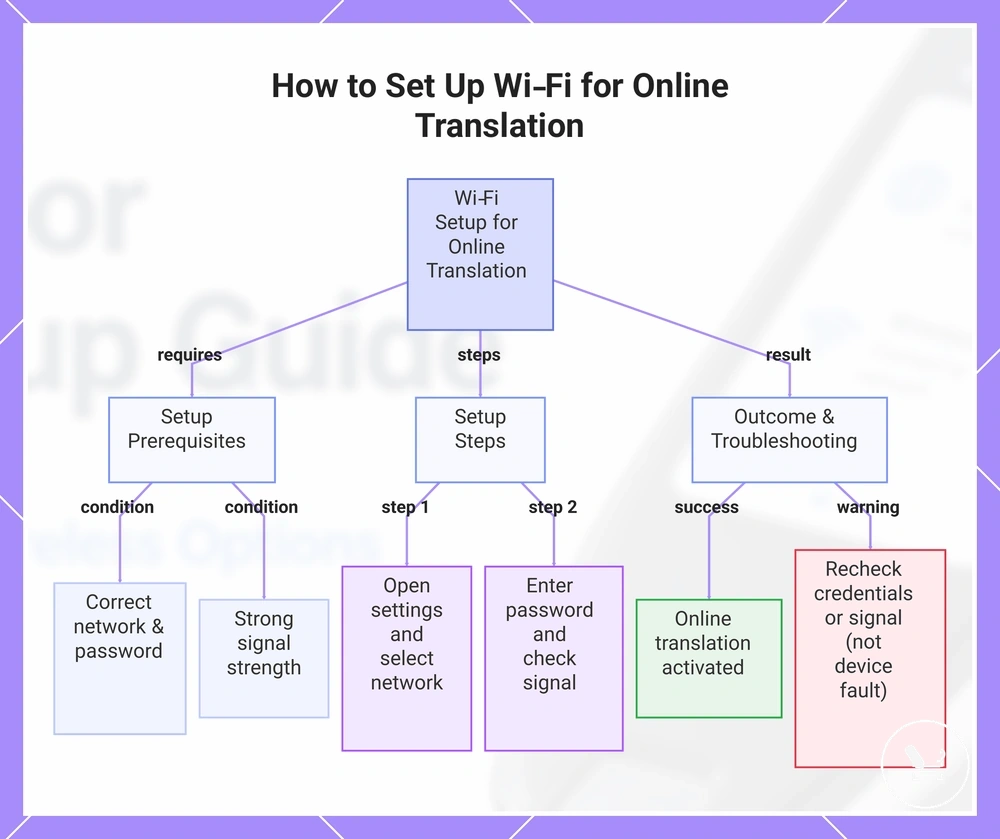
Wi-Fi network setup enables online translation features by connecting the translator pen through the settings menu. If the Wi-Fi network is not selected correctly or the password is incorrect, online translation may not activate during setup. Signal strength and connection status influence whether the connection remains stable after pairing. The main condition to verify is a correct Wi-Fi network, password, signal strength, and connection status before accessing online translation.
The Wi-Fi connection process verifies online translation access through the settings menu.
- Open the settings menu and select the Wi-Fi network
- Enter the correct password for the Wi-Fi network
- Check signal strength to ensure stable connection
- Confirm connection status after the device pairs successfully
- Verify that online translation becomes available
If a failed connection prompt appears, recheck the Wi-Fi network selection, password entry, and signal strength before retrying. Connection issues resolved within setup usually relate to incorrect credentials or weak signal rather than device fault.
This chart shows the prerequisites, main steps, and troubleshooting for setting up Wi‑Fi to enable online translation on a translator pen.
Offline language package readiness
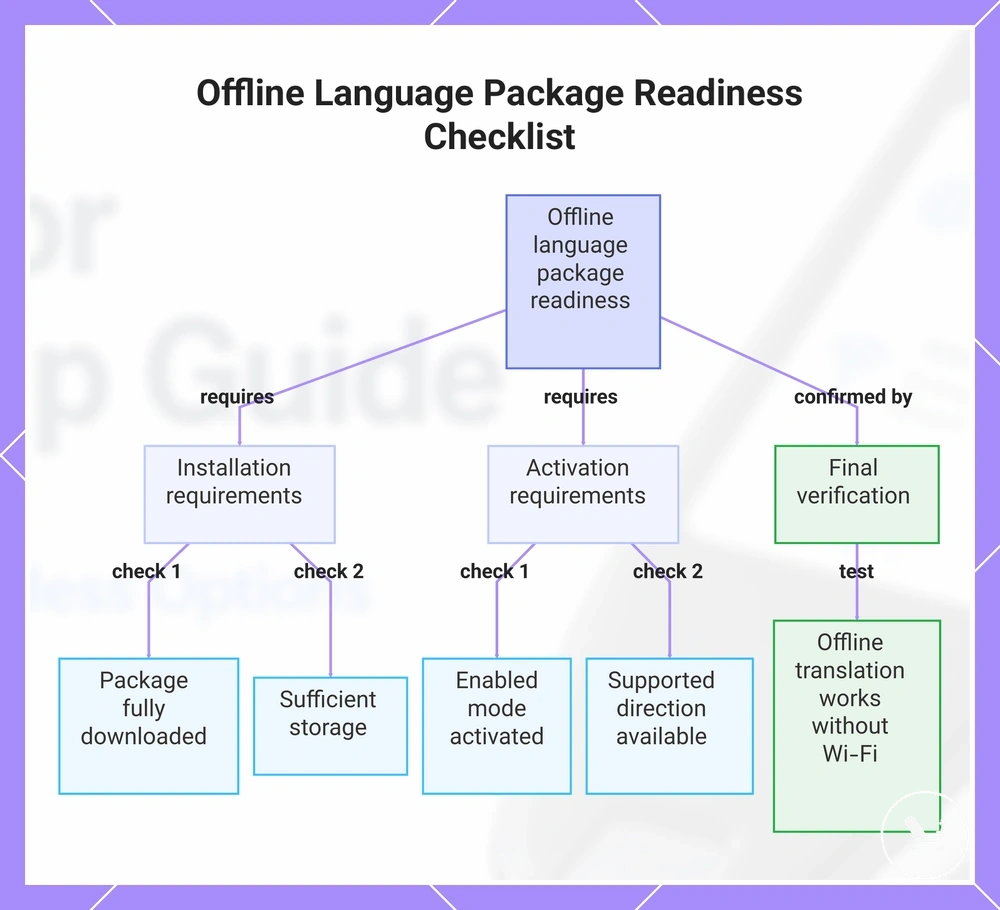
Offline language package readiness refers to whether a translator pen has an offline language package that is properly downloaded, stored, and enabled for offline translation. If these conditions are incomplete, offline translation may not start or may fail during use. Download status, storage availability, enabled mode, and supported direction all affect readiness before relying on offline functions. The main condition to verify is that the offline language package is fully installed and activated.
Offline availability depends on correct configuration through language support setup, where supported languages and download options are defined. A mismatch between downloaded data and enabled mode can prevent offline translation from working even when a package exists.
This distinction is important when comparing readiness states described in Wi-Fi and offline mode, especially where storage limits and model-specific language support may affect offline translation behavior.
Offline language package readiness checklist verifies whether the device is prepared for offline translation use.
- Offline language package is downloaded completely
- Storage status confirms sufficient space for language data
- Enabled mode is activated for offline translation
- Supported direction is available for the selected language pair
- Offline translation responds correctly without Wi-Fi
This chart outlines the key requirements and final test to confirm that a translator pen's offline language package is ready for use.
First scan test after setup
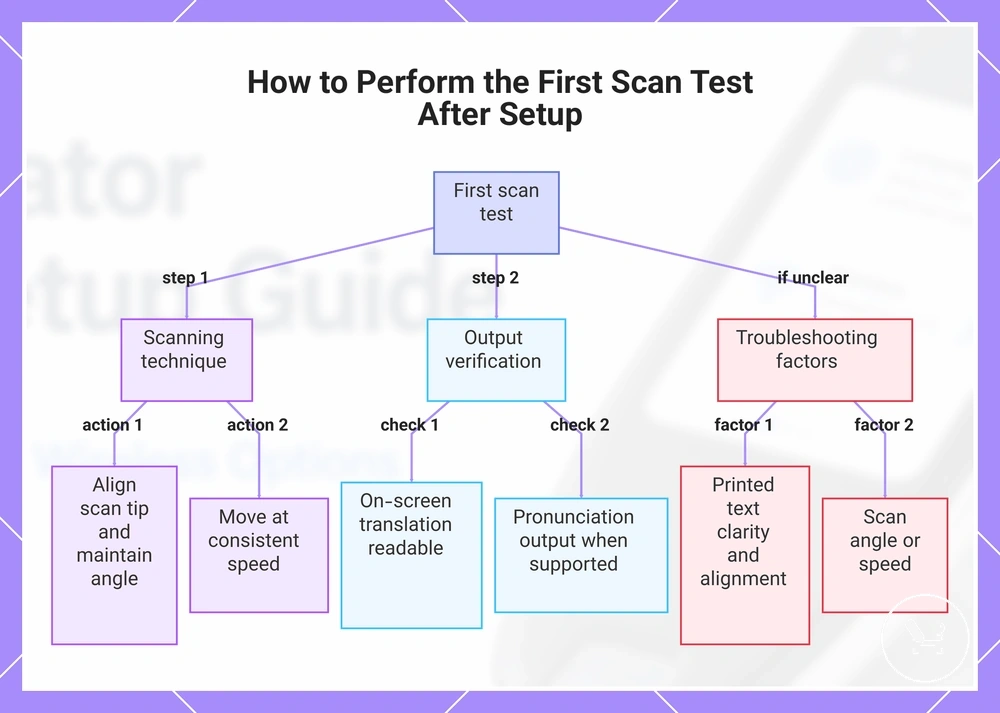
A successful first scan test after setup should confirm that the translator pen captures printed text, performs OCR capture, and displays a clear on-screen translation when the correct mode is active. In some cases, pronunciation output may also be triggered depending on the language pair and device settings.
The first scan test checks whether scanning, capture, and translation flow work correctly after setup. Start with a simple printed text sample and ensure the device is ready before scanning. Follow the ordered steps below to verify scan tip alignment, scan angle control, and output behavior.
- Activate scanning mode and align the scan tip with printed text
- Maintain a steady scan angle across the text line
- Move at a consistent speed to support OCR capture
- Observe on-screen translation output after capture
- Check pronunciation output if supported by the mode
First scan test checklist: This checklist verifies scan position, OCR capture, and translation output during the initial setup test.
- Printed text is clear and properly aligned
- Scan tip maintains stable contact with the surface
- Scan angle remains steady during movement
- Scan speed is consistent for accurate capture
- OCR capture registers text correctly
- On-screen translation displays readable output
- Pronunciation output activates when supported
If results are unclear, factors such as printed text quality, scan angle, or scan speed may affect OCR capture and translation output. For broader usage context after setup, see how to use a translator pen.
This chart shows the key steps for scanning technique, output verification, and common factors affecting results during the first scan test after setup.
Text alignment, scan angle, and scan window position
Scan positioning during the first scan test is affected by text alignment, scan angle, and scan window placement against the printed line. If the scan window is not aligned with the printed line, capture quality can drop and OCR capture may miss parts of the text or shift the on-screen translation. Stable positioning helps separate true setup issues from handling issues. The main condition to verify is consistent alignment between scan window and printed line throughout movement.
When scan output is unclear, the cause is often related to scan angle, pressure, scan speed, or lighting rather than device setup failure. Text alignment and scan window stability play a central role in how the device interprets the printed line during capture. The checklist below clarifies the local variables that influence scan positioning during the first scan test.
Scan-position checklist: This checklist verifies how text alignment, scan window position, and movement conditions affect capture quality during scanning.
- Text alignment follows the printed line without drifting off center
- Scan window stays fully aligned with the printed line during movement
- Scan angle remains steady and consistent along the scan path
- Scan speed is controlled and uniform across the full sentence
- Pressure is light and stable against the surface
- Lighting is sufficient for clear visibility of the printed line
- Printed line remains fully inside the scan window during capture
In many cases, inconsistent scan results come from positioning variables rather than setup failure. For broader scanning workflow context after setup, see how to use a translator pen as the next step.
On-screen translation and pronunciation checks
On-screen translation and pronunciation checks focus on validating two separate outputs after the first scan result: the displayed text and the spoken audio. The on-screen translation should present clear displayed text that matches the selected language pair, while pronunciation is verified through audio playback. If either the screen output or spoken output does not match the scan result, the issue is typically related to display conditions or audio playback settings rather than the scan itself.
When reviewing the first scan result, screen output and audio output should be checked independently to confirm consistent behavior. In some cases, on-screen translation may appear correct while pronunciation varies due to speaker volume or audio playback mode settings. The following checklist helps separate visual confirmation from spoken output validation.
On-screen translation and pronunciation checks: This checklist verifies displayed text and audio playback during first scan result evaluation.
- Displayed text shows a clear on-screen translation result
- Translation output matches the selected language pair
- Pronunciation playback activates when supported
- Speaker volume is adjusted to a clear and audible level
- Audio playback produces the expected spoken output
- Screen result and audio result correspond to the same scan input
If the on-screen translation is correct but pronunciation is unclear, speaker volume or audio playback settings should be checked before assuming a scan issue. The evaluation should always separate screen result verification from audio result verification.
Voice translation checks after initial setup
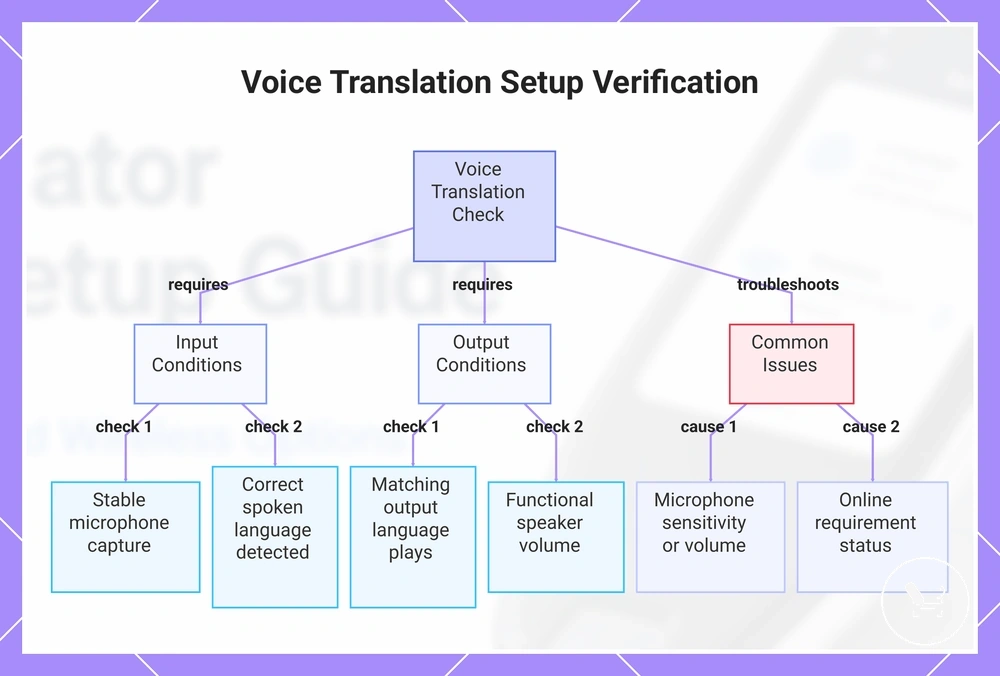
Voice translation after initial setup is confirmed when microphone input is captured, the correct spoken language is detected, and the output language produces audible speech through the device. This check ensures that voice translation works under the required connection conditions and that audio playback responds during early use. The main condition to verify is stable capture from microphone input with matching output language and functional speaker volume.
Voice translation should be tested separately from scan-based functions to confirm that audio translation operates correctly under real use conditions. Microphone input must register speech clearly, while spoken language selection determines how input is interpreted. Output language affects what is played back through audio playback, and speaker volume controls how clearly the result can be heard. The online requirement may influence whether voice translation activates depending on the model and connection mode. The process below verifies microphone input, language direction, and audio response step by step.
- Activate voice translation mode and confirm microphone input access
- Speak a short phrase in the selected spoken language
- Check that the output language displays and plays the translated result
- Adjust speaker volume to confirm clear audio playback
- Verify whether online requirement affects voice translation response
When voice translation works but results are inconsistent, the issue is often related to microphone input sensitivity, speaker volume level, or online requirement status rather than setup failure. In such cases, usage guidance from how to use a translator pen can help confirm correct operation. If microphone or audio issues persist after basic checks, further review may be needed under translator pen troubleshooting questions instead of repeating setup steps. :contentReference[oaicite:0]{index=0}
This chart shows the main conditions and checks to confirm voice translation works after initial setup.
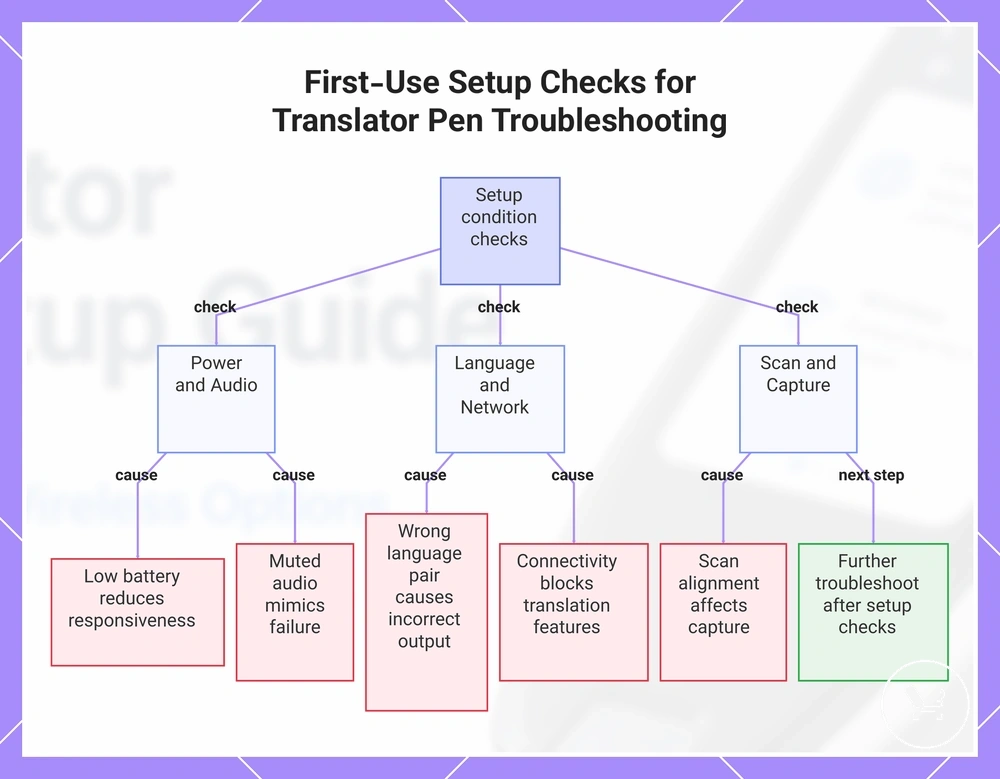
Basic setup checks before troubleshooting
First-use issues are often related to setup conditions rather than a device fault, especially when voice, scan, or language output does not behave as expected. In most cases, problems can be traced to low battery, wrong language pair, disconnected Wi-Fi, missing offline package, scan alignment, or muted audio. The main condition to verify is whether these setup checks are correctly completed before moving into deeper troubleshooting.
Many first-use problems come from a small group of setup conditions that directly affect performance. Low battery can reduce responsiveness, while wrong language pair may cause incorrect translation output. Disconnected Wi-Fi or missing offline package can block translation features, and scan alignment issues may affect text capture. Muted audio can also create the impression of failure even when processing works correctly. The checklist below helps separate symptom-based issues from setup-related causes.
Setup checks diagnostic checklist: This checklist helps diagnose whether the issue is caused by setup conditions or requires further troubleshooting.
- Low battery — check if power level affects startup or response
- Wrong language pair — confirm selected input and output languages match intent
- Disconnected Wi-Fi — verify network connection status for online features
- Missing offline package — check if offline translation data is installed
- Scan alignment — confirm correct positioning during text capture
- Muted audio — verify speaker output and volume level
When symptoms persist after completing setup checks, the issue may require further troubleshooting rather than repeating initial configuration steps. If uncertainty remains about whether the device is functioning correctly, further steps can be reviewed in translator pen troubleshooting questions to isolate setup-related conditions from persistent faults. If setup checks are correct across power, language, network, and audio conditions, reviewing overall usage flow in the translator pen guide can help confirm proper operation before escalating further.
This chart shows the key setup conditions to verify before deeper troubleshooting, including power, audio, language, network, and scan alignment issues, and the next step if symptoms persist.