
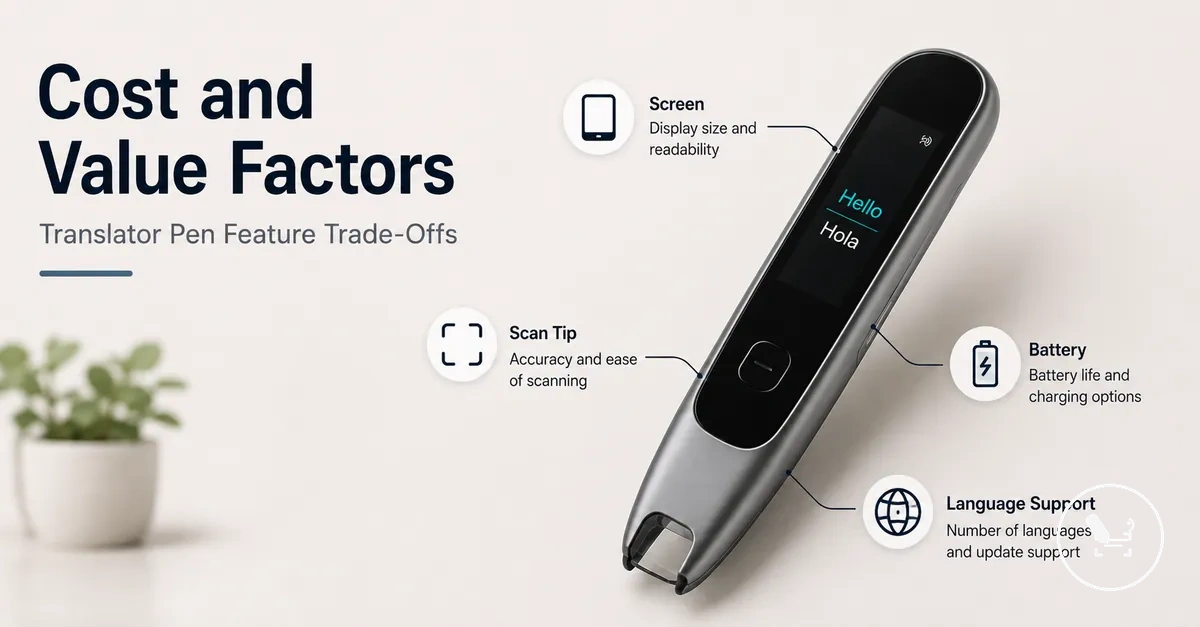
Translator Pen Price Guide and Value Factors
Translator pen price refers to a conditional cost-value range that depends on how a device handles scanning, translation functions, and usage expectations rather than a single fixed amount. It changes based on capability level, feature implementation, and user needs, so there is no universal price that applies to every translation pen configuration.
In real use scenarios, translator pen price is shaped by different contexts such as study environments where OCR scanning supports reading comprehension, travel situations where offline mode and language support matter, and accessibility or reading support use cases where text-to-speech becomes more relevant. These situations influence what functions are considered necessary, which in turn affects how cost and value are interpreted.
The actual value of a translation pen is usually evaluated through its value factors rather than its visible price alone. OCR scanning quality, voice translation clarity, offline mode availability, language support coverage, bundle contents, and reading support features all contribute to how useful the device becomes in daily conditions. When these elements align with user needs, the perceived worth increases even if price levels differ.
Because translator pen price varies by feature configuration and usage context, understanding price range differences requires focusing on how functions are combined rather than expecting uniform pricing across devices. This makes price interpretation a structured evaluation of capability, not a fixed commercial number.
How Translator Pen Prices Usually Vary
Translator pen prices vary by capability and usage context rather than following a single fixed rule. Higher or lower cost differences usually reflect how the device handles translation tasks, system support, and overall feature depth. This makes price variation a direct result of function and design choices rather than a universal standard.
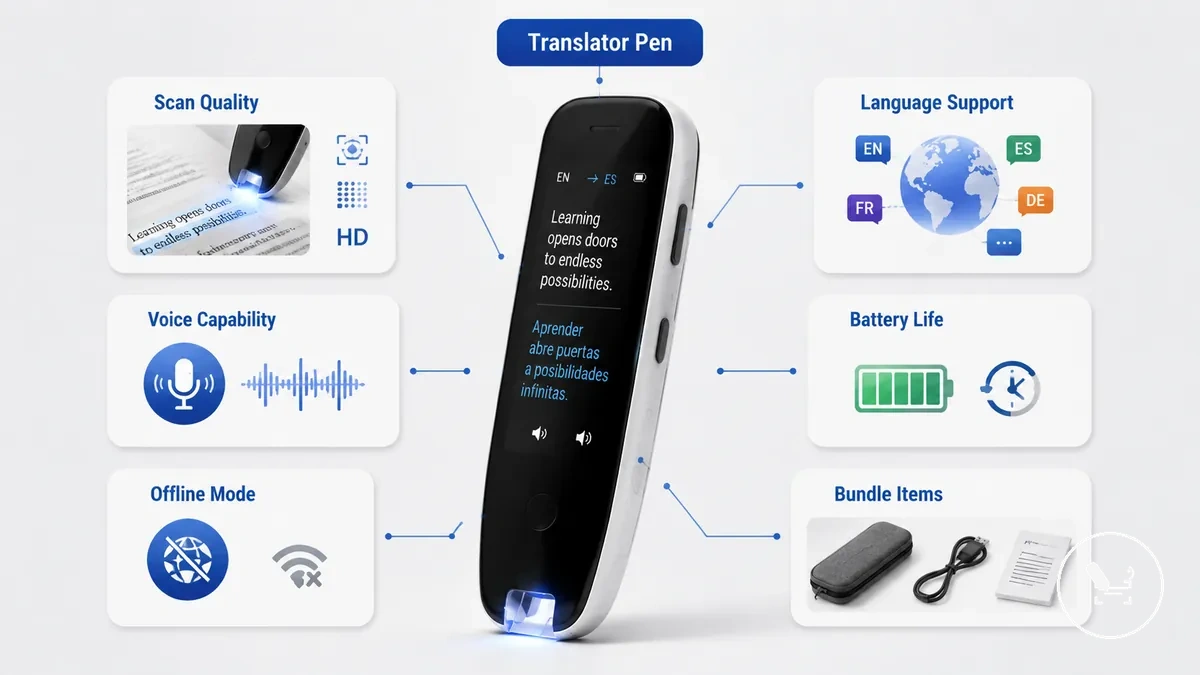
Price variation is mainly driven by how different core components are implemented in a translator pen. Scan quality affects how accurately printed text is captured, while voice capability influences spoken translation clarity. Offline translation support can increase value when internet access is limited, and language support range changes how widely the device can be used. Battery life and bundle contents also contribute because they affect long-term usability and overall completeness of the device setup.
Price variation depends on functions, hardware, software support, and included accessories. The table below organizes the main factors that influence translator pen prices and explains how each one changes cost and value signals in practical use conditions.
| Factor | What changes | Why it affects price |
|---|---|---|
| Scan quality | Text recognition accuracy | Higher recognition systems increase processing and component requirements |
| Voice capability | Speech translation clarity | Advanced audio processing improves output quality and system complexity |
| Offline translation | Dependence on internet access | Local language packs and storage requirements affect system design |
| Language support | Number of supported languages | Broader language databases increase software and maintenance needs |
| Battery life | Usage duration per charge | Larger or more efficient batteries influence hardware design |
| Bundle contents | Included accessories | Additional components change total setup cost structure |
Visible prices can shift based on different market conditions, but the underlying value logic remains tied to capability and configuration rather than temporary pricing changes. This distinction is important when interpreting cost differences and continues in the broader translator pen guide. :contentReference[oaicite:0]{index=0}
Translator Pen Price Ranges by Feature Level
Translator pen price ranges by feature level refer to grouped cost-value bands that organize devices according to capability instead of treating each listing as equal. These price ranges are typically shaped by whether the device is a basic translator pen, a mid-range translator pen, or a higher-feature translator pen with expanded functionality and system support.
Price ranges are easier to interpret when grouped by capability level because each tier reflects different combinations of scan performance, translation support, and system depth. The comparison below organizes translator pen price ranges by feature level and shows how each category relates to decision relevance and practical use conditions.
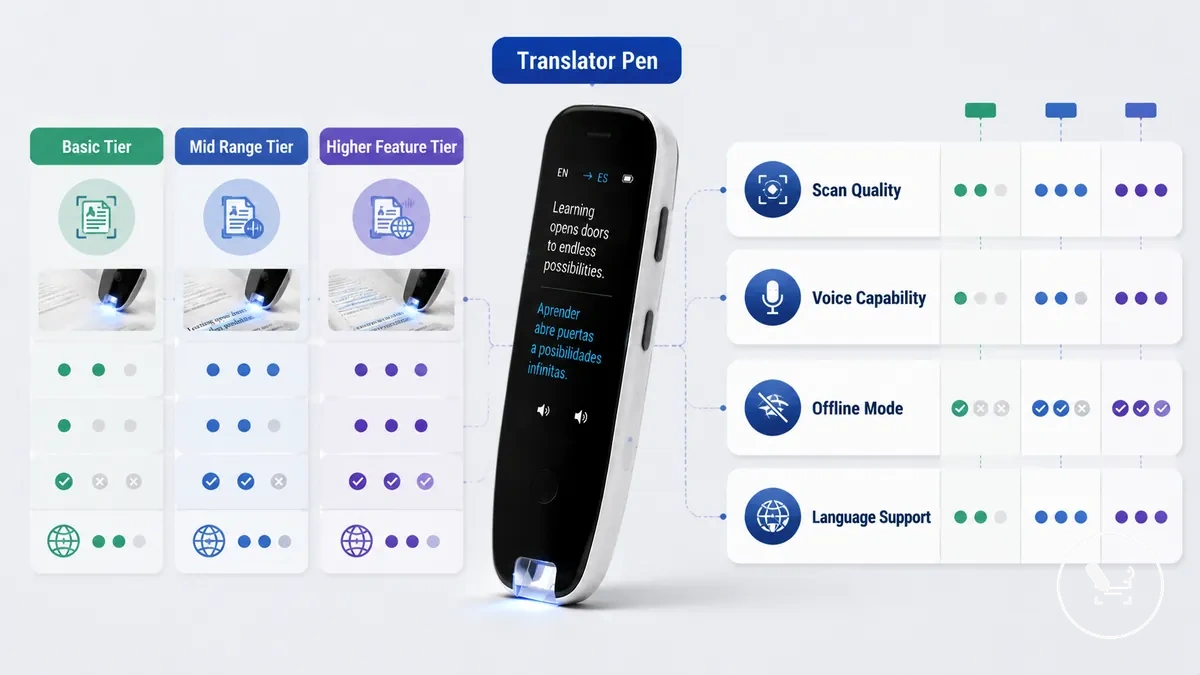
The table below summarizes how translator pen price ranges are structured across feature levels and how each tier differs in capability, limitation, and suitability. This structure helps clarify why price bands are not uniform and instead depend on functional depth.
| Feature level | Usually included | Common limitation | Best-fit use case |
|---|---|---|---|
| Basic translator pen | Core scan function and simple translation support | Limited OCR and fewer advanced language options | Light reading support and simple text translation needs |
| Mid-range translator pen | Improved OCR, voice translation, broader language support | May depend on online connection for full features | Study use and general multi-language reading tasks |
| Higher-feature translator pen | Advanced scan quality, offline mode, stronger hardware, expanded bundle contents | Higher system complexity and feature density | Frequent travel, offline use, and extended reading support |
Translator pen price ranges should be read as capability bands rather than fixed categories, since each level may vary depending on configuration and system design. In many cases, the same feature level can still differ slightly in usability depending on how scan quality, voice capability, and language support are implemented across devices.
For example, a basic translator pen may suit occasional reading support, while a mid-range translator pen often aligns with regular study needs, and a higher-feature translator pen may better support offline environments or more intensive language use cases where broader capability is required.
Basic price bands for scanning and text-to-speech
The basic price band refers to an entry-level range of translator pens focused on core functions such as scanning and text-to-speech. It typically includes dictionary support with varying scope, along with light reading and simple translation support depending on configuration. These capabilities are designed to prioritize essential use rather than advanced processing features.
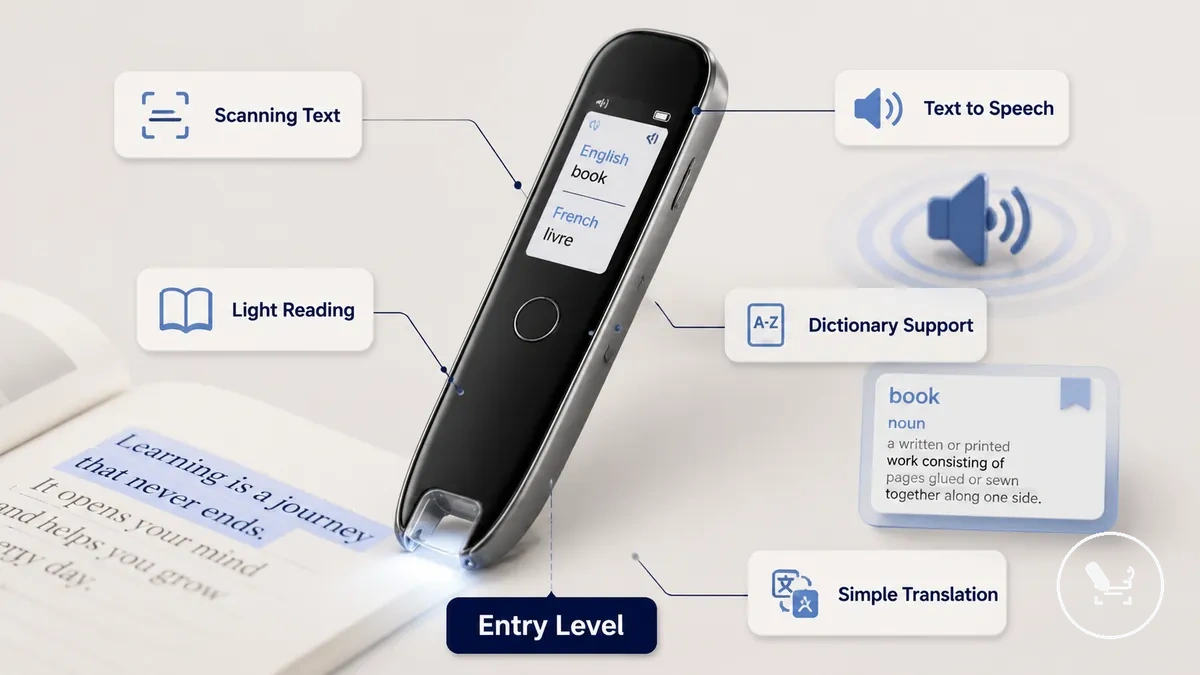
In light reading scenarios, the basic price band can support scanning printed text and converting it into spoken output for easier understanding. Dictionary support and text-to-speech may assist with simple translation support tasks, especially for occasional use, though language coverage, screen features, and voice functions can vary by device design and implementation.
Mid-range price bands for OCR, voice, and language support
Mid-range price bands for translator pens refer to the middle tier where added capabilities such as OCR, voice translation, and broader language support build on basic scanning and text-to-speech functions. This range typically expands dictionary functions and may include pronunciation support, depending on implementation quality and configuration. The focus is on improving usability across more varied reading and translation situations rather than changing the core device role.
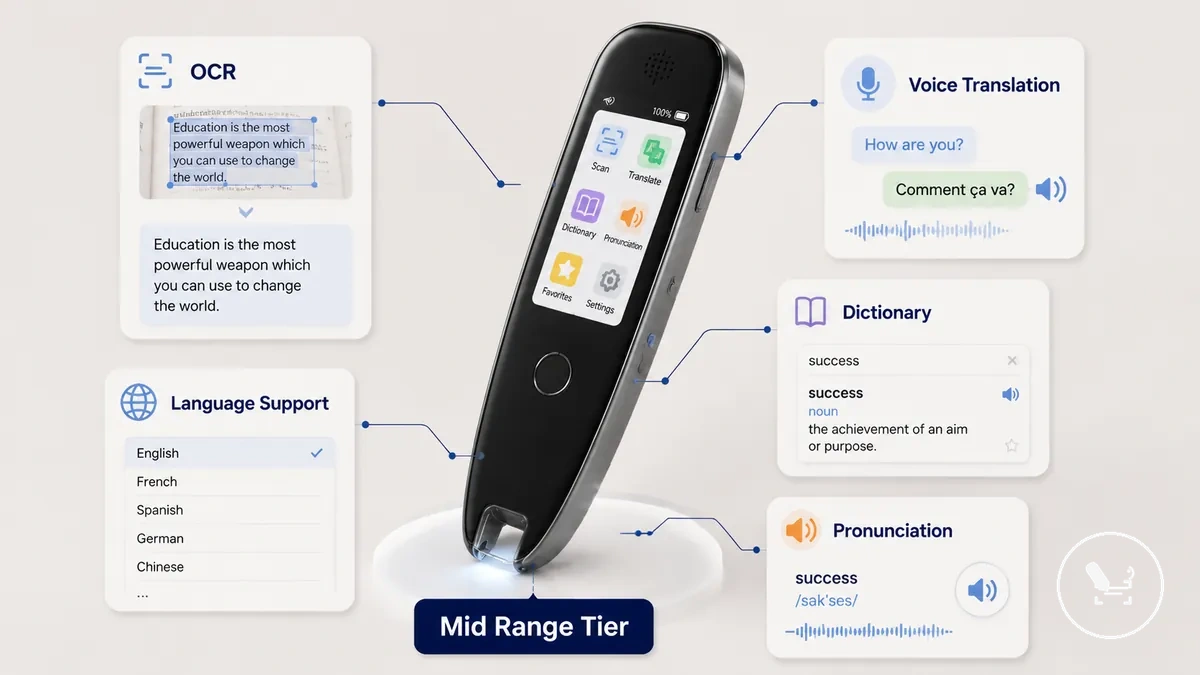
Implementation quality in mid-range price bands can vary across devices, especially in how OCR recognition handles printed text clarity and how voice translation processes spoken output. Language support may differ in coverage and consistency depending on system design. Dictionary functions and pronunciation support can improve usability when integrated well with scanning and audio output. These differences make the mid-range category more dependent on real-world performance conditions rather than feature presence alone.
Higher price bands for offline mode, hardware quality, and bundles
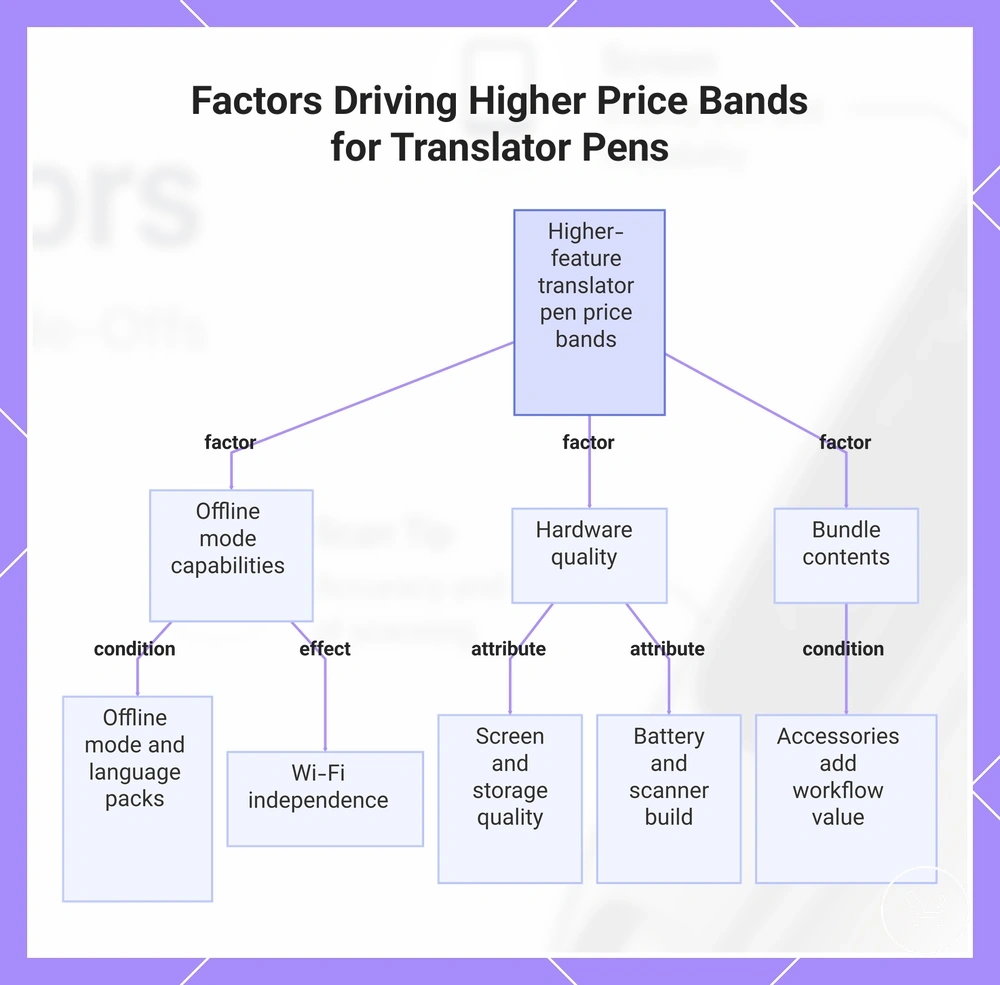
Higher-feature translator pen higher price bands are typically associated with expanded capability requirements such as offline mode, stronger hardware quality, and more complete bundle contents. These factors increase cost because they extend usability beyond basic scanning and text-to-speech functions into more independent and system-heavy operation scenarios.
Offline mode and language packs often add value when translation is needed without stable internet access, while Wi-Fi independence can reduce reliance on external connectivity. Hardware quality factors such as screen quality, storage, battery life, and scanner build may influence durability and consistency in different usage conditions. Bundle contents and accessories can also raise total cost, but their relevance depends on whether the added items are actually used in daily workflows rather than simply included in the package.
The checklist below organizes premium signals by how strongly they affect practical decision-making rather than price alone.
- Offline mode + when translation is needed without internet access
- Language packs + when broader regional coverage is required
- Wi-Fi independence + when stable connectivity cannot be assumed
- Screen quality + when readability and interaction clarity matter
- Storage + when offline processing and data handling are required
- Battery life + when extended use duration is necessary
- Scanner build + when durability and consistent scanning are priorities
- Bundle contents + when accessories add real workflow value
This chart shows the main capability factors that increase the cost of higher-feature translator pens, with conditions for practical value.
Features That Most Often Change Translator Pen Value
Translator pen value is shaped by distinct feature families that influence how well the device supports reading, listening, and translation tasks. These feature families include OCR scanning, voice translation, text-to-speech, offline translation, language support, hardware, battery, and accessories, where each contributes differently depending on real usage conditions rather than feature presence alone.
Value changes when OCR scanning improves printed text recognition quality, when voice translation becomes more reliable in spoken contexts, and when offline translation or reading support performs better in limited connectivity situations. These differences are better understood by separating meaningful capability from superficial specification volume. A structured view is available in features that affect value which groups these criteria into clearer decision layers for comparison.
| Feature family | Quality condition | Practical effect | Value implication |
|---|---|---|---|
| OCR scanning | Printed text recognition clarity | Improves reading and extraction accuracy | Higher usefulness in study and document reading tasks |
| Voice translation | Audio processing stability | Supports spoken interaction scenarios | More practical for real-time communication use |
| Text-to-speech | Output clarity and pacing | Assists comprehension during reading | Improves accessibility and learning support |
| Offline translation | Language pack availability | Works without internet dependency | More reliable in travel or limited connectivity |
| Language support | Coverage consistency across regions | Expands usable translation scope | Better adaptability across user contexts |
| Hardware | Build quality and interface design | Affects durability and handling | Stability in long-term use conditions |
| Battery | Usage duration under load | Extends operational time | More consistent daily usability |
| Accessories | Bundle composition relevance | Supports setup and usage convenience | Value depends on actual usage of included items |
Translator pen features influence value when their quality aligns with the user’s primary usage situation, such as study reading, travel translation, or accessibility support needs. The most relevant evaluation depends on whether OCR, voice, offline, or hardware capabilities match real-world requirements rather than feature quantity alone.
OCR scanning and recognition quality
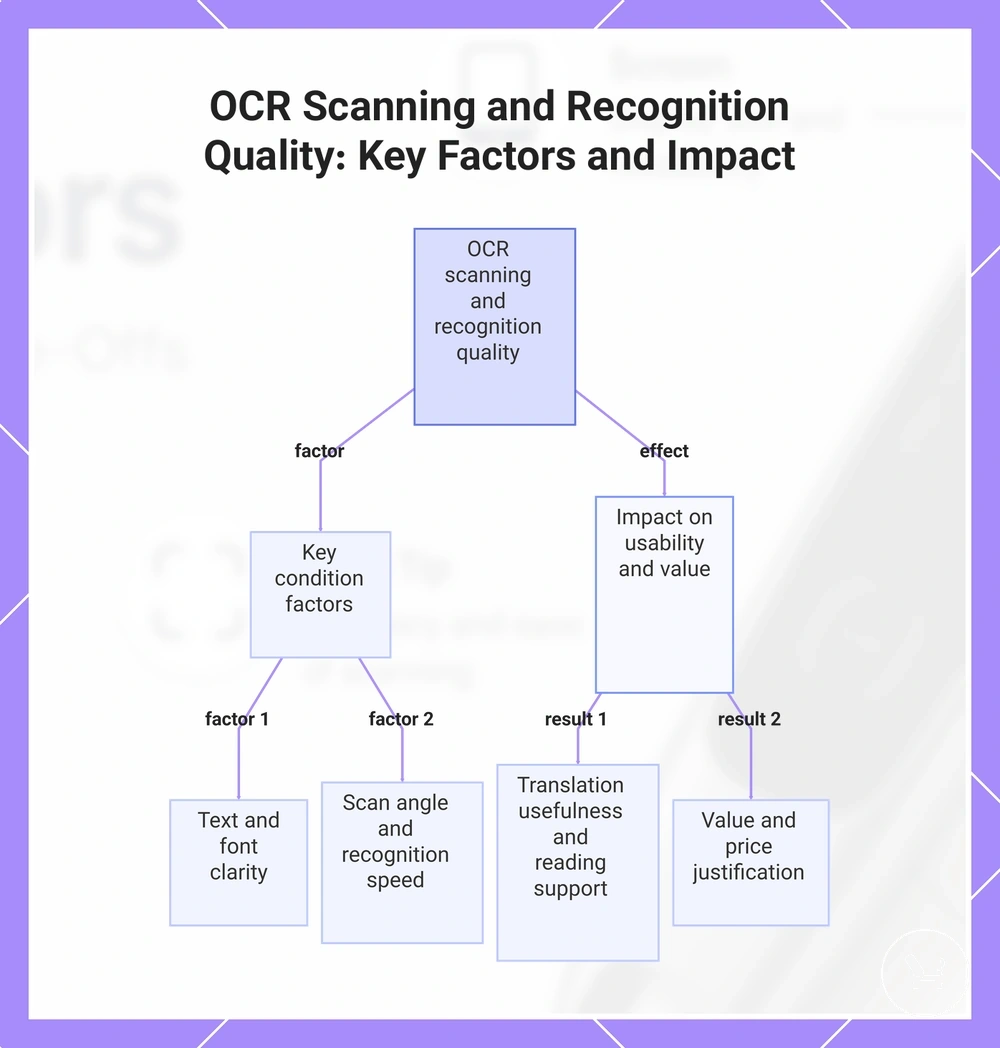
OCR scanning and recognition quality refers to how OCR scanning captures and interprets printed text and how recognition quality affects the usability of extracted text in a translator pen. It directly influences translation usefulness and reading support because clearer OCR scanning usually produces more reliable text output. In this context, recognition quality becomes a direct factor in value and price justification when printed text conditions are consistent.
OCR scanning performance changes depending on recognition condition factors such as printed text clarity, font clarity, scan angle, and recognition speed. These conditions determine how stable text recognition is and how effectively it supports translation usefulness.
- Printed text clarity → affects recognition quality and reading support reliability
- Font clarity → influences OCR scanning accuracy under different text styles
- Scan angle → can reduce or improve recognition stability during capture
- Recognition speed → affects how quickly text is processed for translation usefulness
This relationship between OCR scanning conditions and recognition quality helps explain why performance differences can influence both usability and price justification in real usage scenarios. It also defines boundaries of accuracy and value depending on text and scan conditions.
This chart shows the main condition factors that determine OCR scanning and recognition quality and how they affect translation usefulness, reading support, and price justification.
Voice translation, pronunciation, and text-to-speech
Voice translation refers to spoken translation delivered through audio output via the device speaker, allowing translated phrases to be heard rather than read. Pronunciation support focuses on helping users learn how words or phrases should sound in the target language for learning use. Text-to-speech is a read-aloud function that converts printed text into spoken audio for reading assistance and accessibility.
These audio functions affect translator pen value when spoken output is required in different contexts. Voice translation may support travel conversation support when quick spoken understanding is needed. Pronunciation support adds value in learning use by improving how users repeat and practice language sounds. Text-to-speech improves reading assistance when printed text needs to be heard instead of read, especially for comprehension support.
| Audio function | Best use condition |
|---|---|
| Voice translation | Travel conversation support where spoken output is needed |
| Pronunciation support | Learning use where correct speech formation is required |
| Text-to-speech | Reading assistance when printed text needs audio output |
Offline translation, Wi-Fi dependence, and language packs
Offline translation depends on Wi-Fi dependence and language-pack availability, making it a compatibility condition that directly affects price justification when translation is required without reliable internet access. When offline translation is needed, value increases based on how well downloaded packs support local translation and how consistently the system works without connectivity.
Language packs define which offline languages are available through downloaded packs, while Wi-Fi dependence determines how much the device relies on internet access for full functionality. Setup requirements and feature limits may vary depending on whether translation is processed locally or through online services, which also affects travel reliability in low-connectivity environments.
Offline translation may not cover all language pairs or all functions equally, and support can vary across voice features and OCR functions depending on configuration. This means offline capability should be treated as conditional coverage rather than complete translation parity across all use cases.
The following mini-checklist verifies offline readiness:
- Availability of offline languages for required use cases
- Downloaded packs properly installed and stored locally
- Wi-Fi dependence clarified for setup and full feature activation
- Feature limits identified between online and offline modes
- Expected travel reliability in no-network environments
Screen size, battery life, storage, and included accessories
Screen size, battery life, storage, and included accessories refer to hardware and supporting items that influence translator pen value after core translation features are covered. These attributes affect usability, portability, and total cost of ownership based on how the device is used in daily conditions. Screen size, battery life, storage, charging cable, case, build quality, and accessory bundle together shape convenience rather than translation capability alone.
Screen size affects reading comfort and on-screen usability during text review. Battery life influences how long the device can operate in mobile or travel conditions. Storage determines how much offline data and language resources can be kept locally. Accessories such as a charging cable or case may improve convenience, but their value depends on actual usage frequency and context.
Hardware value depends on usability, portability, and included support items. The following checklist explains how each factor contributes to total cost of ownership:
- Screen size → impacts reading comfort and usability during interaction
- Battery life → affects portability and duration of daily use sessions
- Storage → determines offline content capacity and language data availability
- Build quality → influences durability and long-term usage stability
- Charging cable → supports basic usability and charging continuity
- Case → adds protection and may affect carrying convenience
- Accessory bundle → contributes to total cost of ownership depending on usage
What Affordable Translator Pens Usually Include
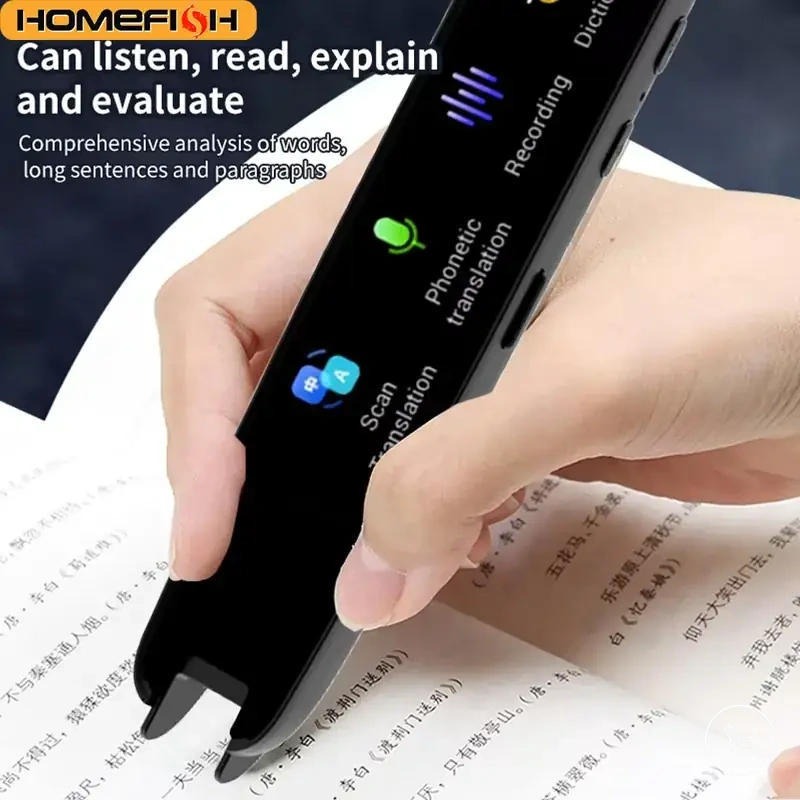
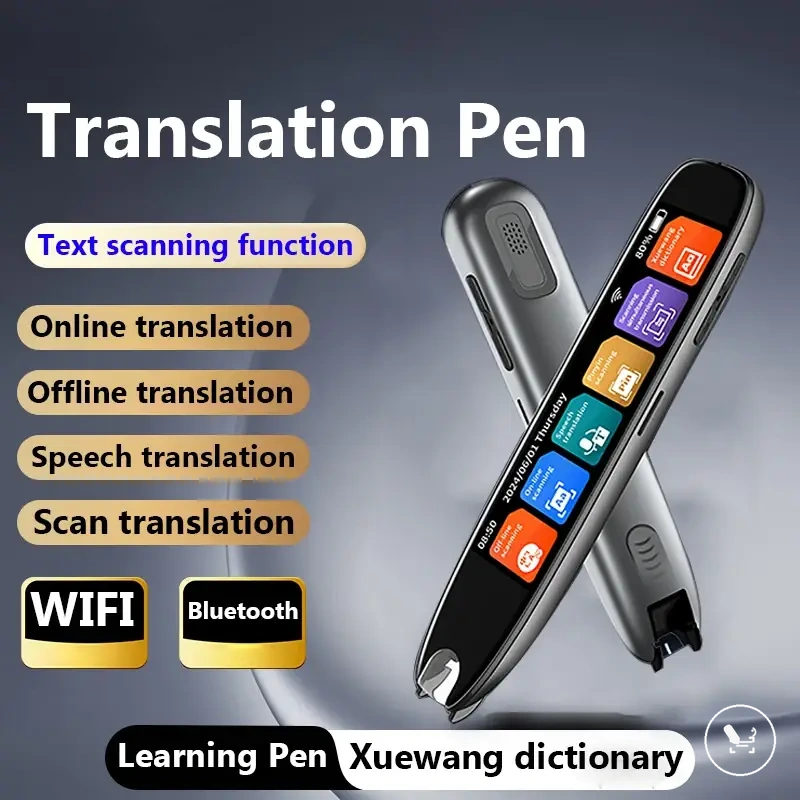
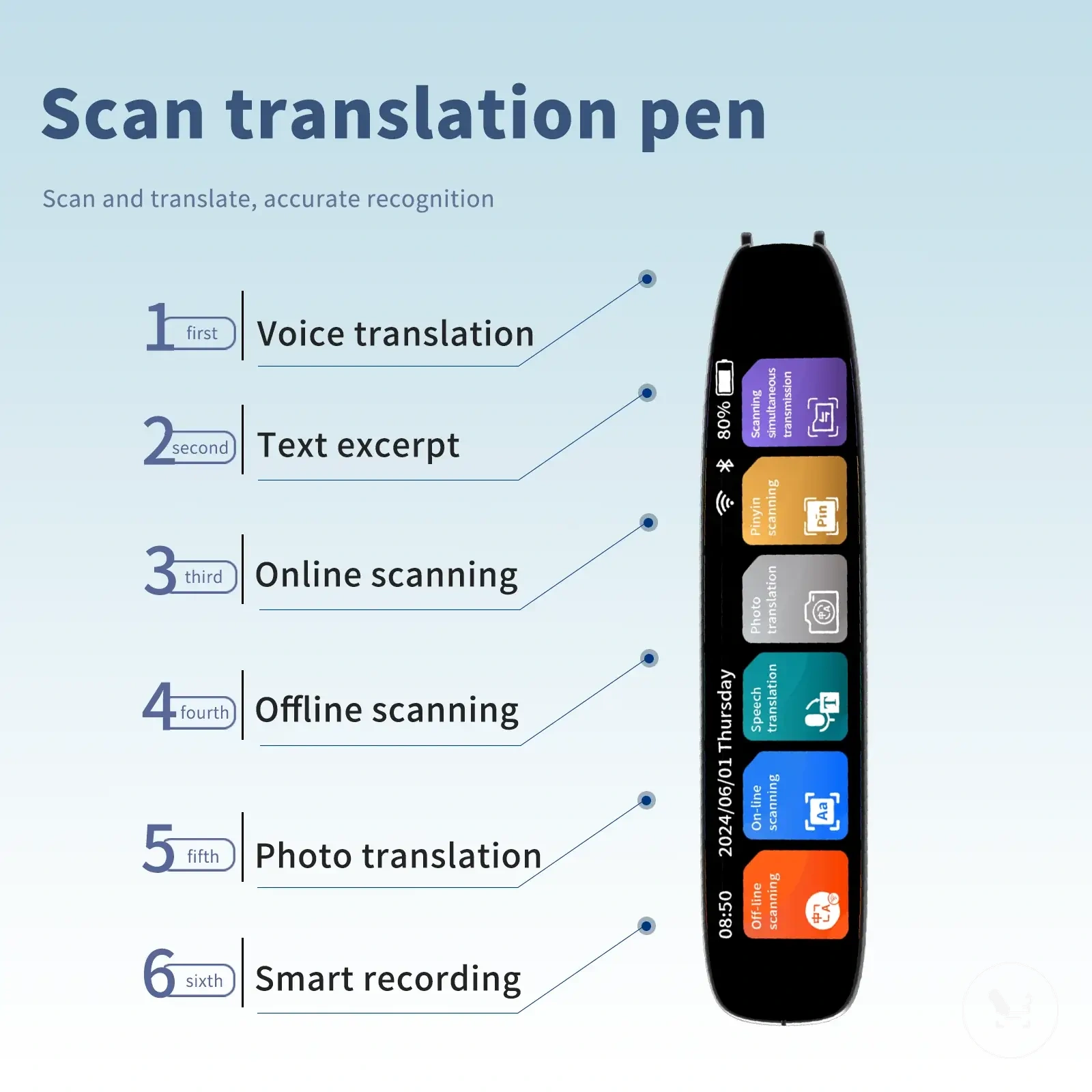
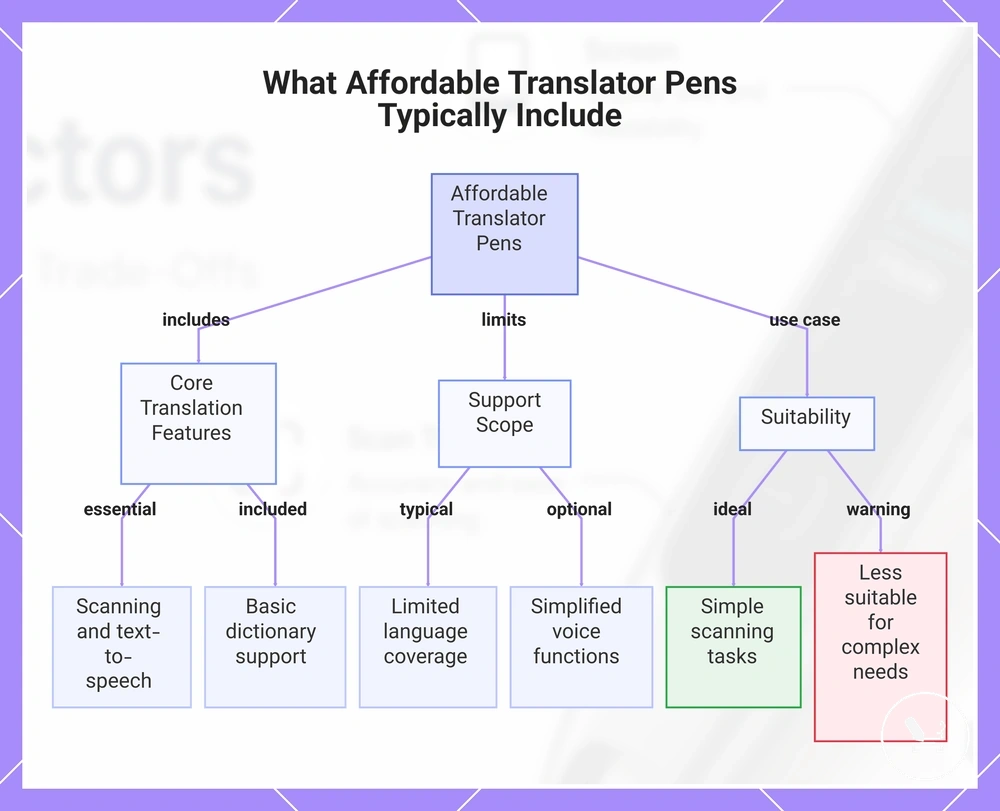
An affordable translator pen typically includes essential scanning, basic text-to-speech, and limited language support, with optional simplified voice functions depending on configuration. It focuses on simple use where core translation features matter more than extended system capabilities. Basic dictionary support is also commonly included for straightforward word-level understanding.
Affordable translator pens are entry-level devices designed for simple use conditions. They usually prioritise included features such as scanning and text-to-speech for basic reading support. Limited voice support and basic dictionary functions may be available depending on the model.
These devices are suitable when usage is focused on simple scanning tasks, light reading assistance, or basic language support needs. They may become less suitable when advanced voice interaction or broader language coverage is required in complex environments.
Selection depends on whether the user prioritises simple use over extended functionality. For broader comparison, best translator pen options can help evaluate alternatives before
Here are product examples that may make comparison easier. Before buying, always review the compatibility criteria, essential features, and product details.
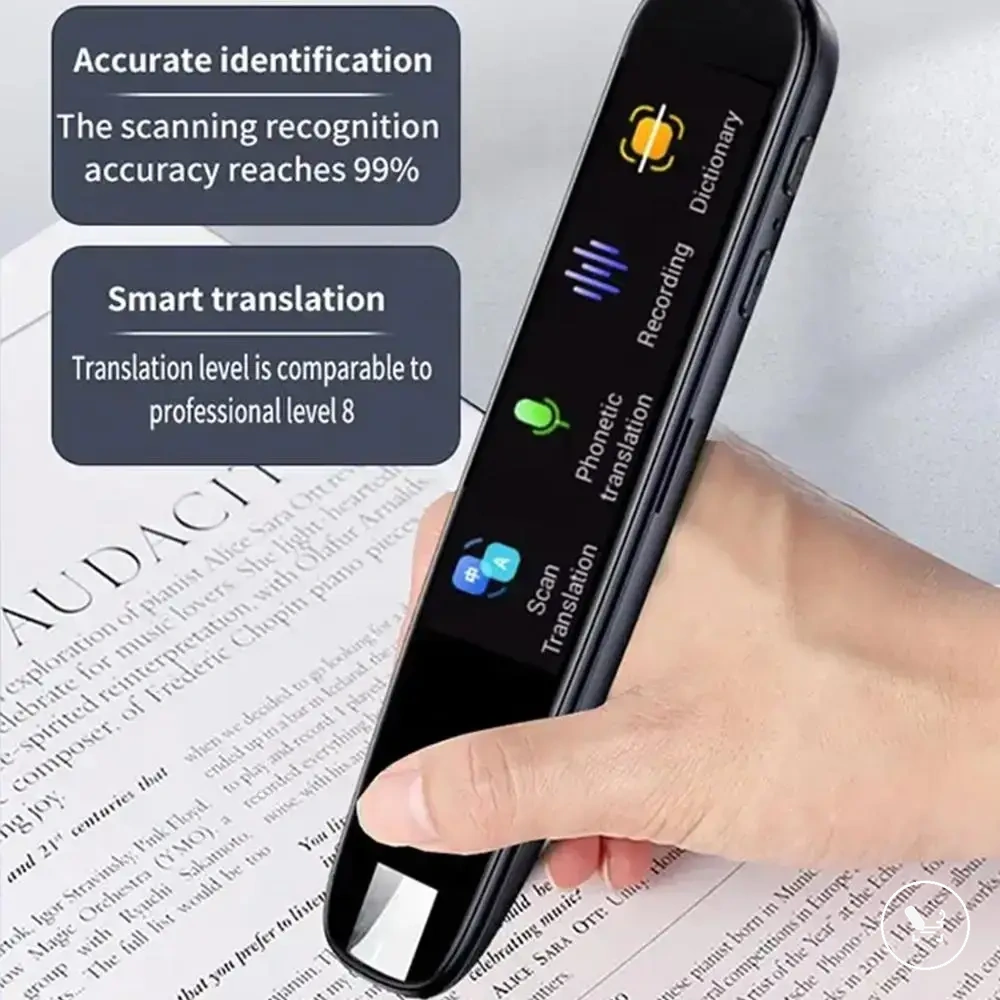
This chart shows the typical features, support scope, and suitability of affordable translator pens for simple use conditions.
When Paying More for a Translator Pen Makes Sense
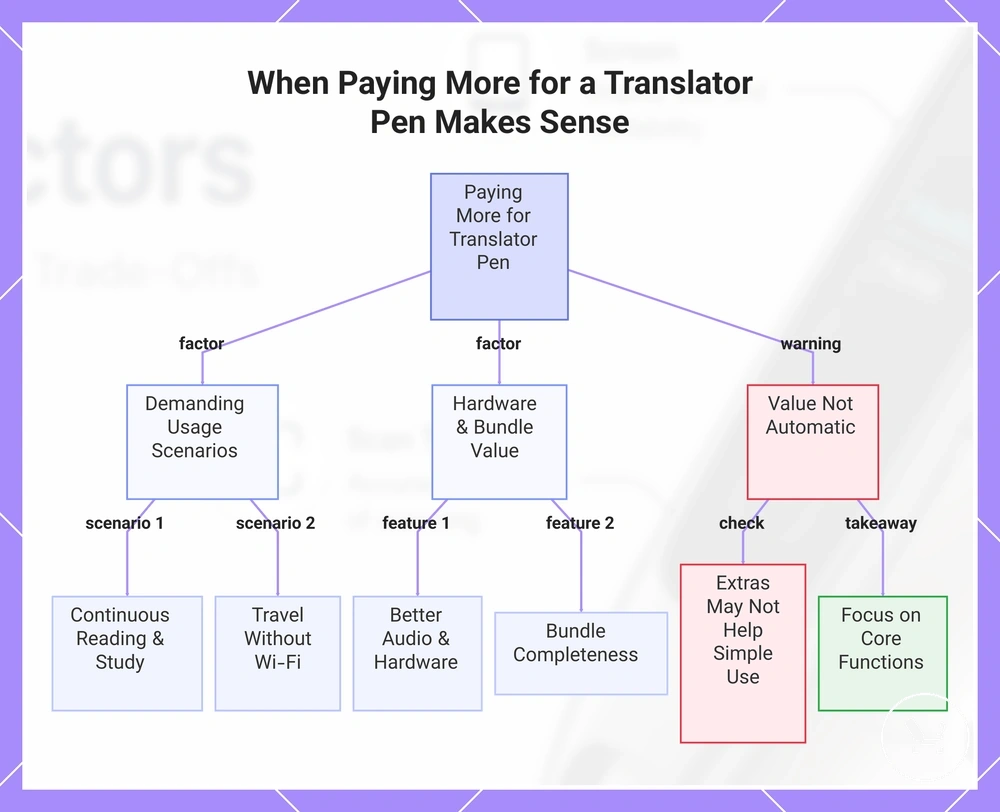
Paying more for a translator pen makes sense when the added cost is justified by stronger usefulness in real usage conditions rather than feature count alone. In cases like intensive reading, study needs, travel without Wi-Fi, frequent OCR scanning, stronger audio support, better hardware, and bundle completeness, the higher price is often price justified. The decision depends on whether these capabilities reduce practical usage risk or improve consistency.
In intensive reading or study needs, paying more may be justified when continuous scanning and text-to-speech performance need to stay stable over long sessions. For travel without Wi-Fi, offline reliance and language support can become more important than extra features. Frequent OCR scanning scenarios also depend on consistent recognition quality, where stronger audio support and better hardware may improve usability depending on conditions.
Higher price does not automatically indicate better value because some added features or bundle completeness may not affect simple use. The key distinction is whether capabilities directly support scanning, text-to-speech, or basic dictionary functions in real conditions, versus extras that do not change actual workflow performance.
This chart shows the scenarios and features that justify a higher price for a translator pen, and warns that extra cost does not automatically mean better value.
Translator Pen Bundles, Add-Ons, and Hidden Cost Considerations
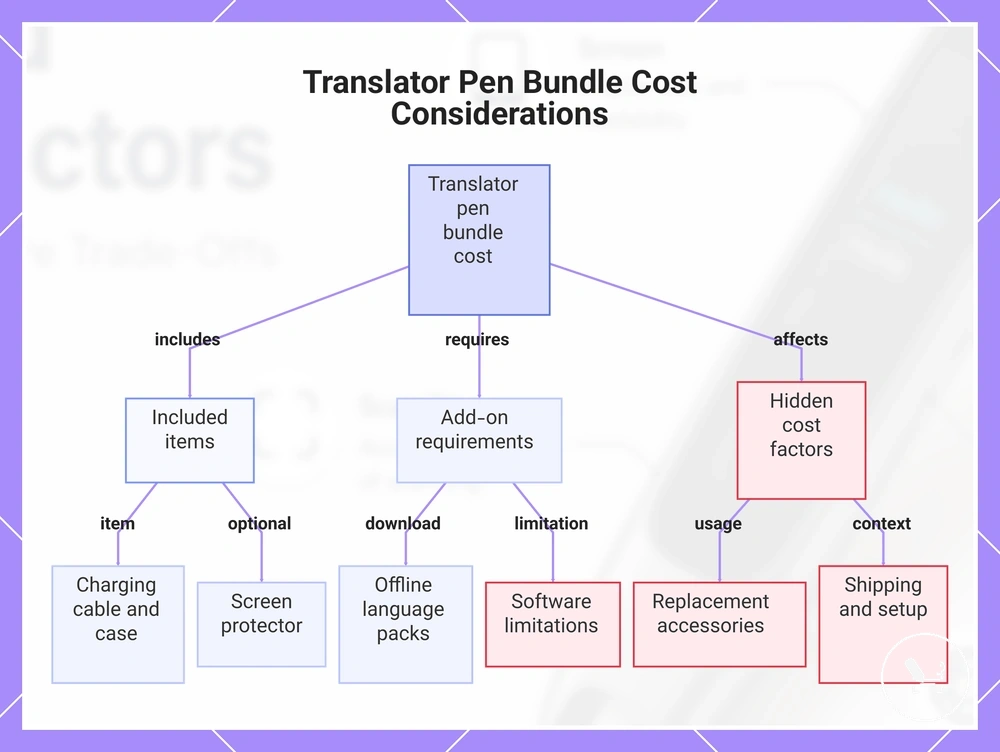
A translator pen bundle refers to the combined package of the device and included items, where total value depends on more than the advertised price alone. The translator pen bundle may include core accessories, while add-ons or setup-related requirements can introduce extra costs depending on usage conditions. Understanding included items versus separate requirements helps clarify total cost beyond the base device price.
Translator pen bundle contents may include a charging cable, case, or screen protector, while other elements such as offline language packs or software limitations can affect usability beyond initial setup. Replacement accessories may introduce extra costs over time depending on usage intensity. In some cases, shipping or setup-related steps may also influence perceived total cost depending on how the device is configured or maintained.
Hidden cost considerations may appear when add-ons are required for full functionality or when software limitations restrict certain features without updates or expansions. Edge cases include situations where offline language packs require additional downloads or where replacement accessories are needed more frequently due to usage patterns. These factors can shift total value compared to the advertised price without changing the core translation capability.
The checklist below helps separate included bundle items from potential add-on or hidden cost factors:
- Charging cable → may be included, but missing units create immediate extra purchase needs affecting usability readiness
- Case → inclusion varies and influences protection level and potential replacement cost over time
- Screen protector → often optional, adding minor extra cost for device protection and durability
- Offline language packs → may require downloads or setup steps, affecting readiness and functionality access
- Replacement accessories → can create recurring costs depending on usage frequency and wear
- Software limitations → may require updates or expansions that influence long-term usability
- Shipping and setup factors → can vary by context and affect total acquisition cost calculation
This chart breaks down the components of a translator pen bundle, highlighting included accessories, add-on requirements, and hidden cost factors that affect total value.
How to Judge Whether a Translator Pen Is Worth the Price
A translator pen is worth the price when OCR accuracy, offline use, voice support, language coverage, hardware durability, and real-world usefulness match the user need with consistent quality conditions. The decision is based on a price-worth check that compares required feature performance against expected usage rather than feature lists alone.
Worth evaluation depends on aligning user need with required feature performance. OCR accuracy must support clear printed text reading for study and reading support use. Offline use and language coverage matter more when travel or low-connectivity environments are expected. Voice support and hardware durability influence long-term stability and usability in repeated daily scenarios.
This decision framework organizes worth by connecting user need, required feature, quality condition, and value outcome into a single structured view. It helps separate functional necessity from optional capability and clarifies where cost is justified based on real-world usefulness rather than specification count.
The criteria below apply across common usage scenarios such as students, travellers, reading-support users, and light occasional users. These conditions reflect how real-world usefulness and hardware durability influence decision confidence, supported by general user expectations and translator pen reviews insights before final evaluation.
| Need | Required feature | Quality condition | Worth signal |
|---|---|---|---|
| Student use | OCR accuracy + voice support | Consistent reading support output | Worth increases with frequent study workload |
| Traveller use | Offline use + language coverage | Reliable no-network performance | Worth increases in travel dependency scenarios |
| Reading support use | OCR accuracy + voice support | Stable comprehension output | Worth increases with accessibility needs |
| Light occasional use | Basic scanning functions | Simple and stable operation | Worth depends on minimal usage requirement |
The final decision is that a translator pen is worth the price only when required features consistently meet quality conditions under real-world use, producing meaningful value outcomes aligned with user need rather than relying on feature availability alone.
Here are product examples that may make comparison easier. Before buying, always review the compatibility criteria, essential features, and product details.