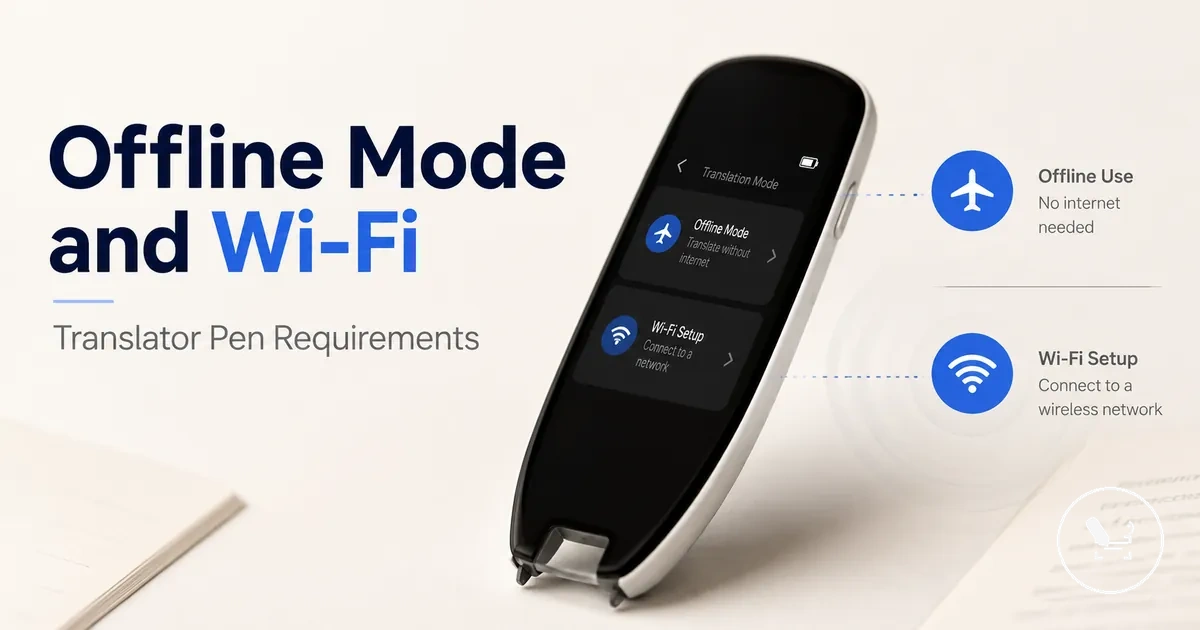
Translator Pen Offline Mode and Wi-Fi Requirements: compatibility, connectivity conditions, and usage limits
Translator pen connectivity mode refers to how a translator pen operates under different network conditions, where offline mode and Wi-Fi requirement define what features are available during use. This connectivity layer acts as a dependency system that influences OCR scanning, cloud translation access, and language support behavior in real situations. In offline mode, the translator pen typically relies on stored language data to process OCR scanning and generate translation output without internet access. In Wi-Fi-based operation, cloud translation services may extend language coverage and contextual processing depending on connectivity availability. These modes do not change the core function of the translator pen but shape how translation features behave under different conditions. As a result, connectivity dependency becomes a key factor in understanding usability across travel, study, and everyday environments.
The difference between offline mode and Wi-Fi requirement is best understood through how feature access changes based on connectivity conditions. For a broader overview of the device context, see the translator pen guide which frames how these modes fit into overall usage scenarios. Offline operation generally depends on preloaded language data, which can support OCR scanning and basic translation output with varying coverage depending on stored resources. Wi-Fi connectivity, on the other hand, may enable cloud translation functions that expand language support and improve contextual processing when internet access is available. These dependency patterns help explain why translation behavior can vary across environments without implying fixed or universal performance outcomes. Understanding this separation leads into more detailed breakdowns of specific feature conditions and limitations in the following sections.
Does a Translator Pen Need Internet? Offline vs Online Connectivity Explained
A translator pen does not require internet for all functions because its behavior depends on whether it operates in offline mode or cloud-based mode. In offline translation, the translator pen can function using stored language packs combined with OCR scanning, allowing basic translation output without internet access. This enables operation in environments where connectivity is limited or unavailable. However, the range of supported languages and contextual processing may vary depending on locally stored data. Cloud translation introduces an internet requirement where external data access supports expanded language support and richer processing. This separation creates a clear boundary between offline capability and internet-dependent enhancement rather than a single fixed dependency.
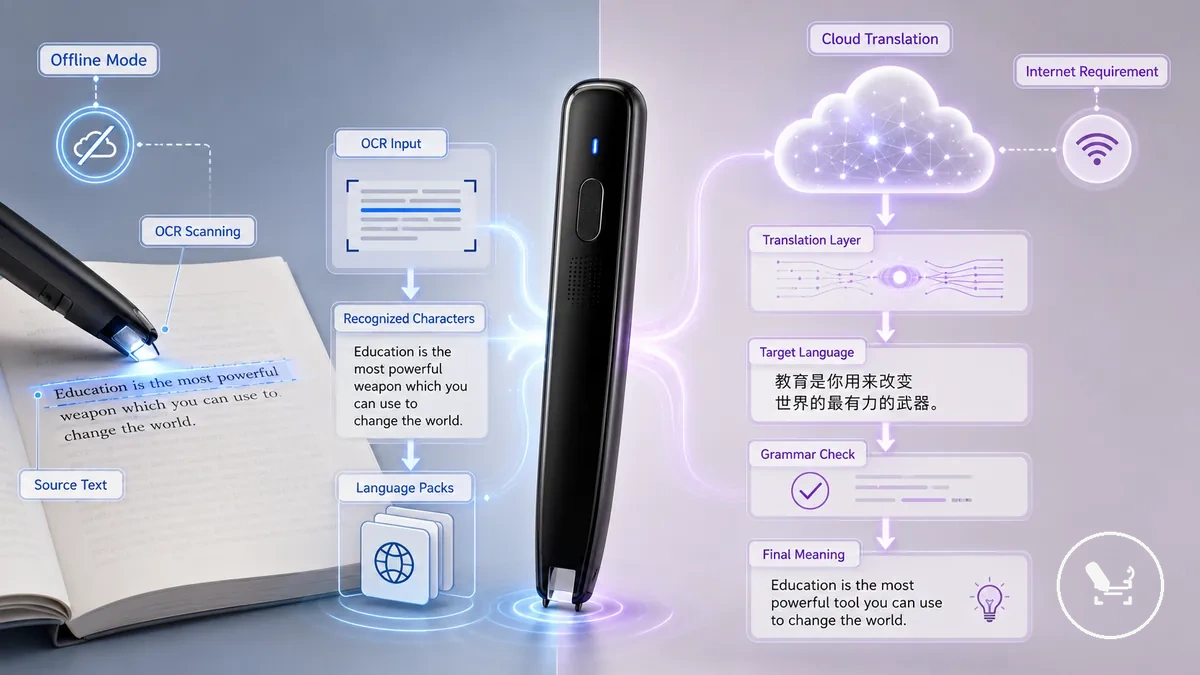
Internet is required mainly for cloud translation features, while offline translation can operate without it depending on stored language packs and device capability. The translator pen features typically determine how far offline capability extends versus cloud-based expansion. Offline translation relies on OCR scanning and preloaded language data to generate outputs, which may limit coverage compared to online processing. Cloud translation depends on internet requirement to enable broader language support and more context-aware processing in certain cases. These differences highlight a dependency model where connectivity influences function availability rather than replacing the core purpose of the translator pen. This structure helps clarify how usage shifts between disconnected and connected environments.
How Translator Pens Work in Offline Mode (On-Device Processing and Stored Language Data)
Offline mode in a translator pen is based on on-device processing where OCR scanning captures printed or handwritten text and converts it into machine-readable input. This input is processed locally using stored language data without relying on internet access. The system interprets recognized characters through internal language data and applies translation logic directly on the device. The OCR scanning stage functions as the input layer, while on-device processing handles interpretation and mapping of text meaning. The result of this input → processing → output chain is a translation output generated entirely within the device environment. This flow defines how offline mode maintains operation through internal resources rather than external connectivity.
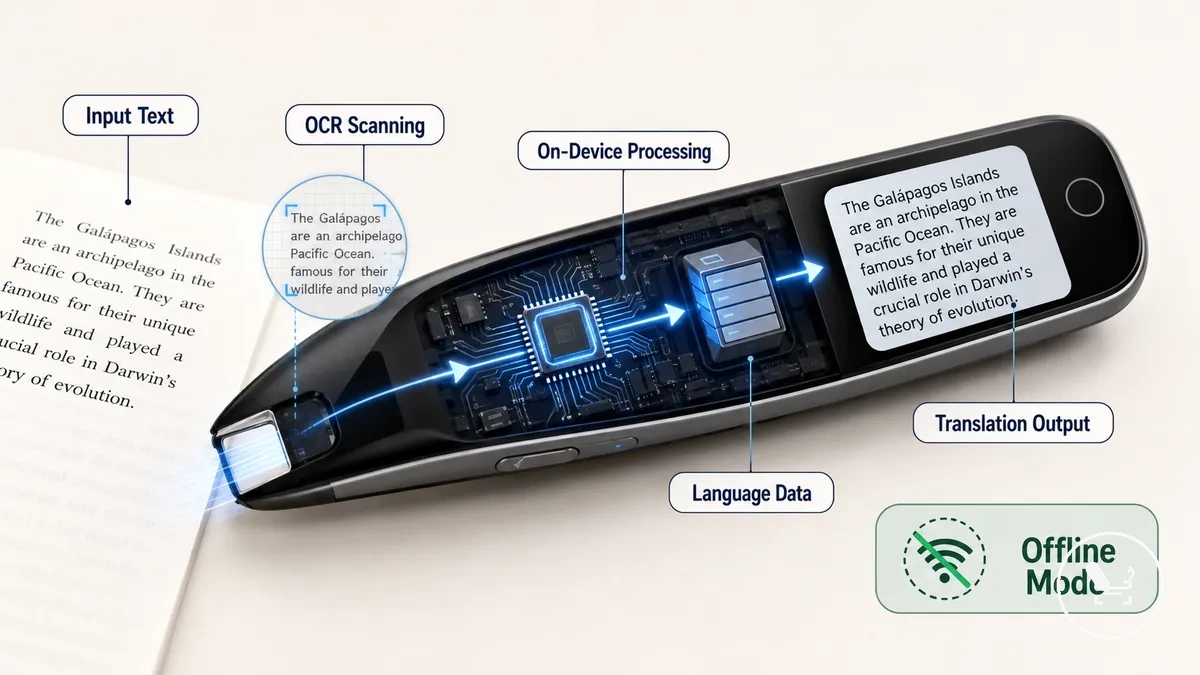
Offline translation depends heavily on language data stored inside the translator pen, which determines how much vocabulary and structure can be interpreted without internet access. These language data packs act as a local reference system that supports recognition and translation output generation. In many cases, offline mode may show variations in coverage depending on how complete the stored datasets are. Translation output is produced directly from this internal processing chain, which means results are shaped by available on-device resources. The performance of offline mode can vary based on how the language data aligns with the scanned content. This structure keeps the system functional even in environments where connectivity is not available.
Wi-Fi and Internet Requirements for Cloud Translation and Full Feature Access
The Wi-Fi requirement in a translator pen primarily affects cloud translation functions rather than every core capability of the device. Internet access enables cloud translation to extend processing beyond stored resources, while other functions may still operate under offline conditions depending on design. This creates a feature dependency where certain outputs rely on connectivity to external services. When Wi-Fi is available, the system can access expanded language coverage and additional processing layers that are not stored locally. Without internet access, the translator pen typically falls back to local processing and reduced feature scope. This separation positions connectivity as an enhancement layer rather than a universal requirement for operation.
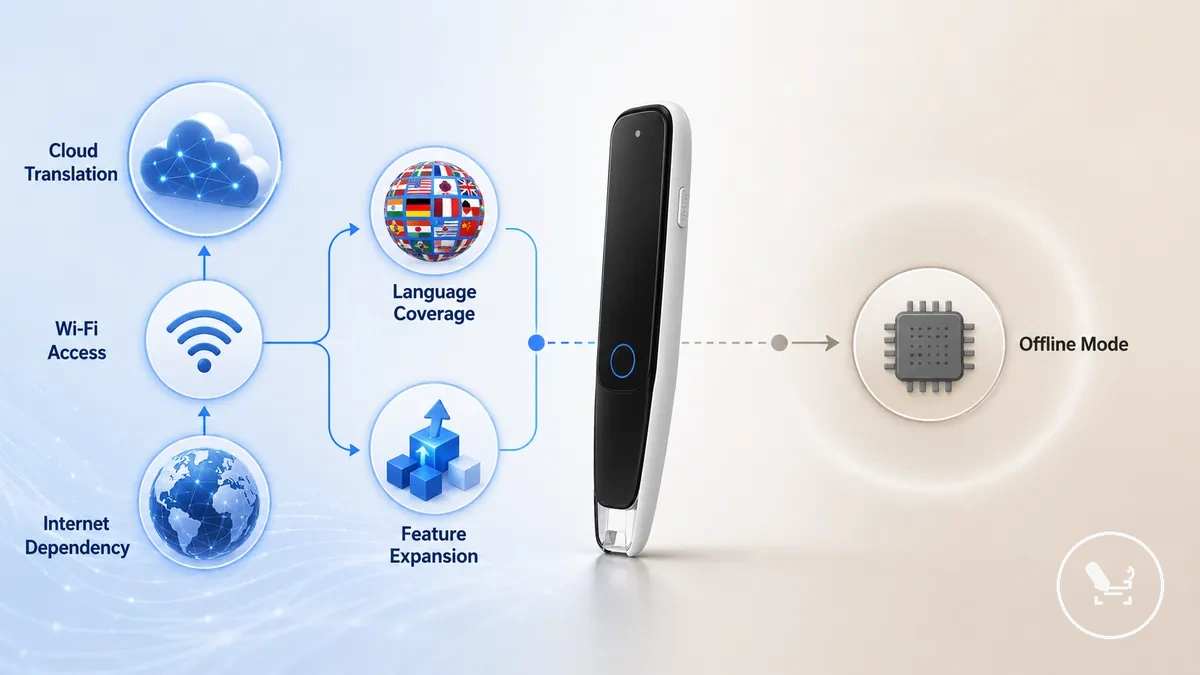
Cloud-based functions rely on internet access to extend translation depth and improve contextual processing in supported scenarios. The translator pen language support determines how different languages interact with cloud translation systems and offline resources. This dependency model ensures that feature availability shifts based on connectivity status and system configuration.
- Cloud translation – uses internet access for expanded processing
- Language coverage – increases through online databases
- Context processing – enhanced via cloud-based computation
- OCR refinement – may improve with online support
- Feature dependency – defines offline vs online capability split
Overall, Wi-Fi requirement influences only the cloud-enabled portion of functionality, while core scanning and baseline translation may remain available without connectivity depending on stored language resources. This maintains a clear dependency boundary between offline capability and cloud enhancement.
What Offline Mode Supports: OCR Scanning, Languages, and Voice Functions Without Internet
Offline mode in a translator pen supports core functions such as OCR scanning, basic translation output, and limited text-to-speech processing using stored language support. OCR scanning works by capturing printed or handwritten text and converting it into readable digital input directly on the device. This input is processed through on-device language data, allowing translation output without internet access. Offline mode can provide reading support through translation output and internal dictionary-based language support depending on preloaded packs. Text-to-speech functions may operate with reduced voice output options based on device configuration. Language support in offline mode is limited to stored datasets, which determines how much content can be processed without connectivity. Overall, offline mode focuses on essential OCR scanning, translation output, and voice-assisted reading within local constraints.
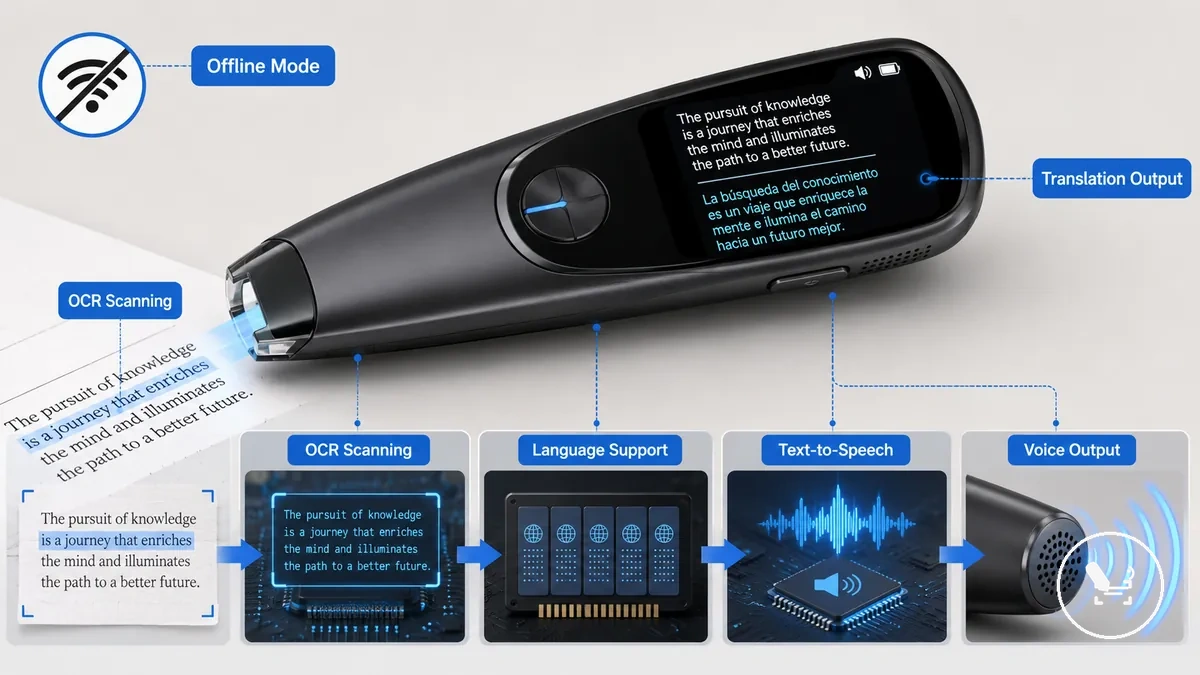
Offline capabilities depend strongly on the available language support and stored processing resources inside the device, which can limit coverage compared to online modes. This limitation may affect translation quality limits depending on language complexity and dataset completeness. translation quality limits can become more noticeable when offline dictionaries do not fully cover the input text. Text-to-speech output may also vary in clarity and language range due to offline constraints. Despite these restrictions, offline mode remains useful for OCR scanning and basic reading tasks without internet access. Performance typically depends on how well the stored language packs match the scanned content and required translation output.
| Feature | Availability | Limitation | Effect |
|---|---|---|---|
| OCR scanning | Available offline | Depends on image clarity | Converts text to input |
| Translation output | Available with language support | Limited vocabulary coverage | Provides basic translations |
| Text-to-speech | Partially available | Reduced voice options | Enables audio reading |
| Language support | Preloaded only | No cloud expansion | Restricts language range |
Compatibility Conditions and Feature Constraints in Offline Translator Pen Use
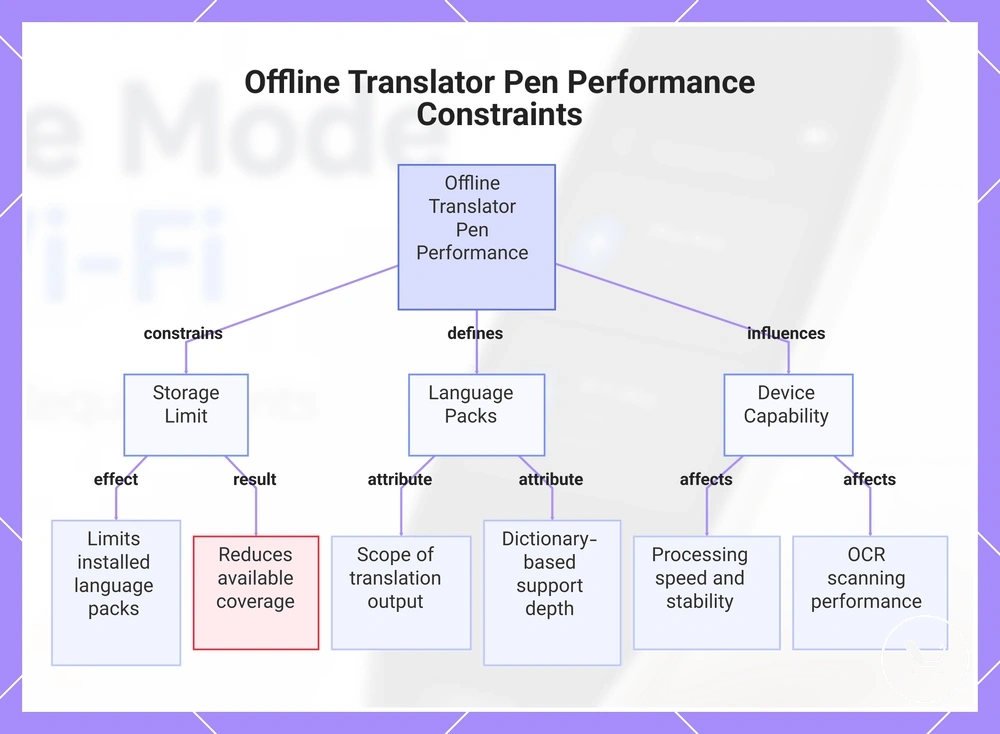
Offline translator pen performance is constrained by storage limit, language packs, and device capability, which collectively determine how reliably features operate without internet access. The storage limit controls how many language packs can be installed and therefore directly affects available coverage in offline mode. Language packs define the scope of translation output and dictionary-based support, and limited packs can reduce contextual language coverage. Device capability influences processing speed and stability, shaping how OCR scanning and translation output perform under local conditions. These constraints create variability in offline performance depending on available resources and configuration. In many cases, stronger device capability may improve responsiveness, while limited storage or incomplete language packs can reduce consistency. As a result, offline translator pen performance is best understood as a resource-dependent system rather than a uniform output environment.
- Storage limit – restricts number of language packs and available coverage
- Language packs – define translation scope and dictionary depth
- Device capability – affects processing speed and OCR scanning performance
- Offline performance – varies based on resource availability and configuration
Offline performance constraints therefore depend on how storage limit, language packs, and device capability interact in each usage scenario. Variability is expected when language packs are incomplete or when device capability is limited, which can affect overall translation output consistency. These constraints define the operational boundaries of offline translator pen functionality without changing its core purpose.
This chart shows the three main resource factors that determine offline translator pen performance and how they interact.
Limitations and Performance Differences Between Offline and Online Translation
Offline translation and online translation differ in how they handle accuracy, speed, language coverage, and context, and these differences are shaped by system access to data. Offline translation relies on stored language data and device-based processing, which can influence consistency in accuracy depending on available resources. Online translation uses cloud translation systems that can access broader and continuously updated language models, which may improve adaptability in complex inputs. Speed varies across both modes, with offline translation depending on device capability and local processing efficiency, while online translation depends on network stability and cloud response time. Language coverage is typically narrower in offline translation due to fixed language packs, whereas online translation expands through cloud translation infrastructure. Context handling also differs, as offline systems often work within limited local datasets, while online systems can enhance context interpretation using larger linguistic models. These differences make performance vary depending on environment, connectivity, and resource availability.
In practical use, offline translation is often chosen in environments without reliable connectivity, while online translation is preferred when broader language coverage and contextual refinement are required. A user relying on a translator pen for travel may switch between both modes depending on connectivity and communication needs. Offline mode provides stable baseline translation, but online mode can improve contextual understanding in complex sentences. Speed differences may also vary depending on device capability and network conditions. Language coverage remains one of the clearest distinctions, as online translation can extend through cloud translation systems while offline translation remains limited to installed language packs. Overall, the comparison is defined by trade-offs between accessibility, accuracy, speed, language coverage, and context depth.
| Mode | Accuracy | Speed | Coverage |
|---|---|---|---|
| Offline translation | Depends on language packs and stored data | Depends on device capability | Limited to installed languages |
| Online translation | Often enhanced by cloud translation models | Depends on network stability | Expanded through cloud systems |
Choosing Between Offline Mode and Wi-Fi Based on Travel, Study, and Connectivity Needs
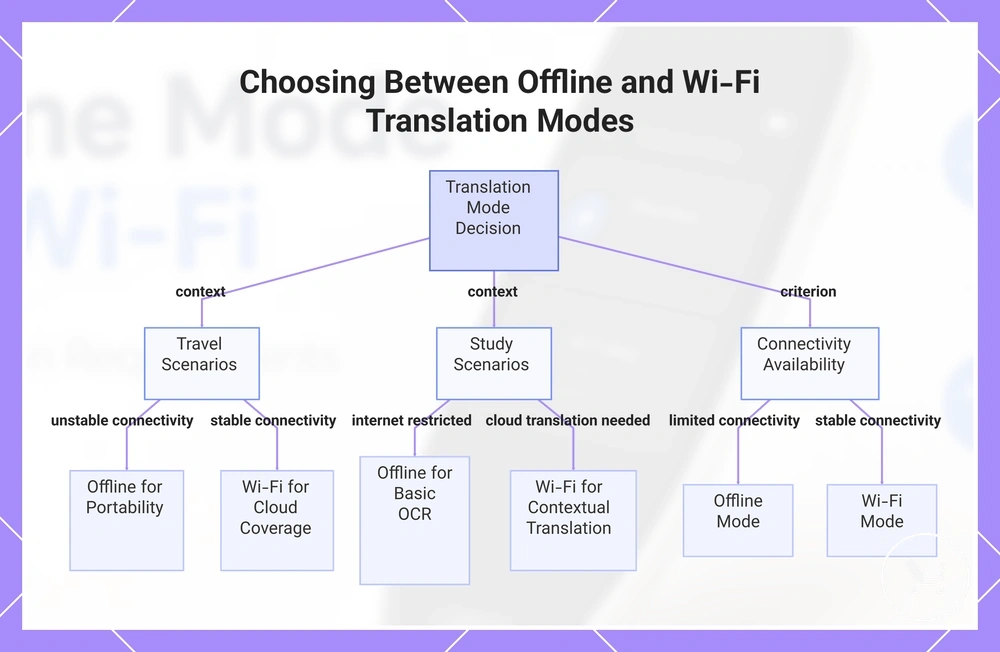
Selection between offline mode and Wi-Fi depends on travel, study, and connectivity conditions, where each scenario changes how translation support should be prioritized. In travel situations, offline mode is often preferred when connectivity is unstable or unavailable, as it supports basic translation without relying on network access. This makes offline mode more suitable for portability-focused use cases where continuous access matters more than extended language coverage. Wi-Fi becomes more relevant when stable connectivity is available and broader language support is required through cloud translation. In study contexts, the choice may shift depending on whether OCR-based reading or expanded language support is needed for learning materials. Connectivity availability therefore acts as a primary selection criteria shaping real-time usage decisions. The decision remains flexible and varies according to environment and task requirements.
In travel scenarios, offline mode supports portability by enabling translation without dependency on network access, especially in areas with limited or unstable connectivity. For study use, OCR and language support in offline mode can assist with basic reading tasks when internet access is restricted. Wi-Fi, however, may be preferred when cloud translation is needed for broader coverage and improved contextual interpretation during learning. A balanced approach is often used where users switch modes depending on connectivity conditions and task complexity. For example, during travel transitions, offline mode maintains continuity, while Wi-Fi enhances coverage when available. This creates a flexible selection framework based on travel, study, and connectivity constraints rather than a fixed rule.
This chart shows the key factors for selecting between offline and Wi-Fi translation modes based on travel, study, and connectivity conditions.