
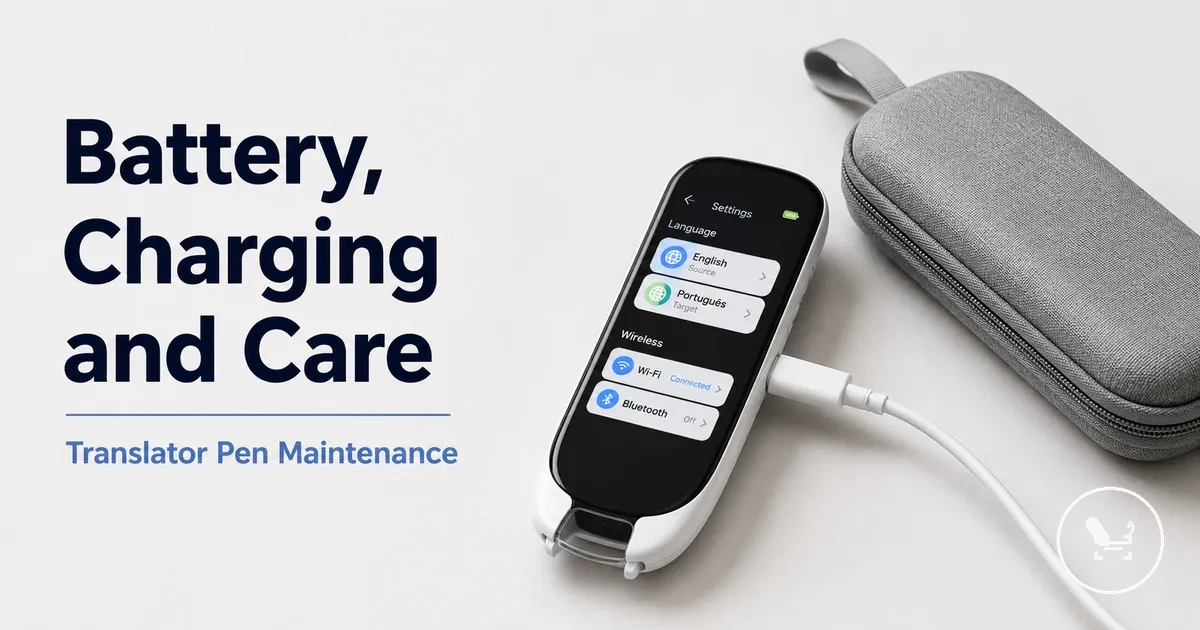
Translator Pen Battery and Charging Care
Translator Pen Battery and Charging Care refers to how a translator pen battery behaves and how charging, charging cable use, and everyday care practices work together during normal ownership. It focuses on maintaining stable performance through consistent charging habits, safe handling, and basic maintenance conditions.
When a translator pen is used regularly for scanning and translation, battery drain patterns and charging behavior can vary depending on usage intensity, storage state, and charging conditions. These variations are part of normal maintenance understanding rather than immediate fault indicators. For broader context on device function and structure, see the translator pen guide as a boundary reference between general usage and deeper device-level considerations.
When charging becomes inconsistent or a translator pen shows irregular battery behavior, the cause is often related to charging cable condition, USB power source stability, or charging port contact rather than immediate device failure. Basic maintenance expectations help separate routine care from deeper not charging issues while keeping troubleshooting boundaries clear.
Care and charging behavior vary by model and usage conditions, meaning battery performance and charging response are typically influenced by how the translator pen is stored, charged, and handled over time.
Translator pen battery and charging basics
Translator pen battery and charging basics refers to how a translator pen stores power and how charging behavior connects to everyday use. It explains the relationship between charging stability and core components like the battery, charging port, cable, and power source awareness. These basics help form a clear starting point for understanding normal charging conditions and routine care.
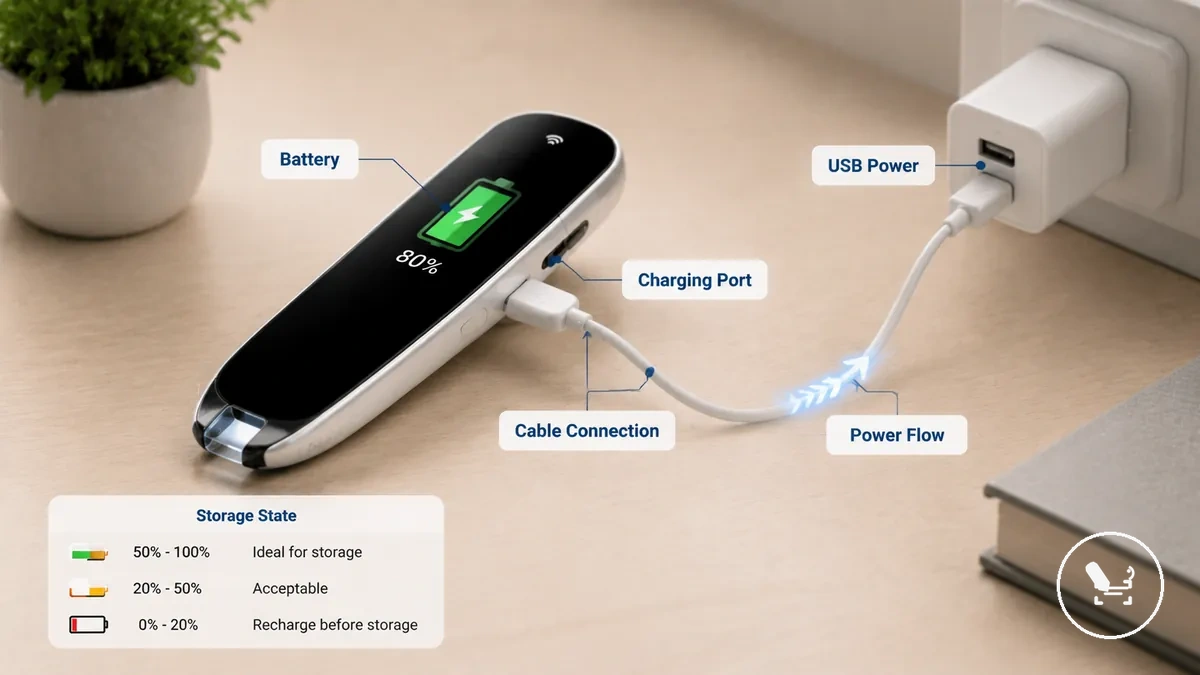
When a translator pen is used in daily translation tasks, charging behavior can vary depending on cable condition, USB power source strength, and storage state. These variations are usually part of normal charging basics and do not always indicate a fault. In many cases, model design and usage patterns influence how stable charging appears over time.
Charging irregularities or unclear battery response in a translator pen often relate to external conditions like cable stability, charging port contact, or power source consistency. This is usually where routine care differs from first-time setup behavior. For first-time configuration, see translator pen setup as a reference for initial setup context, while battery and charging basics focus on ongoing usage conditions and storage state.
Translator pen battery and charging basics checklist overview: The following checklist summarizes the core conditions that support stable charging behavior in a translator pen.
- Battery state during use and storage state awareness
- Charging port condition and physical contact quality
- Cable integrity and proper fit with the charging port
- USB power source stability and output consistency
- Device indicator response during normal charging
Battery life and power use in translator pens
Battery life in a translator pen is not fixed and depends on how the device uses and distributes power across its functions. The translator pen battery supports multiple operations, and power use changes based on features, settings, and overall use intensity, which directly affects battery drain patterns over time.
In everyday use, different activities create different levels of energy demand. Light scanning usually places a lower load on the battery, while continuous scanning, speaker output, wireless use, and higher screen brightness can increase battery drain. Standby mode typically uses less power, but background readiness still contributes to gradual energy consumption.
Variation in battery performance often comes from how different functions interact during active use, especially when multiple features run together. In many cases, understanding these interactions helps interpret why battery life feels inconsistent without assuming a fixed runtime limit.
Interpreting battery behavior becomes clearer when linking power use to specific device features, since each function contributes differently depending on usage conditions. When evaluating energy demand through core functions, the translator pen features provide the main reference point for understanding how operational design influences battery performance patterns.
Translator pen battery life and power use table overview: The table below organizes key translator pen functions and how each one typically influences battery drain under different conditions.
| Function or setting | Power-use attribute | Condition that increases drain | Likely effect |
|---|---|---|---|
| Scanning | Active processing | Continuous text capture | Moderate to higher battery drain |
| Audio playback (speaker) | Sound output energy use | High volume or extended playback | Increased battery consumption |
| Wireless use | Signal transmission | Frequent syncing or data transfer | Higher energy demand |
| Screen brightness | Display power load | High brightness settings | Faster battery drain |
| Standby | Idle background power | Long idle periods | Slow, gradual drain |
| Charging while in use | Simultaneous power flow | Active operation during charging | Variable charging efficiency |
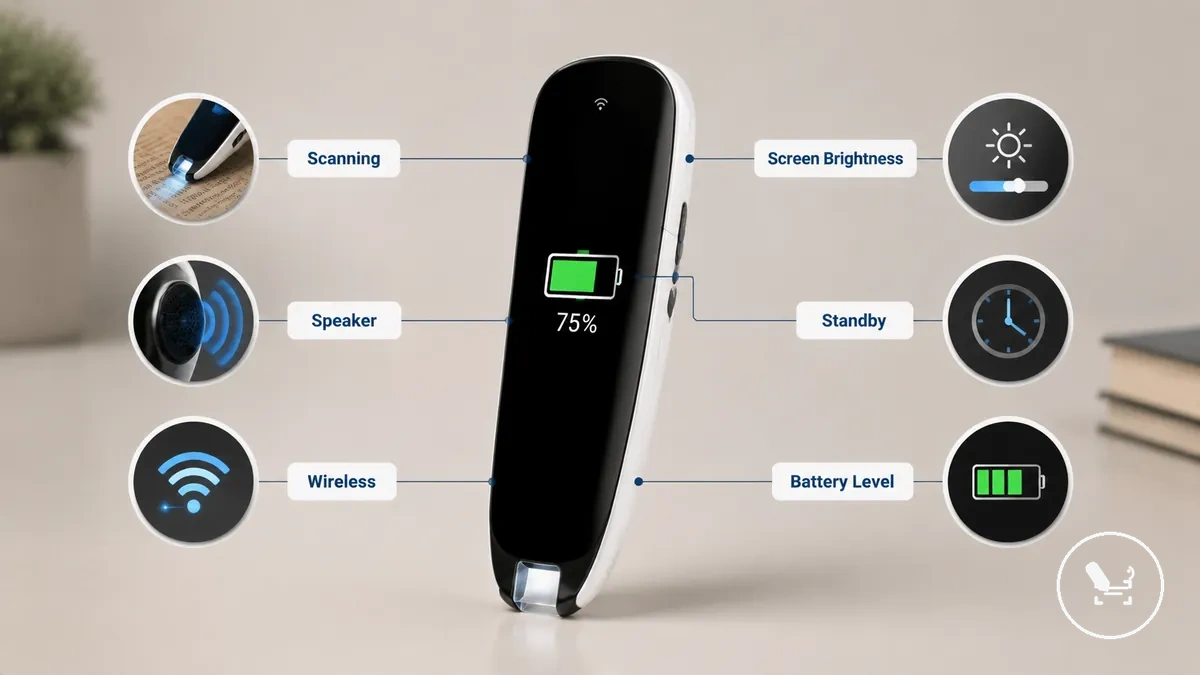
Screen brightness, wireless use, and standby drain
Screen brightness, wireless use, and standby drain directly affect translator pen battery drain by changing how much background activity and display power the device needs. Higher screen brightness increases display energy demand, while wireless use adds continuous transmission load. These settings, together with speaker use and scanning frequency, define the main local power-use factors.
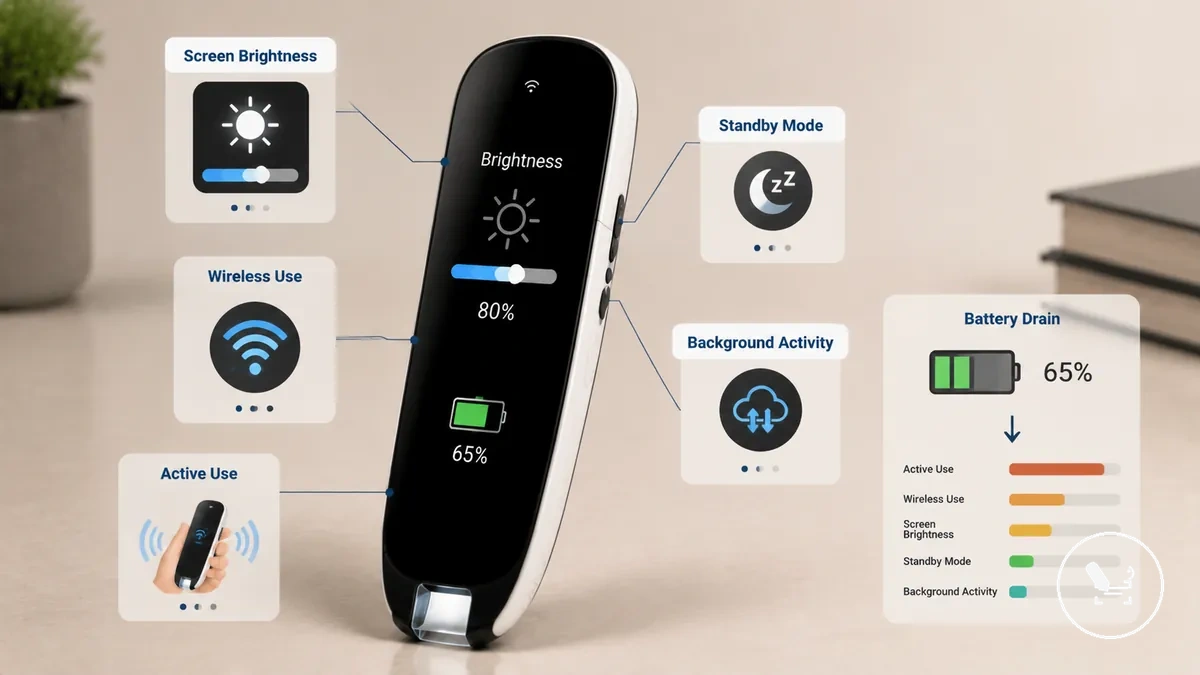
Active use and standby drain should be separated because they affect battery performance in different ways. Active use involves scanning frequency, speaker use, and wireless use that increase immediate power demand. Standby drain, however, comes from background activity that keeps the translator pen ready even when not in active operation.
Screen brightness, wireless use, and standby drain factors overview: The bullets below organize local drain factors by showing how each condition influences power demand and battery drain behavior.
- Screen brightness — higher display brightness increases energy use and accelerates battery drain during active use
- Wireless use — continuous Wi-Fi or data activity increases transmission load and raises power demand
- Standby drain — background activity in idle mode slowly reduces battery level over time
- Speaker use — audio output increases active power consumption during playback or translation
- Scanning frequency — repeated scanning increases processing load and contributes to faster battery drain
Charging time and full-charge expectations
Charging time and full charge expectations for a translator pen depend on charger output, cable condition, battery age, and how the device handles power during charging. These factors influence how the charge indicator progresses and why charging time and full charge behavior may vary between models and usage conditions.
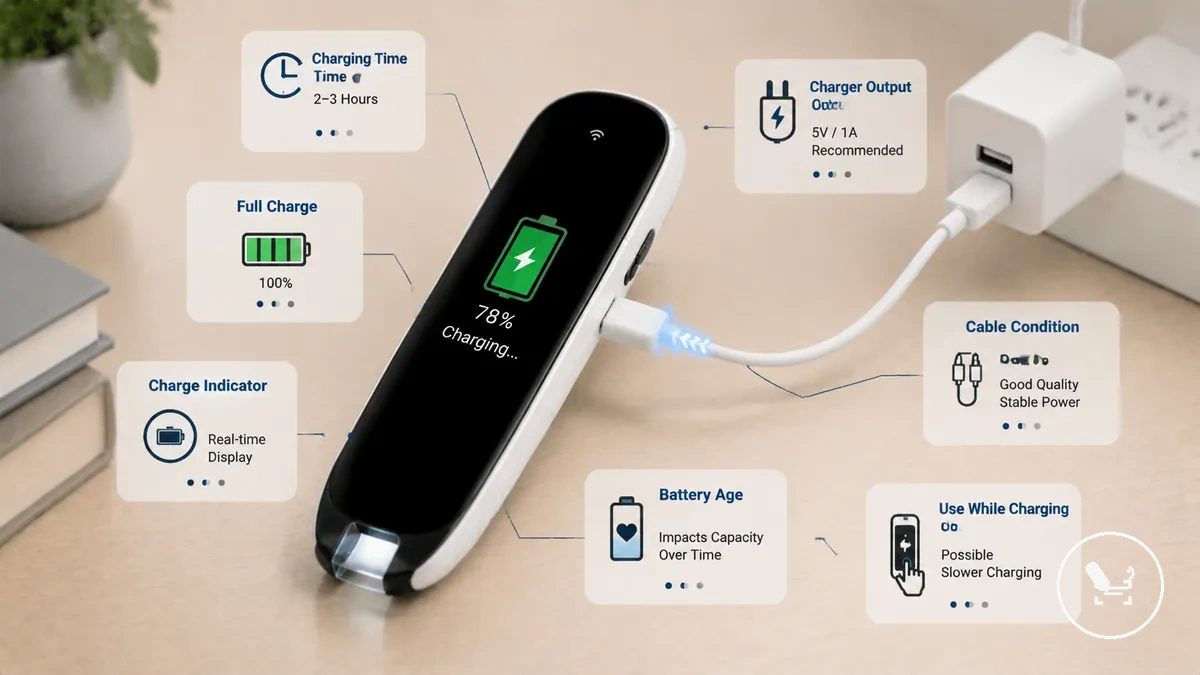
When the charge indicator appears slow or inconsistent, it is usually linked to charger output, cable condition, or battery age rather than a fixed issue. The indicator reflects charging status, but it may behave differently depending on device condition and current power flow.
Use while charging can also influence expectations, since active operation may extend charging time and delay full charge progression. In many cases, reduced activity during charging allows the charge indicator to move more steadily toward full charge.
Charging time and full-charge expectations checklist overview: The checklist below verifies the main conditions that influence charging time and full charge behavior.
- Charger output — insufficient power delivery may extend charging time and slow full charge progress
- Cable condition — worn or unstable cables can affect charging stability and indicator response
- Battery age — older batteries may show slower progression toward full charge
- Charge indicator — behavior may vary depending on device status and power flow conditions
- Use while charging — active use can increase power demand and extend charging duration
- Slow charging pattern — combined conditions may lead to extended charge time
Charging cables, ports, and USB power
Charging reliability for a translator pen depends on the charging cable, charging port, and USB power source working together under compatible conditions. These elements directly shape charging outcome, since cable type, port condition, and adapter output determine how stable the power flow remains during use.
When any component is damaged or mismatched, charging behavior can become unstable or inconsistent. A worn charging cable may interrupt power transfer, while a loose or degraded charging port can reduce contact quality. Similarly, an unstable USB power source or unsuitable adapter can result in slow or irregular charging even when the connection appears correct.
A physically fitting cable does not guarantee reliable charging. Charging outcome depends on the combined condition of the charging cable, charging port, and USB power source rather than connector fit alone. Stable charging requires alignment between cable condition, port integrity, and power source consistency.
The table below compares charging cable, charging port, and USB power conditions to show how each factor affects charging compatibility and outcome.
| Component | Attribute to check | Acceptable condition | Risk if mismatched |
|---|---|---|---|
| Charging cable | Cable type and integrity | Stable, undamaged connection | Interrupted charging outcome |
| Cable condition | Wear level and flexibility | No fraying or instability | Unstable charging behavior |
| Charging port | Port condition and contact quality | Secure and consistent contact | Intermittent power transfer |
| USB adapter | Power output stability | Consistent regulated output | Slow or irregular charging |
| USB power source | Source reliability | Stable power delivery | Reduced charging efficiency |
USB-C, micro-USB, and replacement cable checks
When charging fails or becomes inconsistent, USB-C or micro-USB connector type mismatches and worn cable condition are often the cause rather than the device itself. A loose connector or degraded charging cable can interrupt power transfer even when the plug appears to fit. This separates physical connector fit from reliable charging behavior, which depends on stable contact and cable condition.
USB-C and micro-USB compatibility depends on connector type, cable condition, and whether the replacement cable is charging-capable. Replacement cable matching should focus on secure port fit, intact wiring, and proper power transfer capability rather than appearance. In many cases, a physically fitting cable may still fail to charge reliably if internal conductors are damaged or unsuitable for stable power delivery.
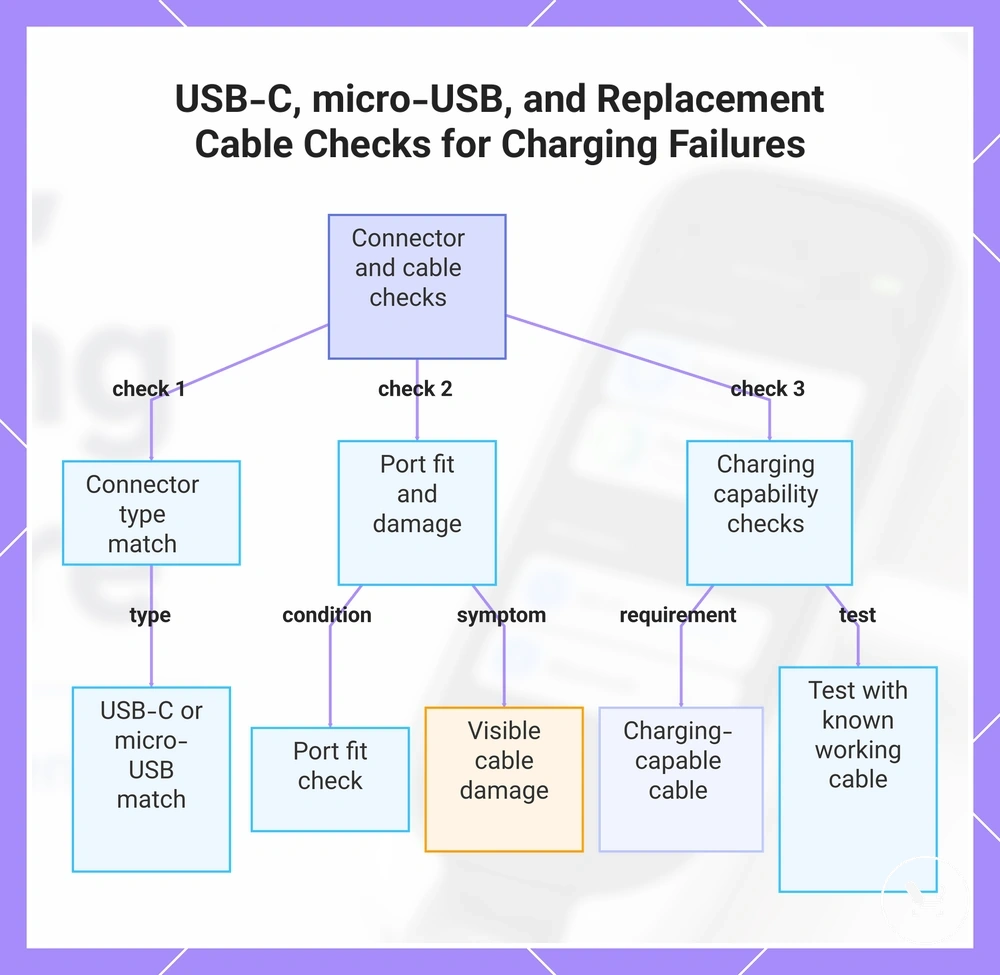
USB-C, micro-USB, and replacement cable checks verify local cable fit and condition before assuming a compatibility issue. The checklist below helps identify whether charging behavior is affected by connector type, cable wear, or port alignment.
- Connector type — confirm USB-C or micro-USB matches the device port shape
- Port fit — check for loose connector seating or unstable physical contact
- Visible damage — inspect cable condition for fraying, bends, or wear
- Charging-capable cable — ensure the cable supports power transfer, not only physical connection
- Safe match — verify the connector aligns securely without force
- Test comparison — try another known working cable to confirm charging outcome consistency
This chart shows the key checks to identify whether charging behavior is affected by connector type, cable wear, or port alignment.
Safe charging habits for battery health
Safe charging habits for battery health refer to repeatable charging behaviors during normal ownership that help reduce avoidable battery stress from charging frequency, heat exposure, and charging routine patterns. These habits influence how a translator pen battery responds over time without guaranteeing long-term performance outcomes. :contentReference[oaicite:0]{index=0}
Heat exposure and charging while in use can increase battery stress when they occur repeatedly, especially if the device is used during frequent charging cycles or kept under sustained power demand. Storage charge levels during long-term inactivity also influence battery condition, since both deep discharge and prolonged high charge states may contribute to less stable behavior depending on usage patterns.
When battery performance becomes inconsistent, the cause is not always related to usage habits alone. In some cases, damaged cable conditions or issues with the charging port may affect charging stability, making it necessary to shift from habit adjustments to basic hardware checks before further changes to charging behavior are considered.
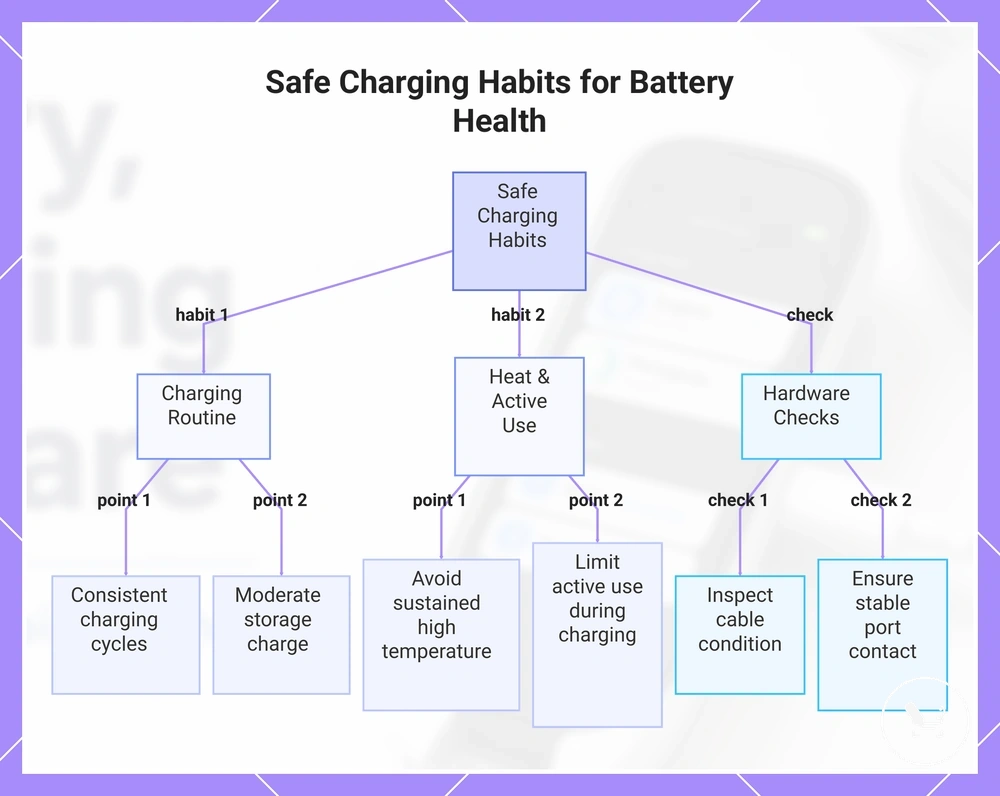
Safe charging habits for battery health checklist organizes repeatable charging behavior during normal ownership:
- Charging frequency — keep charging cycles consistent to avoid repeated deep discharge stress on the battery
- Heat exposure — avoid sustained high-temperature conditions during charging to reduce battery stress
- Charging while in use — limit active use during charging when possible to reduce combined power load
- Storage charge — maintain moderate charge levels during long-term storage to support stable battery condition
- Damaged cable check — inspect cable condition regularly to prevent unstable power transfer
- Charging port check — ensure the charging port maintains stable contact for consistent charging behavior
This chart shows the main safe charging habits and hardware checks that help reduce battery stress and maintain stable battery condition.
Cleaning, storage, and everyday physical care
Cleaning, storage, and everyday physical care refer to the protection and maintenance of a translator pen’s external surfaces during normal use. Physical care focuses on preserving the scan window, screen, casing, and charging-port area by reducing exposure to dust, moisture, and pressure, which may affect usability over time. It separates surface maintenance from internal repair and supports stable everyday handling. :contentReference[oaicite:0]{index=0}
Dust, moisture, and pressure can accumulate during transport or daily carrying, especially when the device is stored in tight bags or exposed to changing environments. The scan window and screen may become less clear due to surface buildup, while the charging-port area can be affected by debris or humidity that interferes with reliable contact. Repeated pressure on the casing during storage or transport may also influence long-term surface condition depending on handling patterns.
When external issues appear, they are typically related to everyday exposure rather than internal faults. Separating cleaning and storage practices from internal repair helps identify whether adjustments in physical care are sufficient or whether further checks are needed. This distinction helps keep attention on external protection instead of unnecessary internal intervention.
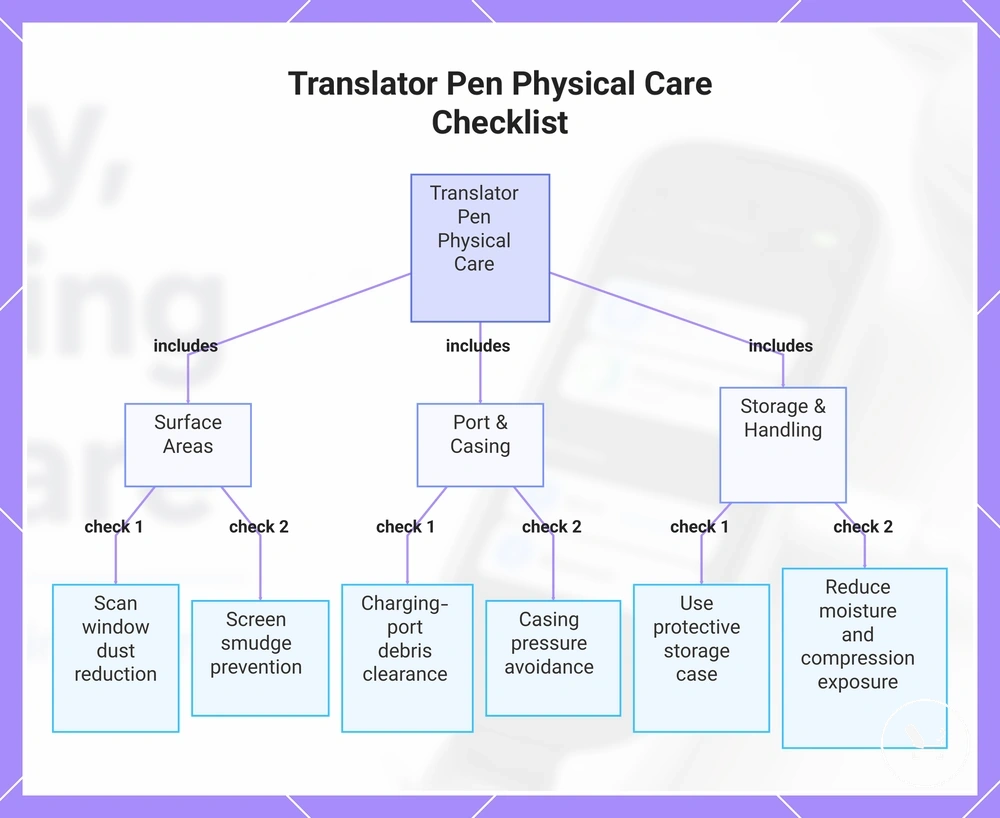
Cleaning, storage, and everyday physical care checklist organizes external protection practices:
- Scan window — reduce dust buildup to maintain clear surface visibility
- Screen — limit smudges and surface residue that can affect readability
- Charging-port area — keep clear of dust and moisture to support stable contact
- Casing — avoid sustained pressure that may stress or mark the exterior
- Storage case — use protective storage during transport to reduce exposure risk
- Moisture exposure — minimize contact with humid environments to protect surfaces
- Transport handling — avoid tight compression to reduce pressure-related wear
This chart shows the main areas of external physical care for a translator pen, including surface, port, casing, and storage handling actions to protect against dust, moisture, and pressure.
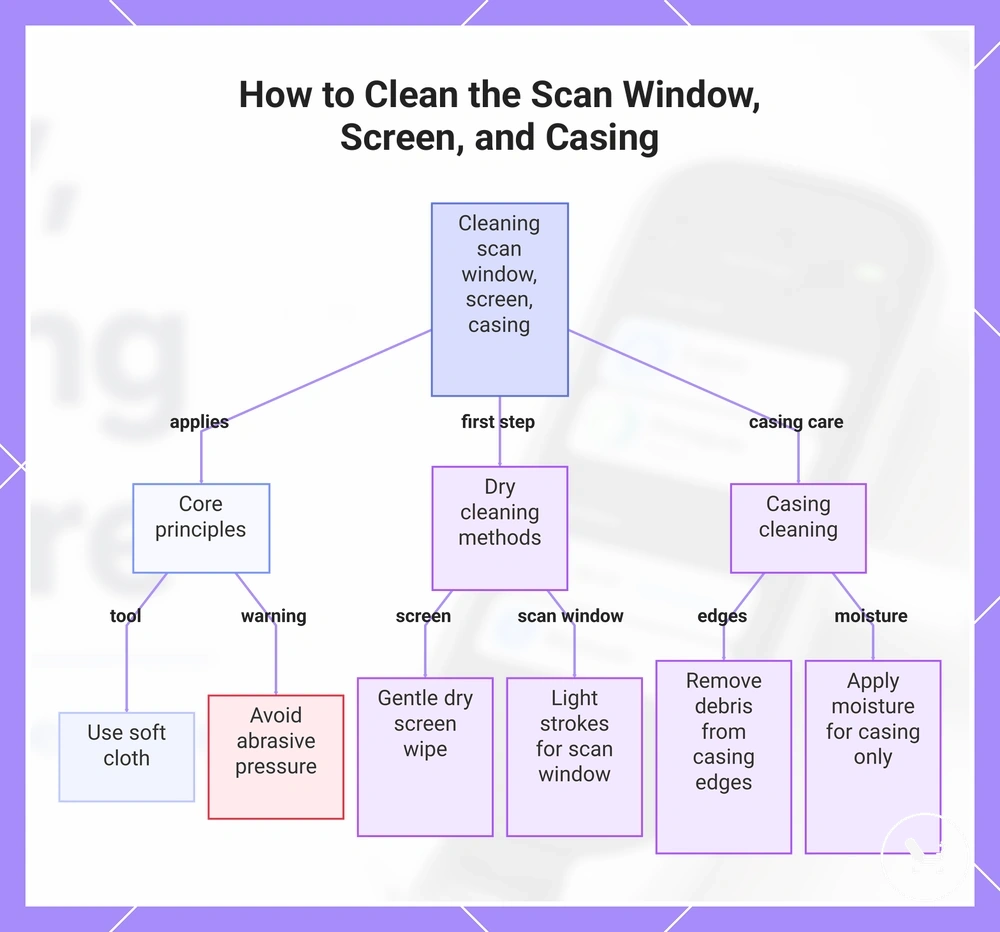
Cleaning the scan window, screen, and casing
Dust buildup and surface residue can reduce clarity and usability on the scan window, screen, and casing during normal handling. These are visible external surfaces that may collect debris around edges and require gentle maintenance to stay clean and functional.
Cleaning the scan window, screen, and casing should remain strictly external and gentle. The process focuses on dry cleaning first, using a soft cloth and avoiding abrasive pressure to prevent surface stress.
Cleaning the scan window, screen, and casing steps organize safe surface cleaning practices:
- Use a soft cloth on the scan window, screen, and casing with dry cleaning first to remove light surface residue without abrasive pressure.
- Wipe the screen gently with dry cleaning only, avoiding strong pressure that may stress the display surface.
- Clean the scan window using light strokes to remove dust while avoiding pressing into the surface.
- Remove debris around casing edges carefully, ensuring particles are not pushed into tight gaps.
- If needed, apply minimal moisture to the soft cloth only for the casing, avoiding any excess exposure to external openings.
This chart shows the key principles and step-by-step process for safely cleaning the scan window, screen, and casing external surfaces.
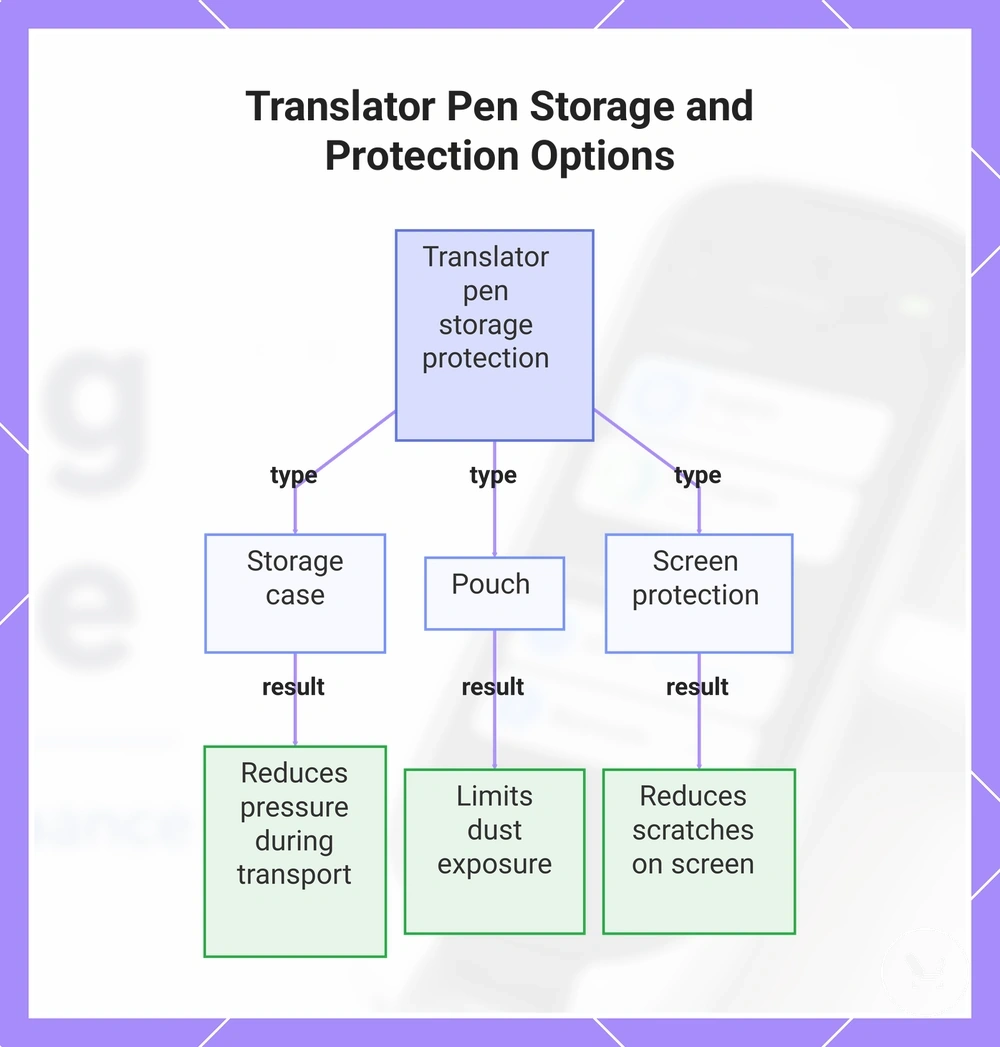
Storage cases, pouches, and screen protection
Storage cases, pouches, and screen protection influence how a translator pen handles carrying and non-use exposure such as dust, pressure, and moisture exposure. These conditions also affect cable separation and charging port access when the device is stored for longer periods, linking storage choices to everyday handling risks.
Storage cases, pouches, and screen protection vary in usefulness depending on transport habits and storage conditions. Their role is to reduce specific exposure risks rather than serve as universal requirements for every situation or device use pattern.
- Storage case — helps reduce pressure during transport, lowering strain from packed bags or external compression.
- Pouch — helps limit dust exposure during carrying and reduces surface accumulation during everyday transport.
- Screen protection — helps reduce scratches on the screen and supports clearer surface condition during handling.
- Cable separation — helps prevent charging cable strain and reduces stress around the charging port during storage.
- Moisture exposure — helps reduce risk from humid or damp storage environments affecting external surfaces.
- Charging port — helps keep the port unobstructed, reducing blockage from debris during non-use storage.
This chart shows the three main protective accessories for a translator pen and the specific risk each reduces.
When a translator pen is not charging
When a translator pen is not charging, it should be checked through the power source, charging cable, charging port, device state, and battery condition before assuming failure. This sequence separates external charging interruptions from device-related causes. It helps identify whether the issue comes from the power source, charging cable, charging port, device state, or battery condition.
Charging symptoms such as no charge response, intermittent charging, or an unstable charge indicator are often linked to a weak power source, loose charging cable connection, debris in the charging port, or temporary device state issues. In some cases, battery condition may also contribute to slower or inconsistent charging behaviour, so each factor should be checked in order without assuming a single cause.
When charging issues appear alongside scanning or translation instability, the problem may extend beyond charging alone. In such cases, broader device troubleshooting may be required using translator pen not working fixes as a continuation step for wider device behaviour checks.
When a translator pen is not charging, the following diagnostic flow separates external charging causes from device-state causes and helps structure troubleshooting.
| Symptom | Likely attribute issue | Check | Meaning |
|---|---|---|---|
| No charge response | Power source or charging cable | Test adapter and cable stability | External power interruption likely |
| Intermittent charging | Charging port connection | Inspect port for debris or loose fit | Unstable contact affecting charging |
| Slow charging | Power source or battery condition | Try another adapter and observe response | Reduced power flow or battery ageing effect |
| No device response | Device state | Perform restart and observe charge indicator | Temporary device state issue possible |
Cable, port, charger, and restart checks
Cable, port, charger, and restart checks are first-line checks for a translator pen charging problem before assuming battery-related failure. These checks move from external causes such as cable check, port check, and charger issues toward device-state causes like restart and indicator behavior. The sequence helps separate charging problem sources in a structured way. :contentReference[oaicite:0]{index=0}
Most charging issues can be narrowed down through cable check, port check, charger, and restart checks before considering battery condition. If the charging problem persists after these steps, broader troubleshooting may be required. The focus stays on observable charging status, not assumptions about permanent failure.
- Cable check — try another charging cable and observe charging response. If the indicator behavior improves, the original cable may be limiting power flow.
- Port check — inspect the charging port for debris or loose fit and observe charging status. Unstable indicator behavior may suggest inconsistent contact.
- Charger check — change the charger or USB power source and monitor the charge window. Any improvement in charging response may indicate a power source issue.
- Charge window check — allow a short charging period and observe delayed response. Gradual indicator movement may suggest stabilizing power intake.
- Restart check — restart the device and observe indicator behavior. A change in device state after restart may restore normal charging status.
- Indicator behavior check — monitor consistency of charging status across all steps. Irregular patterns may indicate combined cable, port, or device-state issues.