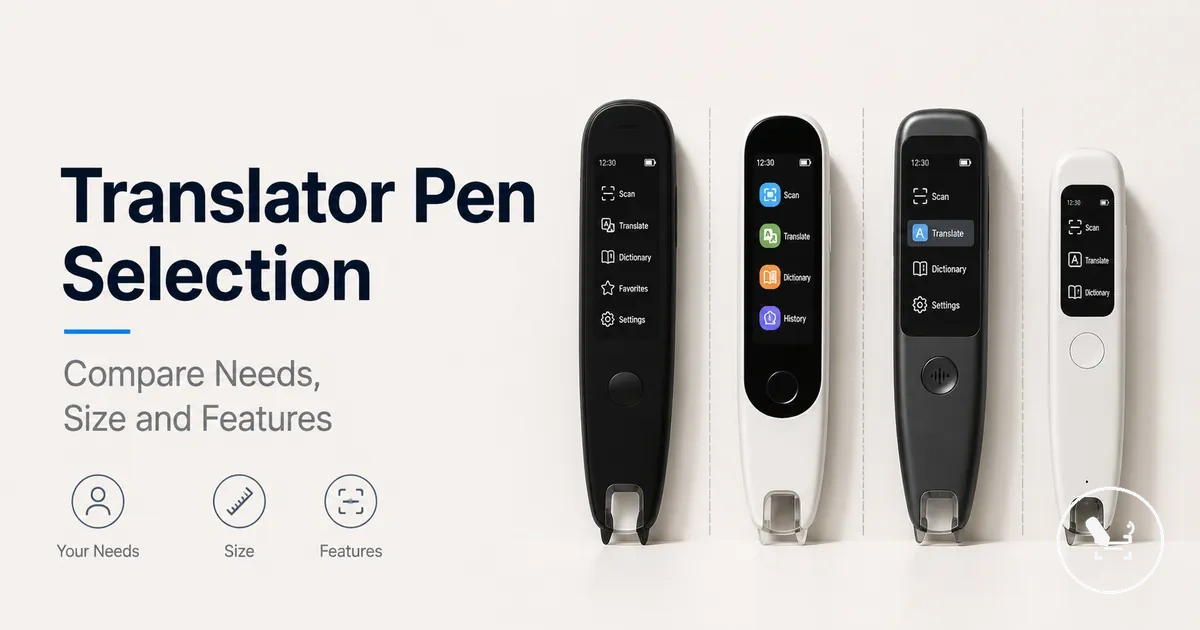
Best translator pens by need and selection criteria
Best translator pens by need and selection criteria depend on how well a translator pen matches specific use case requirements rather than feature count. Selection is shaped by OCR quality, language support, offline needs, portability, voice translation, reading support, budget fit, and the specific use case a user intends to solve.
Different users approach a translator pen with different priorities, such as scanning printed text in books, supporting travel translation in low-connectivity environments, or improving reading support during study. These differences shift which selection criteria matter most and how trade-offs between accuracy, portability, and functionality are evaluated. The broader product context and usage framing is explained in the translator pen guide where the main concept and usage boundaries are outlined.
Because no single configuration fits every situation equally, evaluation should start from the use case and then map it to core attributes such as OCR quality, offline capability, language coverage, and usability factors like screen readability and voice output. This ensures the selection process stays aligned with actual needs rather than relying on generalized assumptions about performance.
What makes a translator pen worth choosing
A translator pen depends on fit and selection criteria rather than feature count. It is worth choosing when its core capabilities align with how you plan to use scan translation, voice translation, offline access, language support, reading support, and portability. The value comes from matching function to use case rather than expecting uniform performance across all conditions.
What makes a translator pen worth choosing is how clearly its capabilities match printed text translation needs in real use situations. The decision becomes easier when you separate scan translation performance from voice translation and offline access expectations.
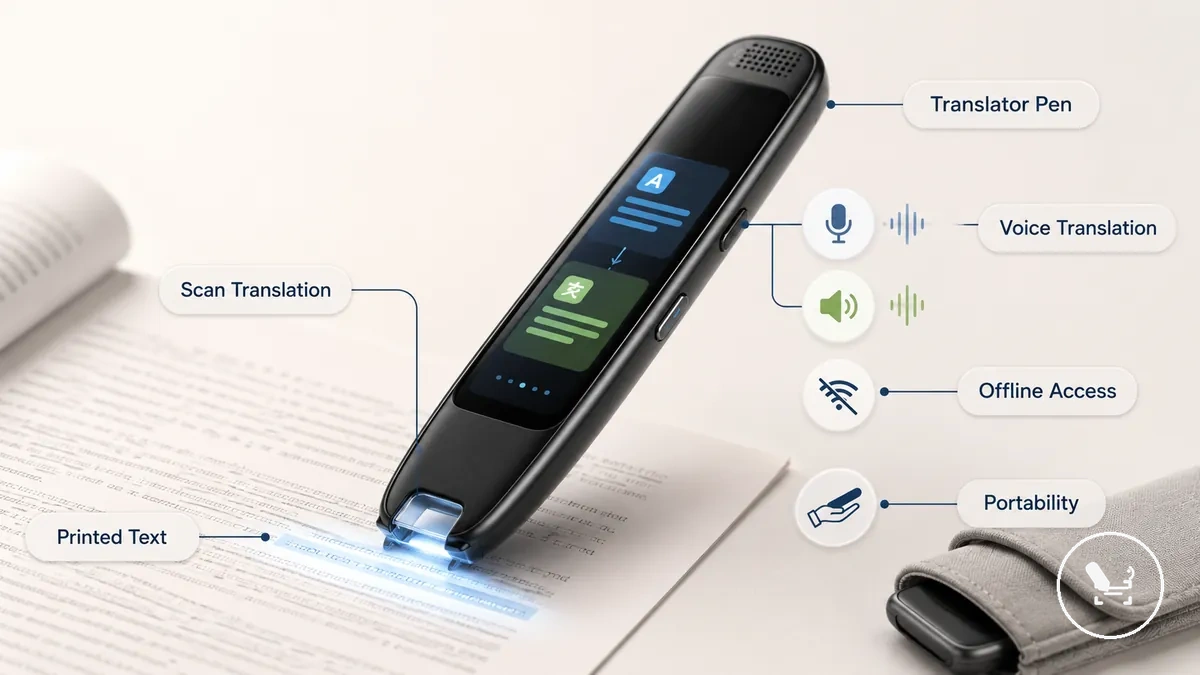
It is typically most suitable when scanning printed text in books or documents where portability and reading support matter most. This boundary helps distinguish when a translator pen fits the task and when other translation approaches may be more suitable.
What makes a translator pen worth choosing can be verified through a simple fit check of its core capabilities against real usage conditions. The checklist below clarifies how each capability connects to a practical requirement so selection stays grounded in actual need rather than assumptions.
- Scan translation + printed text — worth choosing when OCR quality supports readable printed text conversion in books or documents
- Voice translation — worth choosing when spoken output is needed for short interaction contexts with clear audio conditions
- Offline access — worth choosing when translation is required without stable Wi-Fi in travel or low-connectivity environments
- Language support — worth choosing when required language pairs match your study, travel, or reading requirements
- Reading support — worth choosing when text-to-speech and pronunciation assistance improve comprehension during learning
- Portability — worth choosing when compact use and on-the-go scanning are more important than extended multi-device workflows
Match the translator pen to the main use case
Match the translator pen to the main use case because selection depends on how the device will actually be used rather than general feature expectations. The main use case guides whether scan translation, voice translation, offline access, language support, reading support, or portability should take priority. Travel, students, and reading support typically represent the most common selection priorities.
Overlap between use cases is common because a single user may need both portable translation and reading assistance in different contexts. In these situations, the translator pen is evaluated by which requirement is primary and which one is secondary. This makes scan accuracy and practical usability more important than broad feature coverage alone.
Match the translator pen to the main use case by identifying the dominant scenario first and then mapping it to required attributes. For travel-focused usage, see travel translator pen needs to understand mobility and offline constraints. For learning environments, student translator pen needs explain how reading support and scan accuracy shape selection priority.
Match the translator pen to the main use case to compare how different scenarios change selection priority. The image below organizes travel, study, and reading support use cases by their key decision attributes to clarify how fit should be evaluated across contexts.
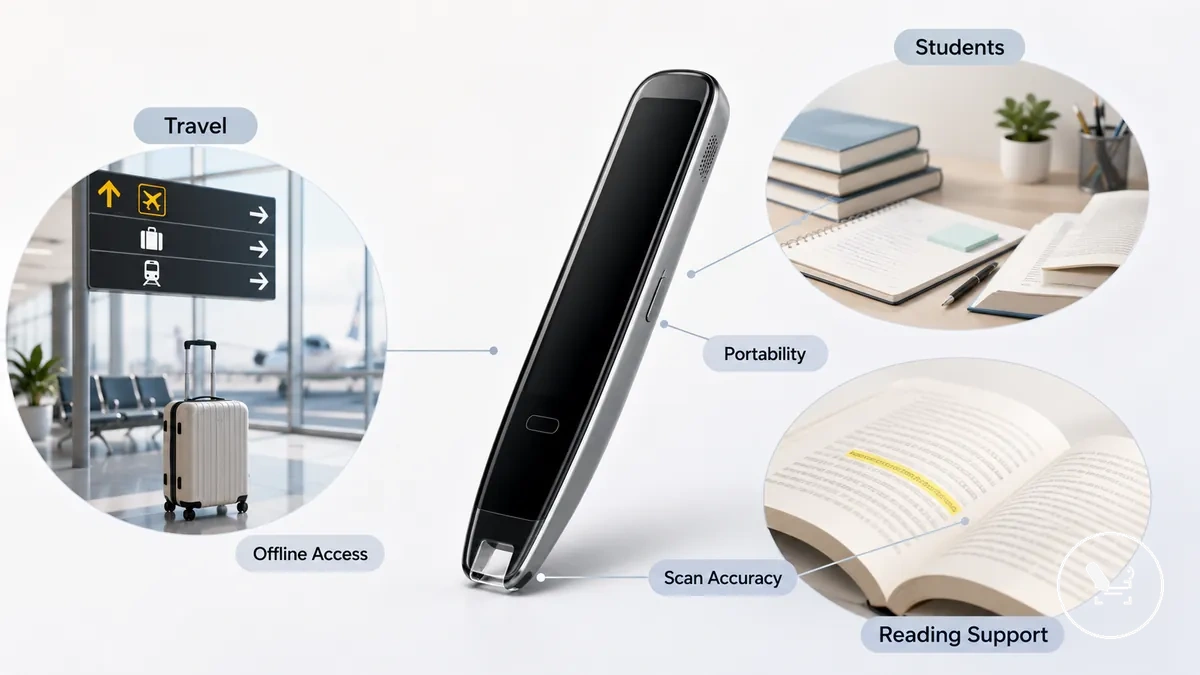
| Use case | Priority attributes | What to check | Buying implication |
|---|---|---|---|
| Travel | Portability, offline access, voice translation | Connection flexibility and quick scan translation | Choose models that support mobile use and limited connectivity conditions |
| Students | Scan accuracy, reading support, language coverage | OCR performance on printed text and learning usability | Prioritize devices that support study-focused reading and comprehension |
| Reading support | Printed text scanning, pronunciation output, ease of use | Clarity of scan translation and text-to-speech function | Choose based on reading comfort and consistent scan translation quality |
Travel needs portability, offline support, and voice translation
Travel use depends on low-friction translation in changing connectivity conditions when moving between transport hubs, streets, or public spaces where printed travel documents, menus, or tickets may need quick scan translation. The translator pen in this context is evaluated based on how well it maintains usable performance without relying on stable network access. Selection is shaped by travel, portability, offline support, voice translation, battery life, and language coverage.
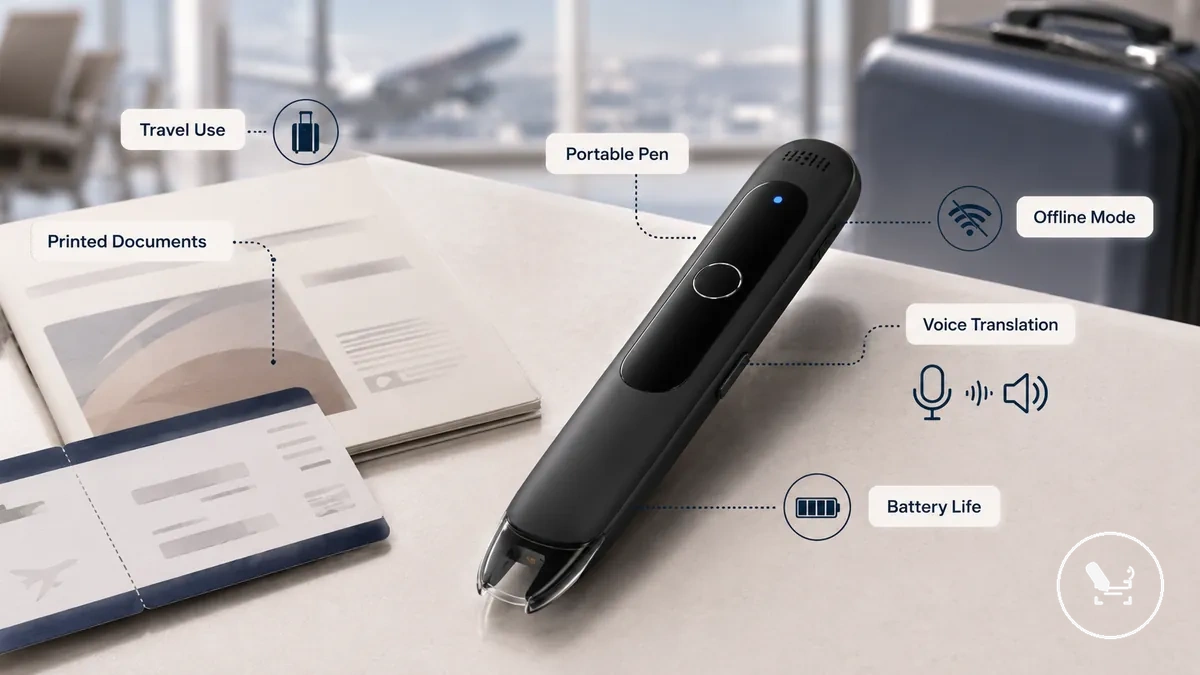
travel needs portability, offline support, and voice translation and the checklist verifies travel-fit conditions for a translator pen in changing connectivity situations.
Portability matters when the device must be carried and used quickly during movement.
Offline support is relevant when Wi-Fi or mobile data may be inconsistent or unavailable.
Voice translation helps when short spoken exchanges are needed in real time.
Battery life becomes important when charging opportunities are limited during trips.
Language coverage should align with expected travel interactions and printed travel documents.
Student needs scanning accuracy, dictionary depth, and reading support
Student use depends on repeatable study situations where the translator pen is used across textbooks, notes, and vocabulary materials rather than one-time translation. In these conditions, scanning accuracy affects how reliably OCR scanning captures textbook scanning content, while dictionary depth and reading support shape how useful the device remains during repeated study use. Selection depends on student needs scanning accuracy, dictionary depth, and reading support.
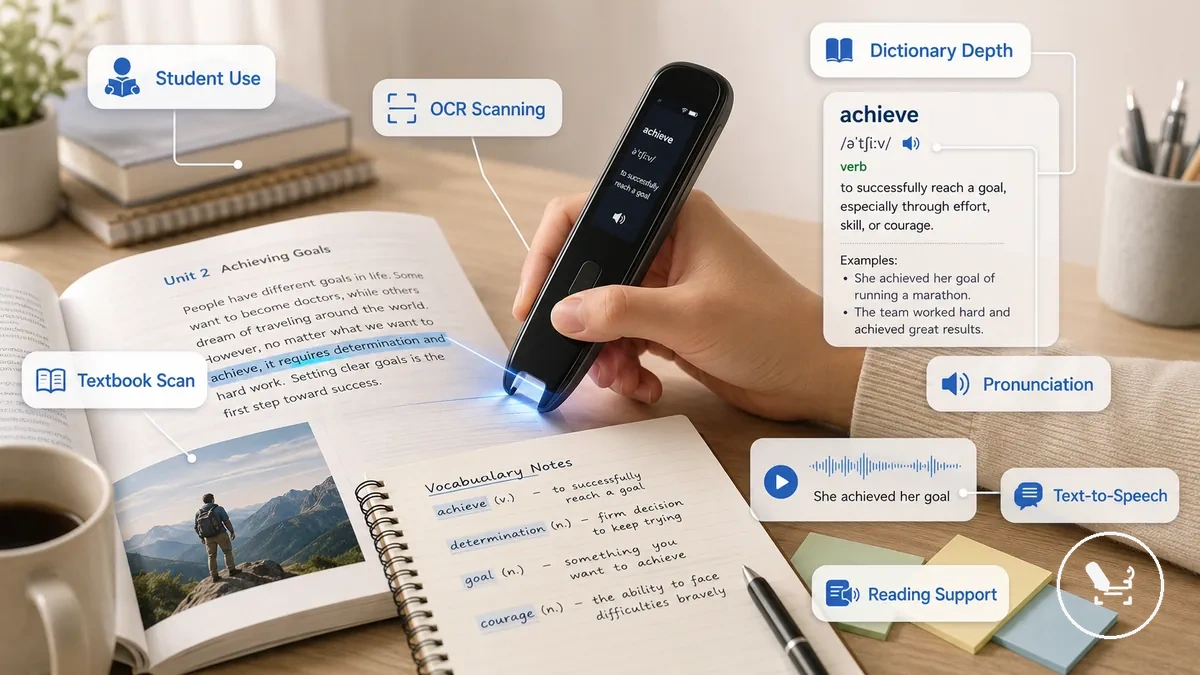
student needs scanning accuracy, dictionary depth, and reading support and the image demonstrates how study tasks influence these selection criteria.
- Textbook scanning depends on OCR scanning quality and scanning accuracy for readable conversion of printed content.
- Vocabulary checks depend on dictionary depth and language support to clarify meaning during study use.
- Reading assistance depends on text-to-speech and pronunciation features to support comprehension during repeated reading.
- Repeat study use depends on consistent performance across classroom and home learning sessions.
Reading support needs OCR quality, pronunciation, and text-to-speech
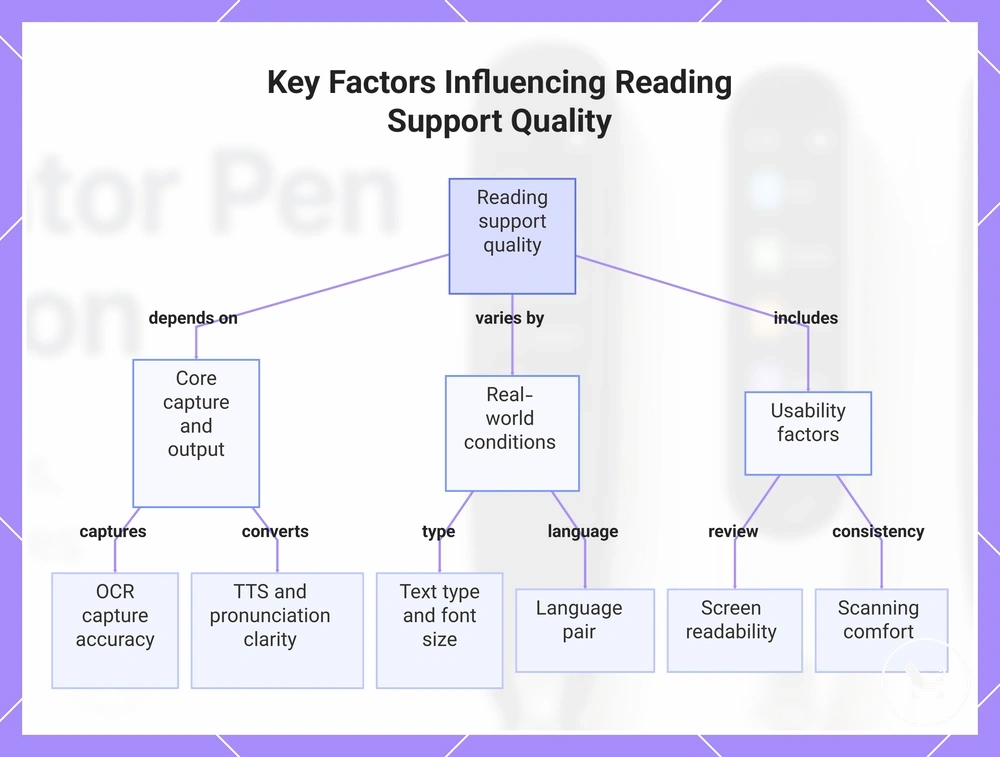
Reading support depends on how reliably a translator pen can capture printed text through OCR quality and convert it into usable spoken output through text-to-speech and pronunciation features. In most cases, usefulness is shaped by how clearly printed text is recognized and how consistently spoken output matches the intended meaning. This also depends on real-world conditions such as text type, font size, and language pair rather than uniform performance across all materials.
The checklist below verifies capture and vocalization performance in real reading conditions.
- OCR quality determines how accurately printed text is captured from books and documents.
- Text-to-speech affects how clearly captured content is converted into spoken output for reading assistance.
- Pronunciation support influences how understandable the spoken output feels in different language pair contexts.
- Screen readability affects how easily captured text can be reviewed during reading use.
- Scanning comfort influences consistency when processing longer printed text passages.
This chart shows the main factors that determine the quality of reading support from translator pens, including core performance factors, real-world conditions, and usability aspects.
Translator pen buying criteria that change the recommendation
Translator pen buying criteria that change the recommendation depend on which weighted attributes directly affect real usage outcomes rather than how many features a device includes. A recommendation shifts only when buying criteria such as OCR quality, offline support, language coverage, voice translation, battery, screen usability, and portability change the expected performance in the user’s actual conditions. This makes recommendation decisions rely on weighted attributes instead of surface-level feature comparisons.
Feature count alone is a weak indicator because it does not reflect how a translator pen performs under real conditions such as scanning accuracy, connectivity limits, or reading comfort. Selection criteria such as features to compare help structure these differences into evaluation-based decision factors rather than generic lists. Once weighted attributes are identified, they can be organized into practical selection signals that guide the recommendation outcome more accurately.
| Criterion | When it matters | What to check | Effect on recommendation |
|---|---|---|---|
| OCR quality | When scanning printed text across books and documents | Consistency in capturing readable text | Higher OCR quality increases suitability for text-heavy use |
| Offline support | When using the device without stable internet | Ability to translate without network dependency | Stronger offline support shifts preference for travel use |
| Language coverage | When multiple languages are required | Supported language pairs for translation tasks | Broader coverage improves suitability across regions |
| Voice translation | When spoken interaction is required | Clarity and responsiveness of audio output | Stronger voice function improves conversational usability |
| Battery | When long or continuous use is expected | Operational duration under normal usage | Higher battery capacity improves mobility reliability |
| Screen usability | When frequent on-device reading is needed | Clarity and ease of reading displayed text | Better usability improves comfort in extended sessions |
| Portability | When frequent travel or movement is required | Size, weight, and ease of carrying | Higher portability shifts preference for mobile scenarios |
OCR scanning quality and translation accuracy
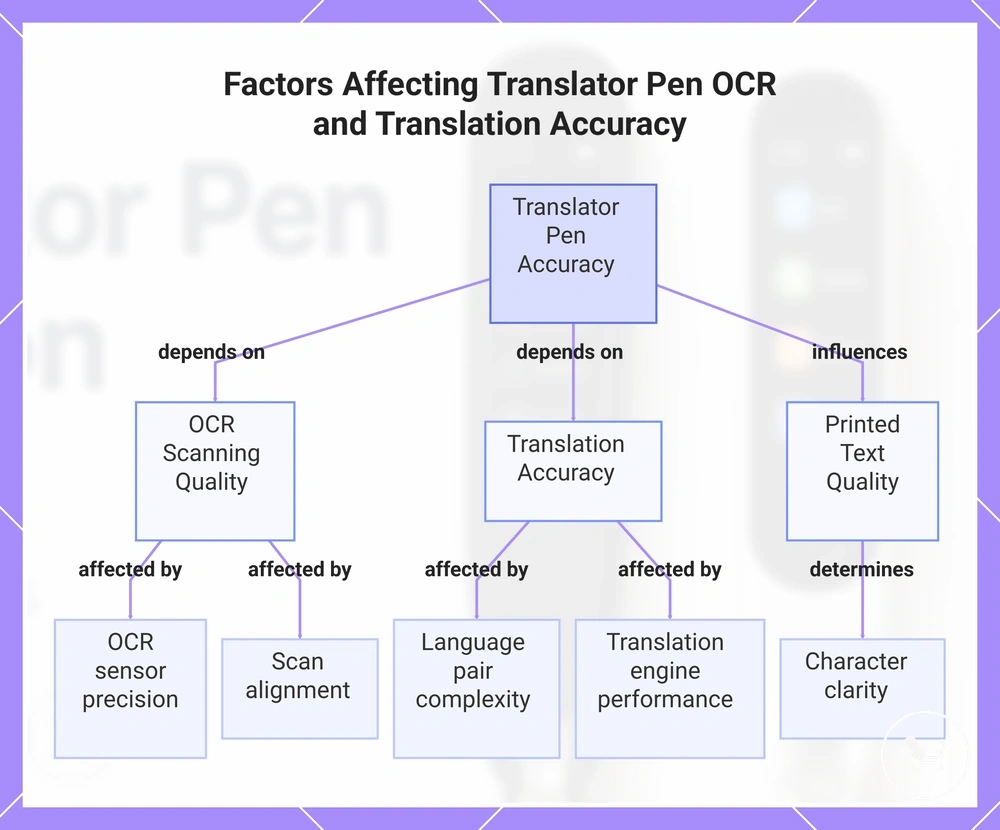
OCR scanning quality and translation accuracy depend on how well a translator pen captures printed text and processes it through its translation engine. OCR scanning quality is influenced by the OCR sensor and scan alignment, while translation accuracy is shaped by the language pair and translation engine performance. Printed text quality also affects how reliably the system can convert scanned input into usable output.
OCR scanning quality and translation accuracy also define how consistent results remain across different use conditions, and more detail is explained in translator pen accuracy where the relationship between capture and output is further clarified.
The points below show how each variable affects overall scan and translation reliability:
- OCR sensor affects how precisely printed text is captured during scanning, especially across different fonts and sizes.
- Scan alignment influences how cleanly text is detected, with misalignment increasing recognition errors.
- Printed text quality determines how easily characters are interpreted, with clearer text improving OCR scanning quality.
- Language pair impacts translation accuracy because some combinations require more complex interpretation.
- Translation engine determines how effectively captured text is converted into meaningful output, especially in context-dependent phrases.
Source reference: :contentReference[oaicite:0]{index=0}
This chart shows the main variables that influence how reliably a translator pen captures and translates printed text.
Offline mode, language coverage, and Wi-Fi dependence
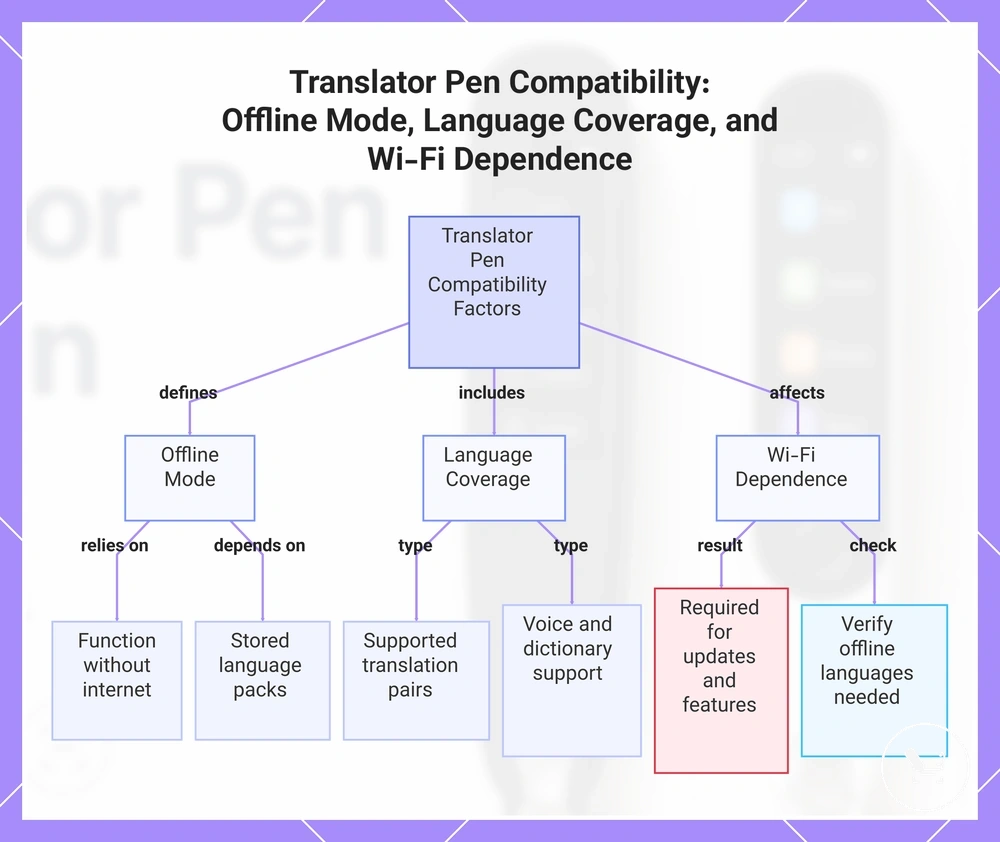
Offline mode, language coverage, and Wi-Fi dependence affect compatibility because translator pen performance depends on supported languages and model behavior. Offline usefulness depends on how language packs are stored and how the device handles translation without connectivity. Wi-Fi dependence may still be required for updates or extended features, so buyers should verify the exact offline languages they need before purchase.
The verification checklist below shows how offline mode, language coverage, and Wi-Fi dependence affect compatibility decisions and helps confirm selection before purchase.
- Offline mode determines whether translation can function without an active internet connection based on stored language packs.
- Wi-Fi dependence affects whether the device requires connectivity for core translation or only for updates and additional features.
- Supported languages define which translation pairs are available in offline mode and which require online processing.
- Language packs control how much linguistic data is stored locally and directly impact offline language coverage.
- Voice languages influence spoken translation availability when operating without Wi-Fi.
- Dictionary support affects how offline definitions and word-level translations behave in different usage conditions.
This chart shows how offline mode, language coverage, and Wi-Fi dependence affect translator pen compatibility and what buyers should verify before purchase.
Voice translation, screen usability, battery life, and portability
Voice translation, screen usability, battery life, and portability matter most in frequent or mobile use scenarios where a translator pen is used beyond occasional scanning tasks. These usability attributes influence daily satisfaction after core translation needs are already met, especially when the device is carried for extended periods or used away from a fixed setup.
The points below group voice translation, screen usability, battery life, and portability into practical usability checks that affect comfort and reliability during frequent use.
Audio (voice translation)
- Voice translation depends on the microphone capturing spoken input clearly in different environments.
- The speaker influences how understandable spoken output feels during repeated use.
- Performance may vary depending on usage conditions such as background noise and speaking distance.
Display (screen usability)
- Screen usability depends on display readability during quick scanning and review of translated text.
- Clear layout supports easier navigation during daily or repeated use.
- Visibility becomes more relevant when checking longer text passages.
Power (battery life and charging)
- Battery life affects how long the device can be used in frequent or extended sessions.
- Charging behavior influences how quickly the pen can return to usable state.
- Power reliability becomes more important when the device is used away from home.
Handling (portability)
- Portability depends on weight and grip comfort during handheld use.
- Lighter weight can improve ease of carrying in frequent-use scenarios.
- Grip design affects comfort during repeated scanning and translation actions.
Best-fit translator pen options by buyer priority
Best-fit translator pen options depend on buyer priority because different usage goals require different attribute strengths. Recommendations should follow buyer priority rather than feature lists, so the decision is guided by required attributes such as portability, OCR reading performance, offline use, and voice translation needs. The main priority categories typically include travel, study, offline use, OCR reading, and voice translation.
Different priorities often involve acceptable trade-offs where improving one capability may reduce emphasis on another, such as portability versus screen usability or OCR reading depth versus device simplicity. This means recommendation direction is shaped by what the user is willing to compromise based on frequency of use and context. The matrix below organizes these priorities into structured selection logic.
| Buyer priority | Required attributes | Acceptable trade-off | Recommendation direction |
|---|---|---|---|
| Travel | Portability, voice translation, offline use | Reduced screen usability or limited advanced dictionary depth | Prefer compact designs that support mobility and spoken translation needs |
| Study | OCR reading, dictionary depth, screen usability | Lower emphasis on portability or minimal voice translation usage | Prefer models optimized for reading clarity and repeated scanning tasks |
| Offline use | Offline language packs, supported languages, basic dictionary support | Reduced online feature depth or slower update flexibility | Prefer models that maintain functionality without connectivity dependency |
| OCR reading | Scanning accuracy, text recognition stability, screen usability | Reduced emphasis on voice translation features | Prefer devices optimized for accurate printed text capture and readability |
| Voice translation | Microphone quality, speaker clarity, real-time spoken output | Less focus on extended reading features or advanced dictionary depth | Prefer models optimized for clear spoken interaction use cases |
Source reference: :contentReference[oaicite:0]{index=0}
How to compare shortlisted translator pens
How to compare shortlisted translator pens depends on focusing only on criteria that directly influence the purchase decision rather than general feature overlap. Shortlisted translator pens should be compared using OCR performance, language support, offline mode, voice translation, usability, and price because these factors determine the most meaningful attribute difference and selection consequence in real use.
Similar-looking shortlisted translator pens can still serve different needs because small differences in OCR accuracy, offline stability, or voice translation clarity often change how they perform in specific conditions. This creates value and limitation gaps between options, even when usability or language support appears similar at first glance. The comparison process therefore helps clarify which trade-offs matter most for each buyer priority.
The comparison approach for shortlisted translator pens aligns with structured evaluation methods such as translator pen comparison, where attribute difference and selection consequence are assessed across OCR, language support, offline mode, voice translation, usability, and price to highlight practical trade-offs rather than surface similarities.
Choosing the stronger fit depends on identifying which attribute matters most under real usage constraints, such as OCR reliability for reading-heavy tasks or offline mode stability for limited connectivity, while balancing usability and price without assuming a universal best option across all shortlisted translator pens.
Here are product examples that may make comparison easier. Before buying, always review the compatibility criteria, essential features, and product details.
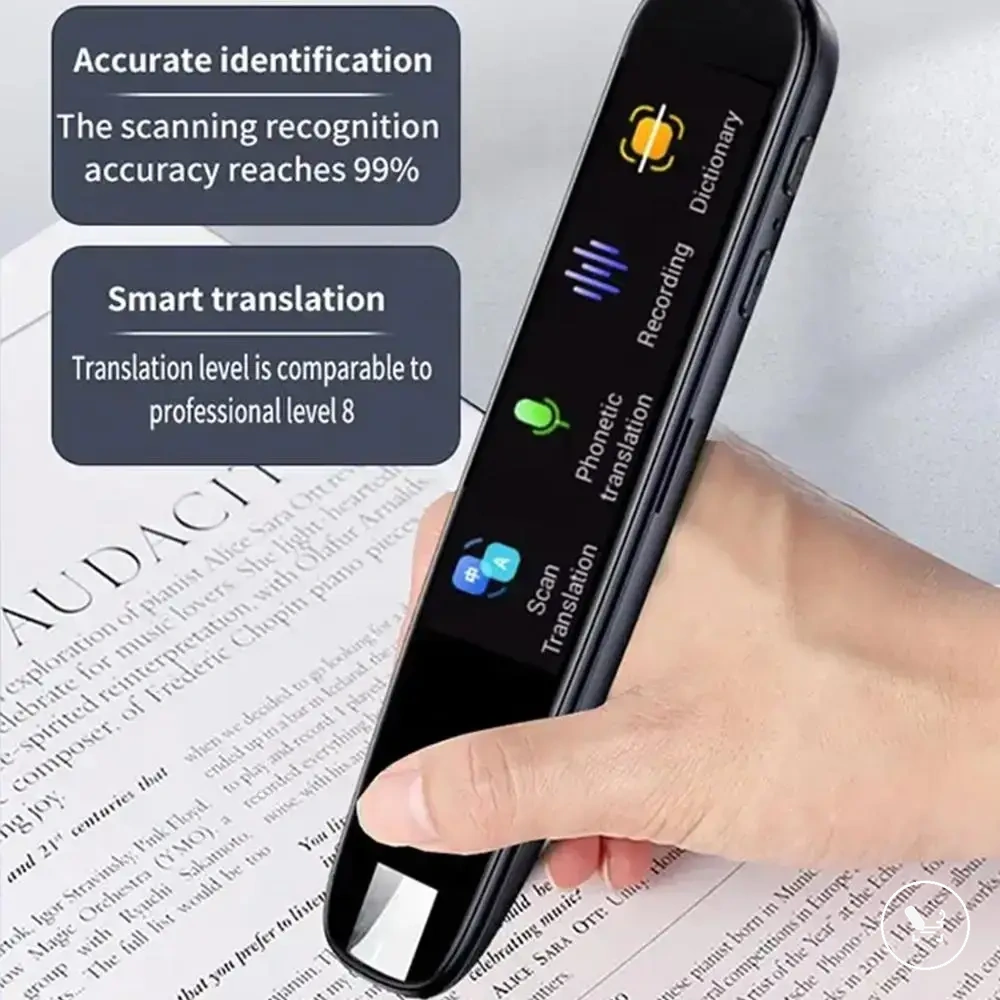
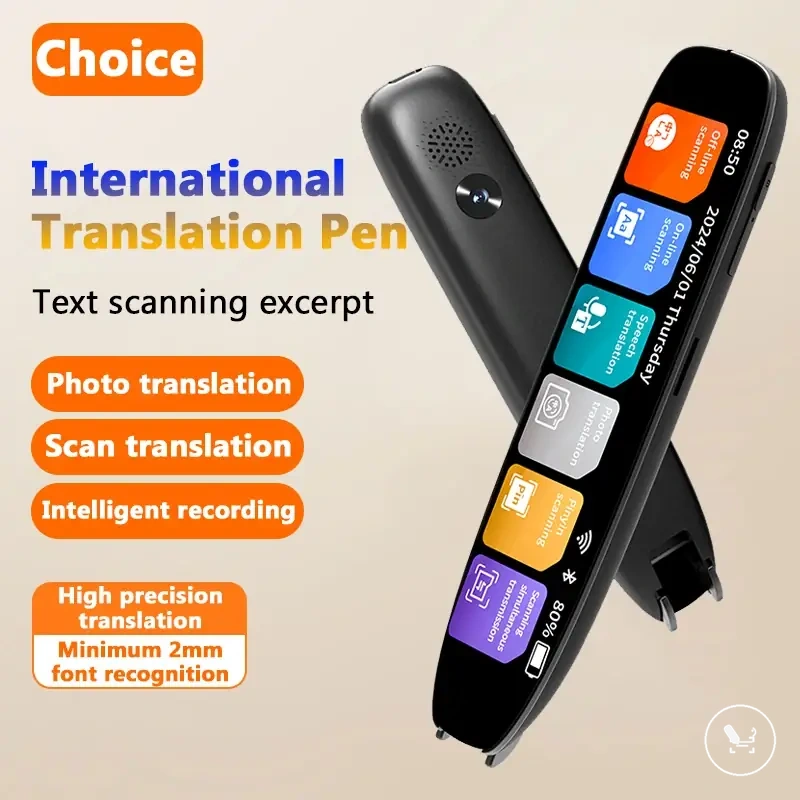
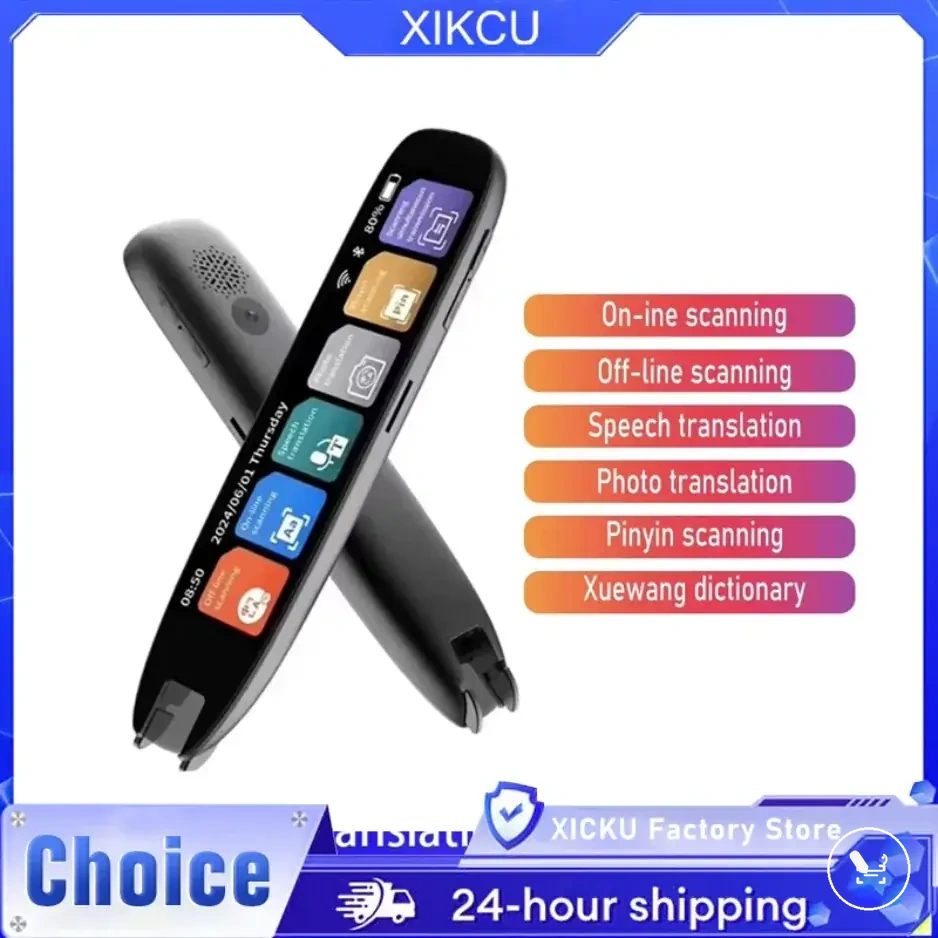
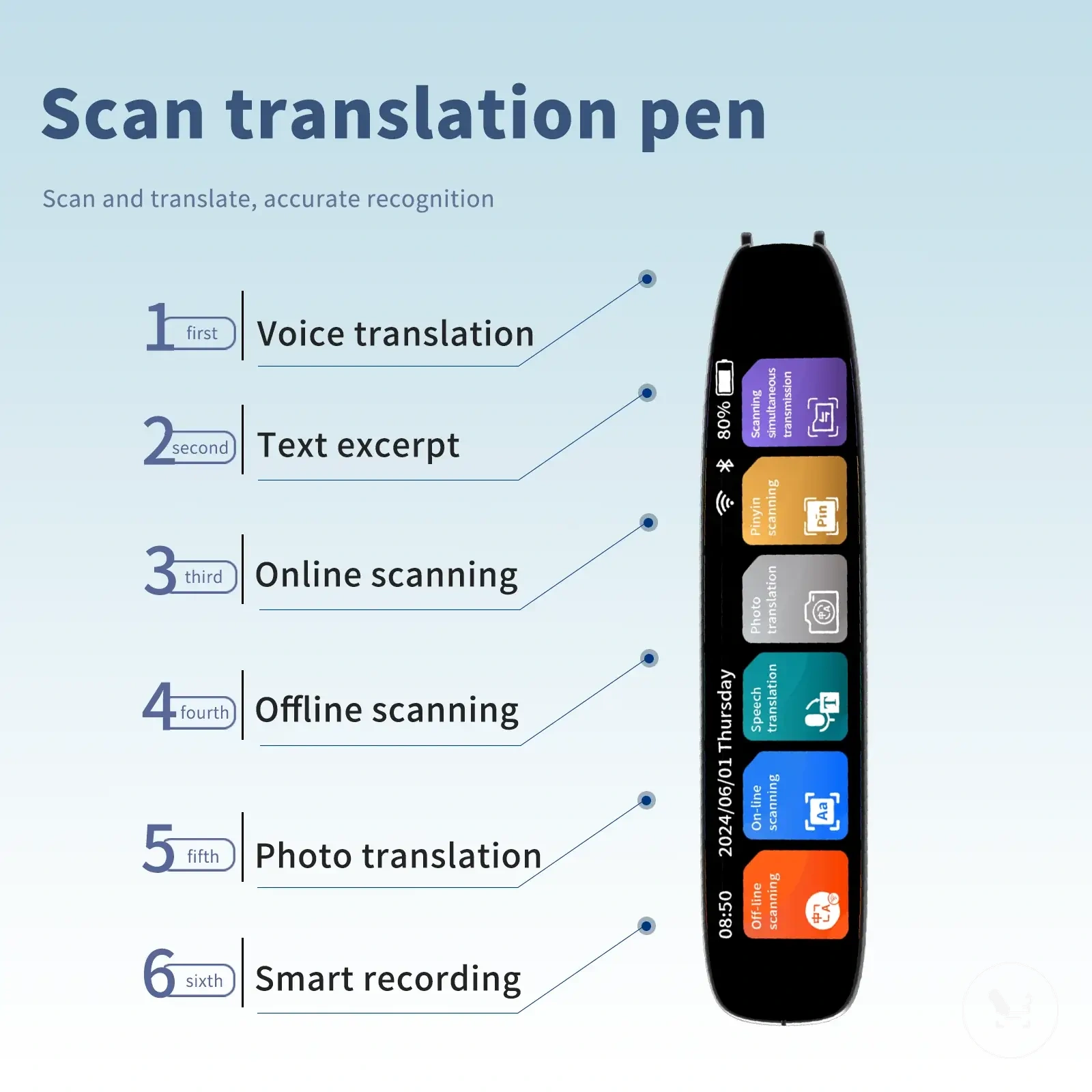
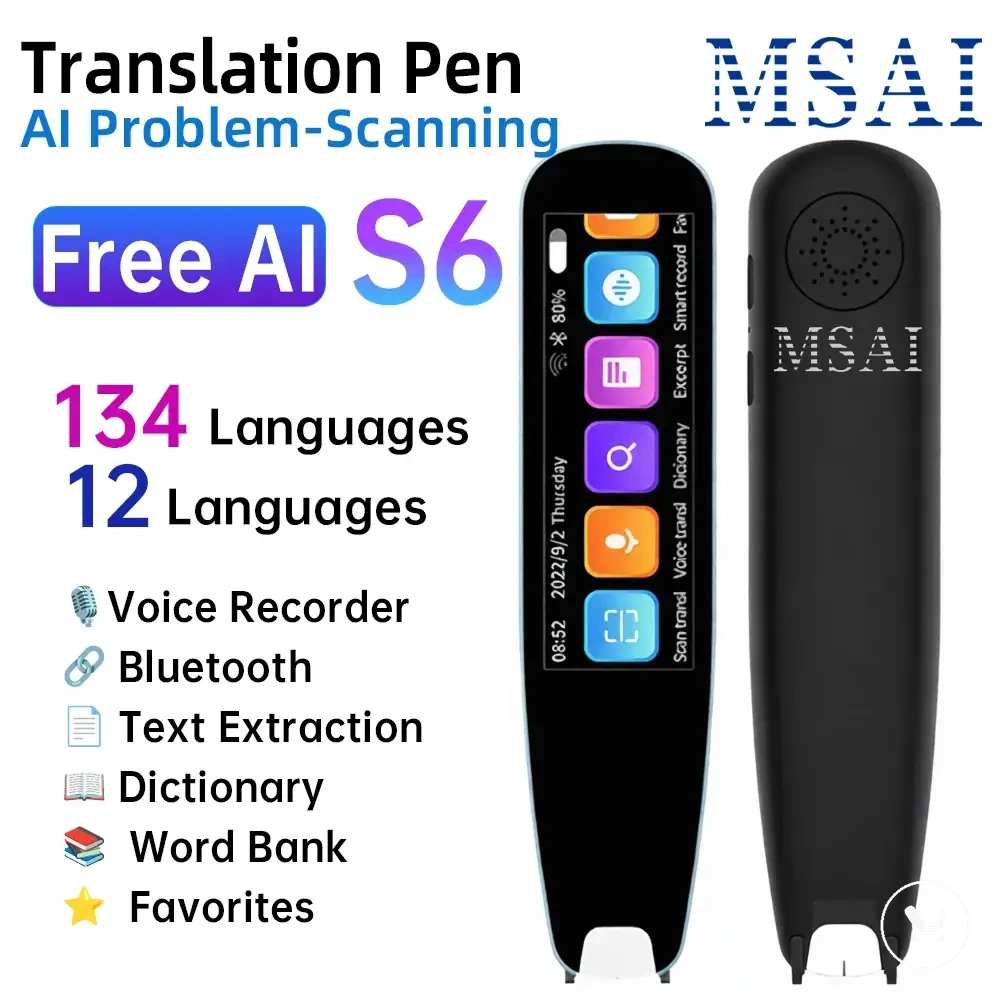
| Comparison criterion | What to check | Stronger fit when | Trade-off to watch |
|---|---|---|---|
| OCR | Text recognition consistency across printed material | Reading accuracy is the main priority | May increase cost or reduce simplicity |
| Language support | Range and depth of supported translation pairs | Multiple languages are required regularly | Less-used languages may have limited depth |
| Offline mode | Availability of offline translation functionality | Use without stable internet is frequent | Offline features may be more limited than online mode |
| Voice translation | Microphone input and speaker clarity | Spoken interaction is a primary use case | Less focus on reading-focused optimization |
| Usability | Screen readability and handling comfort | Frequent daily use is expected | Design constraints may affect compactness |
| Price | Cost relative to feature depth | Budget alignment is a key constraint | Lower price may reduce advanced capability depth |
:contentReference[oaicite:0]{index=0}
Review signals that matter before choosing
Review signals matter when they confirm real-world behavior for the same use case rather than general opinions or isolated feedback. In shortlist evaluation, review signals help validate scan reliability, battery complaints, offline limits, language issues, and durability comments when they appear repeatedly across similar usage conditions. A caution is needed because isolated complaints may not reflect recurring patterns or actual performance consistency.
Review signals that matter before choosing are most useful when they are grouped by attribute tested and confidence effect rather than star ratings or single experiences. :contentReference[oaicite:0]{index=0}
- Scan reliability → tests OCR printed text accuracy → repeated success or errors in similar reading conditions → increases or reduces confidence in text capture stability
- Battery complaints → tests endurance during frequent use → repeated reports of fast drain under similar workloads → lowers confidence in long-session reliability
- Offline limits → tests availability of translation without connectivity → repeated constraints in offline language packs → reduces confidence for no-network usage scenarios
- Language issues → tests translation coverage and accuracy across pairs → repeated mismatch or missing language support → lowers confidence in multilingual environments
- Durability comments → tests physical wear from regular handling → repeated reports of breakdown under similar usage intensity → affects confidence in long-term usability
- Recurring patterns → aggregates multiple similar user experiences → repeated signals across same use case → increases reliability compared to isolated complaints
Feature differences that justify a higher price
Feature differences that justify a higher price depend on whether the added capability changes the expected use outcome rather than just adding extra functions. A higher price is only justified when the improvement creates practical value under a specific buyer condition, not when it simply expands features without changing real usage results. This acts as a meaningful upgrade filter when comparing shortlisted translator pens.
- OCR quality → improves scan accuracy on printed text → when reading consistency is critical in study or document-heavy use → price justification increases because it directly improves scan reliability outcomes
- Offline support → enables translation without connectivity → when travel or low-network environments are expected → higher price is justified due to functional independence in real use conditions
- Language coverage → expands usable translation pairs → when multilingual interaction is a regular requirement → practical value increases as it reduces language limitations in real scenarios
- Battery → extends usage time across sessions → when frequent or long-duration use is expected → price justification applies due to improved operational reliability
- Reading support → improves text-to-speech and screen usability → when learning or extended reading is the main use case → higher price may be justified due to better comprehension support
:contentReference[oaicite:0]{index=0}
Price and value trade-offs before purchase
Price and value trade-offs before purchase depend on whether paid features in a translator pen solve the buyer’s actual use case. Value is not defined by higher cost alone but by how well core features, offline capability, language support, and usability match real usage needs. This creates a cost-value frame where likely cost is only justified when the outcome improves in practical conditions tied to the buyer condition.
Price alone is not enough to evaluate translator pens because similar price tiers can include different combinations of core features, durability cues, and support expectations. Some models may prioritise language coverage while others focus on offline capability or reading support, which changes the actual use case outcome. This makes structured comparison necessary before forming a purchase decision.
Value assessment is often connected to structured evaluation such as translator pen price and value, where price tier and feature value are aligned with buyer condition and support expectations to clarify trade-offs before purchase.
Cheaper or more expensive options can both be reasonable depending on frequency of use and required feature depth. Lower-cost options may fit occasional use with basic offline capability and core features, while higher-cost options may be justified when stronger reading support, durability cues, or language support are needed for frequent or multilingual scenarios. The decision depends on balancing trade-offs against actual use case needs rather than assuming a single optimal price tier.
Here are product examples that may make comparison easier. Before buying, always review the compatibility criteria, essential features, and product details.
| Value factor | What affects cost | When it matters | Buyer decision |
|---|---|---|---|
| Core features | OCR quality and translation processing | When scan accuracy and usability affect daily use | Higher value when it improves actual use case performance |
| Durability cues | Build quality and handling resilience | When frequent handling or travel use is expected | Stronger justification when long-term stability is needed |
| Offline capability | Local language packs and offline processing | When connectivity is limited or unreliable | Higher value when independence from network is required |
| Language support | Range and depth of translation coverage | When multilingual communication is needed | Higher value when broader coverage reduces limitations |
| Support expectations | Updates and system maintenance | When long-term usability is required | Higher value when continued support affects reliability |
When a translator pen is not the right choice
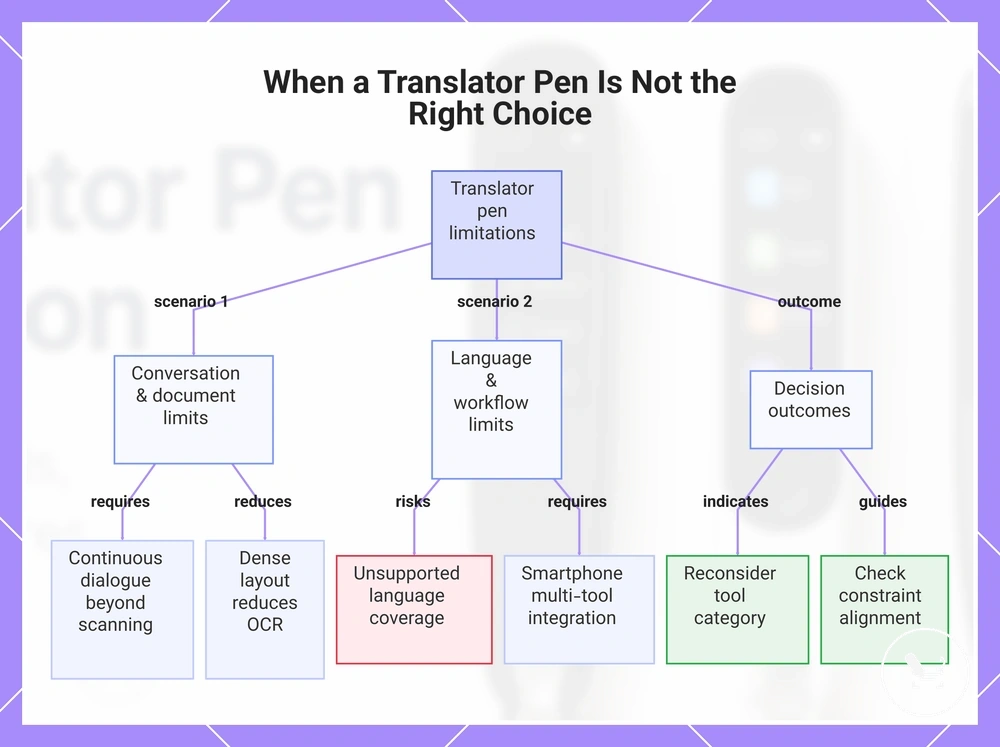
A translator pen is not the right choice when the user need goes beyond short-form scanning and portable translation tasks. It becomes a poor fit in situations involving long-form conversation, complex documents with heavy structure, unsupported languages, or smartphone-first workflows that rely on broader app-based systems. This creates a translator pen limitation where scanning-focused design does not match the actual user requirement, so a safer selection outcome depends on recognizing this boundary early.
This mismatch often appears when expectations shift toward continuous dialogue handling, deep document interpretation, or flexible language coverage that exceeds typical device scope. It can also occur in long-form conversation settings where real-time interaction is more important than scanning, or in complex documents where layout density reduces OCR reliability. In smartphone-first workflows, the alternative decision cue is usually integration across multiple tools, which highlights where a translator pen may be a poor fit.
- Long-form conversation → requires continuous dialogue handling beyond scanning-based interaction → indicates mismatch with translator pen limitation in voice exchange
- Complex documents → dense layouts or structured content → may reduce OCR effectiveness and create interpretation gaps
- Unsupported languages → outside available language coverage → increases risk of incomplete or inaccurate translation
- Smartphone-first workflows → depend on integrated apps and multi-tool environments → reduce suitability of standalone scanning devices
- Alternative decision cue → user need prioritises system-wide flexibility → signals reconsideration of tool category choice
- Safer selection outcome → confirms whether translator pen constraints align with actual use conditions before purchase
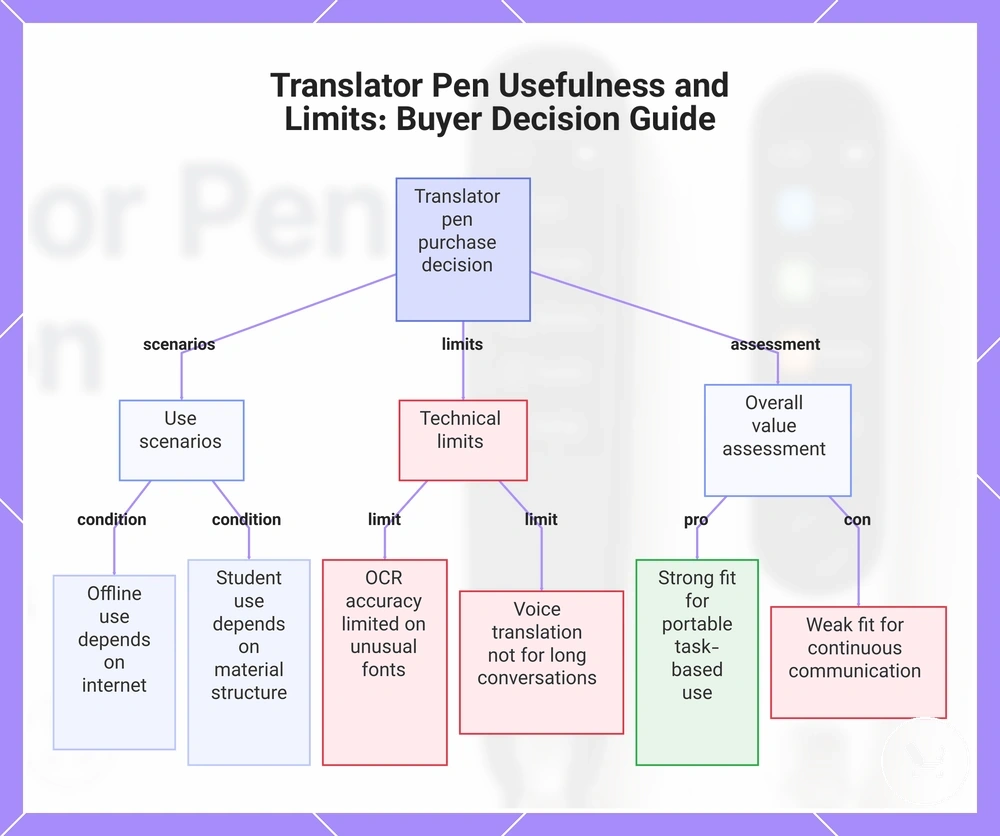
This chart shows the main situations where a translator pen fails to meet user needs, along with the key decision cues for choosing an alternative tool.
Buyer questions about translator pen usefulness and limits
Buyer questions about translator pen usefulness and limits focus on whether the device fits real use needs such as scanning, travel communication, student use, or quick translation tasks. A translator pen is generally useful for portable text capture and short-form translation, but its limits appear when users expect long-form conversation, complex document handling, or broader language coverage beyond its supported range. These conditions help define when it is worth buying based on actual use scenarios rather than assumptions.
Most buyer questions come from comparing usefulness and limits across offline use, student use, travel use, OCR limits, and voice translation performance. Uncertainty often appears when users try to match these needs with real-world workflows and want to understand where a translator pen may or may not be sufficient. The boundary checklist below summarizes these residual doubts and clarifies practical decision fit.
- Offline use → works when offline language packs are available → may be limited by language coverage → decision depends on internet availability needs
- Student use → supports OCR scanning and reading assistance → may struggle with dense or complex layouts → suitability depends on study material structure
- Travel use → supports quick scanning and voice translation → may be affected by noise or fast interaction settings → depends on communication context
- OCR limits → affects accuracy on unusual fonts or structured documents → reduces reliability in complex layouts → impacts reading precision
- Voice translation → supports short interactions → may not fit long-form conversation scenarios → depends on usage length
- Worth buying → depends on frequency of use and price-value balance → stronger fit for portable task-based translation → weaker fit for continuous communication systems
:contentReference[oaicite:0]{index=0}
This chart shows the key scenarios, technical limits, and overall value that determine whether a translator pen is worth buying.