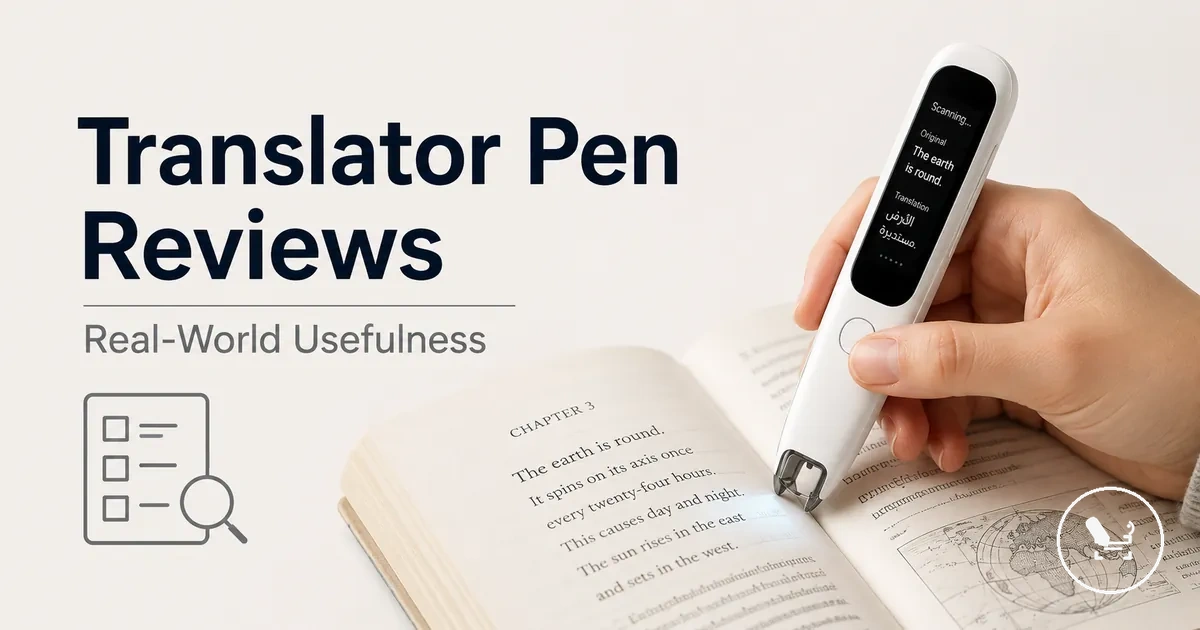
Translator Pen Reviews: Real-World Usefulness and Whether They’re Worth It
Translator pen reviews refer to evaluations of how a translator pen performs in real usage conditions, focusing on real-world reviews that assess OCR accuracy, scanning reliability, translation quality, and overall user experience. These reviews position the translator pen as a practical device whose value is not fixed but depends on context, environment, and usage patterns rather than isolated specifications.
The usefulness of a translator pen in reviews is shaped by how device performance behaves under different real-world conditions, where scanning reliability, OCR accuracy, and translation quality may vary depending on text clarity, language pairs, and user handling. This makes cost-value judgments less absolute, since the same device can deliver different outcomes across reading, travel, or study scenarios. As a result, translator pen reviews typically focus on balancing strengths and limitations to reflect realistic user expectations before moving into more detailed breakdowns of performance factors and decision criteria.
What Translator Pen Reviews Reveal About Real-World Performance and User Expectations
Translator pen reviews expose a consistent performance gap between user expectations and real-world outcomes, where expectations set by marketing or assumptions are tested against OCR accuracy, scanning speed, and translation consistency in practical use. User reviews often show that perceived usefulness depends on how closely device performance matches these expectations under real conditions rather than ideal scenarios.
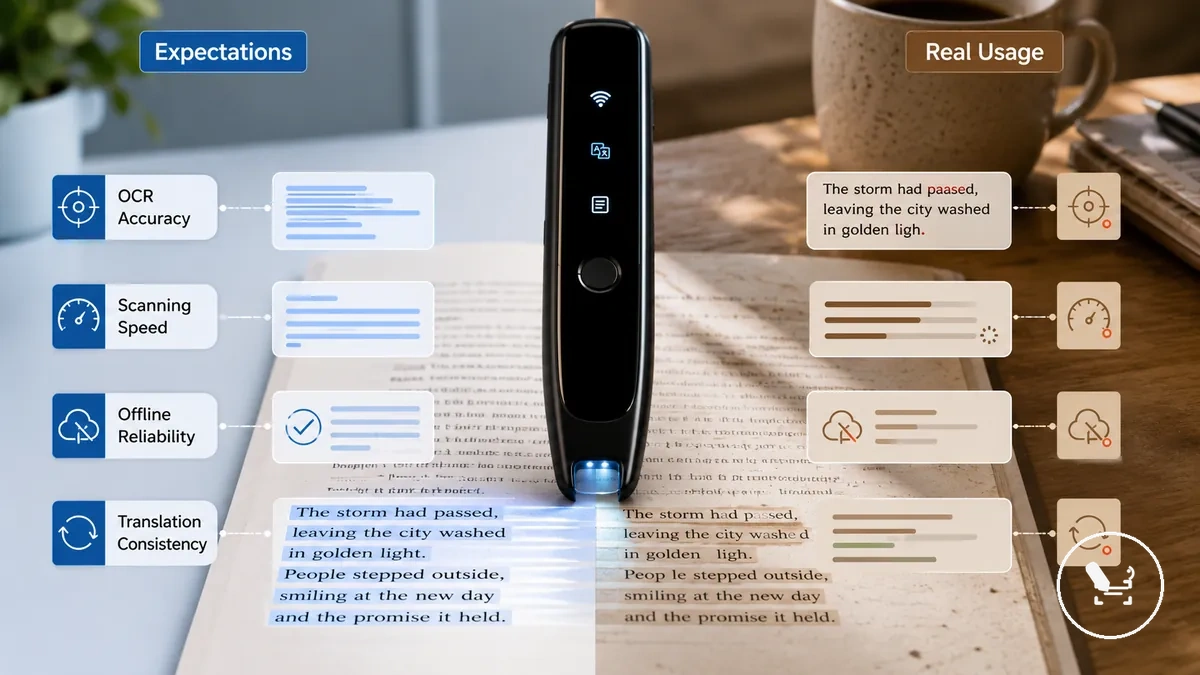
This expectation gap becomes clearer when reviews are grouped around specific performance areas that behave differently depending on environment, user handling, and text conditions. In an expectation–attribute–value (EAV) view, expectations act as reference points while real outcomes shift based on scanning conditions and device response patterns. Common expectation clusters include speed, scanning ease, language coverage, and offline reliability, each reflecting how users anticipate performance before testing it in real use. These clusters often intersect with OCR accuracy and translation consistency, which further influence how performance gaps are interpreted in real-world reviews. As a result, outcomes vary significantly across different usage contexts rather than forming a uniform experience.
- Speed expectations versus actual scanning speed during real use
- Scanning ease expectations compared to OCR accuracy and text recognition stability
- Language coverage expectations versus translation consistency across different inputs
- Offline reliability expectations compared to performance limits without network support
Across these categories, user reviews consistently highlight variability, meaning that device performance is not uniform and may shift based on context, making expectations and outcomes only partially aligned in real-world conditions.
Do Translator Pens Actually Work Well in Everyday Reading, Scanning, and Translation Tasks
Translator pen performance depends on text quality, environment conditions, and device capability tier, so results are not uniform across all usage situations. In real-world conditions, OCR scanning, readability, and translation output quality can vary depending on how and where the device is used.
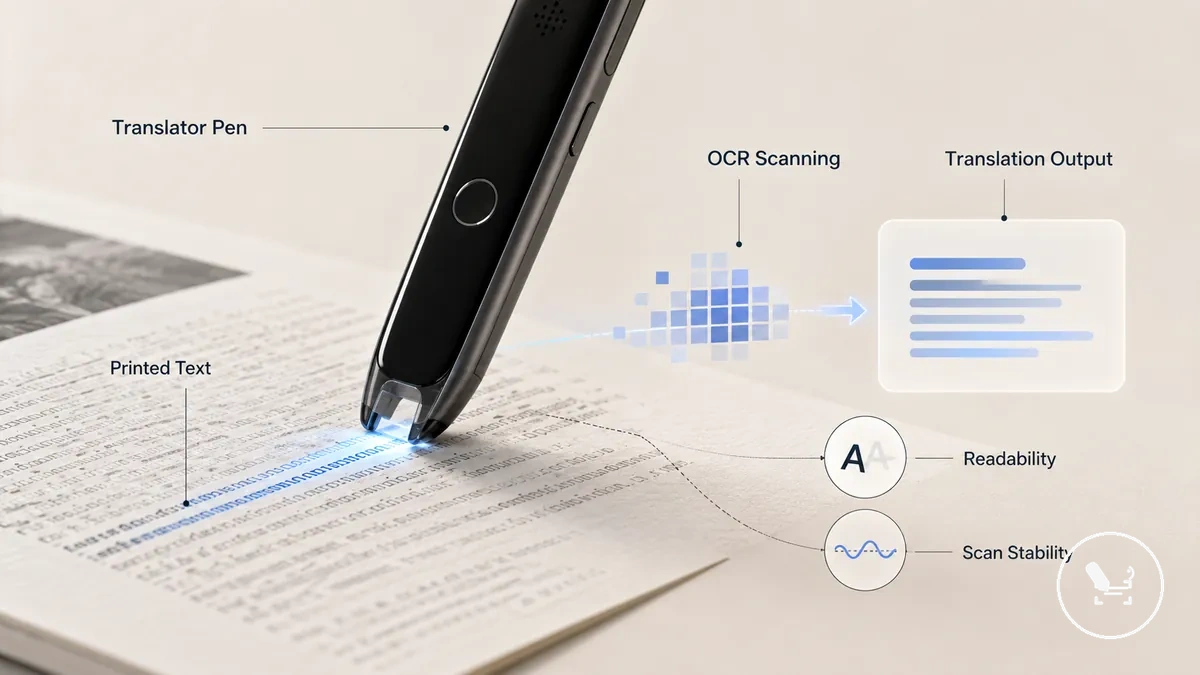
In everyday use, a translator pen is typically evaluated across three core scenarios where performance interacts with different constraints. Reading tasks rely on readability and printed text clarity, where text quality directly influences OCR scanning results. Scanning tasks depend on scanning stability, where small hand movements or uneven surfaces can affect recognition consistency. Translation tasks focus on translation output, where accuracy may shift based on language pairs and input structure. Across these scenarios, OCR accuracy, scan stability, and translation output quality interact under real-world conditions rather than operating as fixed outputs.
- Reading: Depends on readability and printed text clarity under normal lighting conditions
- Scanning: Relies on OCR scanning stability and consistent text capture
- Translation: Focuses on translation output quality and contextual accuracy of processed text
Edge cases can reduce reliability, especially with low-contrast print, unusual fonts, or mixed-language text that affect OCR scanning and translation consistency. In these situations, performance should be treated as condition-dependent rather than fixed.
FAQ: Do translator pens perform consistently across all environments?
Performance varies depending on text quality, scanning stability, and environmental conditions affecting OCR scanning and translation output.
Translator Pen Accuracy in Real User Reviews: What Affects Translation Quality
Translator pen accuracy is an outcome that varies depending on how OCR engine performance, language support, and input conditions interact in real usage. In user reviews, accuracy is not treated as a fixed property but as a system-level result shaped by multiple influencing factors rather than a single device trait.
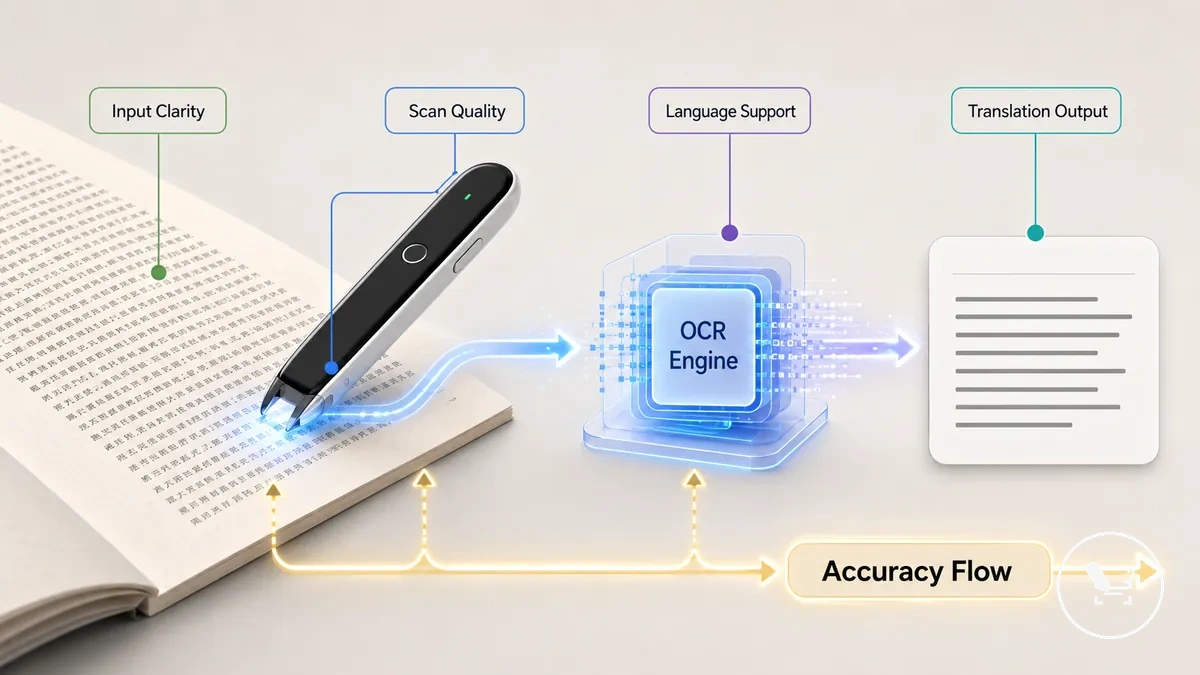
The main drivers of accuracy include the OCR engine responsible for reading printed text, the breadth of language support that determines translation coverage, and scan quality influenced by how clearly the device captures input. These elements collectively define how well a device performs under different conditions, as further explored in translator pen accuracy evaluations, where performance is analyzed as a combined system rather than an isolated feature. Scan quality and text clarity often determine how reliably the OCR engine interprets input before translation processing begins.
| Factor | Attribute | Effect | Outcome |
|---|---|---|---|
| OCR Engine | Character recognition capability | Interprets printed text structure | Base input quality for translation |
| Language Support | Coverage range | Defines translation availability | Varies output completeness |
| Scan Quality | Input clarity | Affects recognition stability | Impacts final translation accuracy |
Accuracy in real use emerges from the interaction between OCR scanning quality, language processing coverage, and input clarity rather than any single isolated factor. When scan stability is high and printed text is clear, translation output tends to be more consistent, while low-quality inputs or unsupported language pairs can introduce variability in results. These interactions make accuracy a conditional outcome that shifts depending on environment, text type, and system constraints, rather than a fixed device-level guarantee.
:contentReference[oaicite:0]{index=0}
Are Translator Pens Worth It? Cost vs Value Analysis Based on User Experience
Translator pens deliver a cost-value outcome that depends heavily on usage frequency, translation dependency, and workflow context. Their overall worth is not fixed, since the same translation tool can feel highly valuable or limited depending on how often and how consistently it is used in real scenarios.
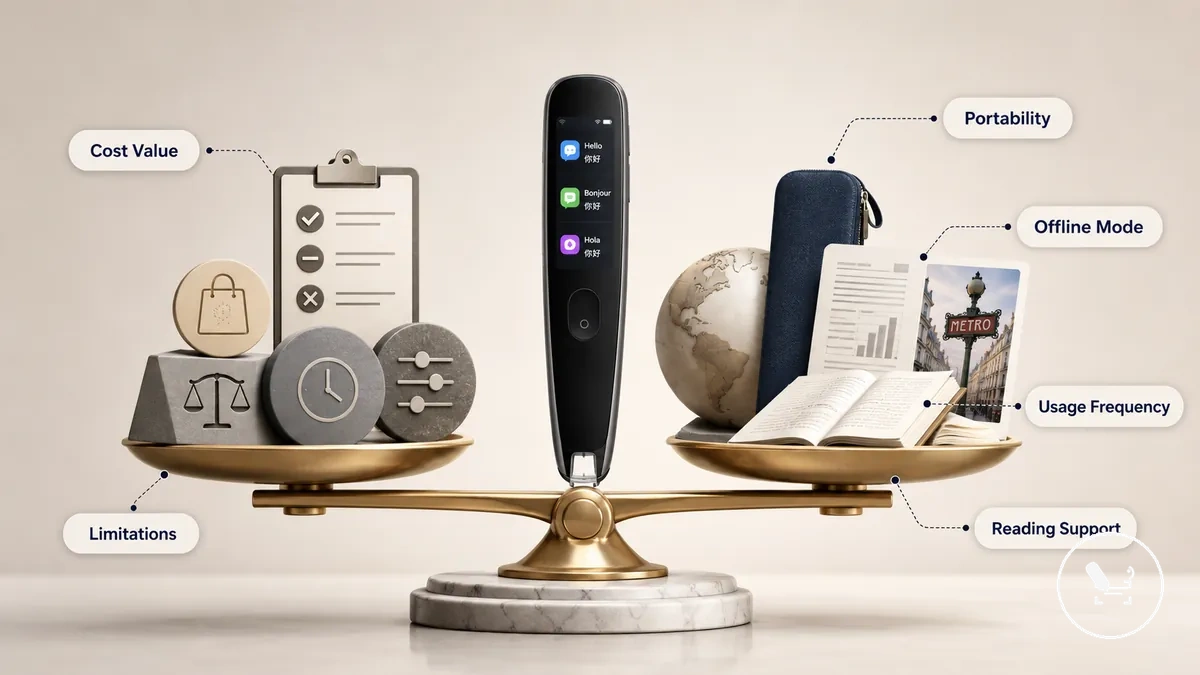
The main value drivers include portability for mobile use, offline mode for situations without stable connectivity, reading assistance for language support, and quick scanning for short text translation tasks. These benefits become more relevant when usage frequency is high or when the translation tool is integrated into daily reading or travel workflows. A deeper breakdown of decision criteria is covered in translator pen value factors, where cost-value evaluation depends on context rather than fixed expectations.
On the limitation side, cost may feel less justified when usage frequency is low or when translation needs are occasional rather than continuous. Variations in scan quality, language support, and input clarity can also influence perceived value across different environments. While portability and offline independence add convenience, they may not fully offset cost concerns for users with minimal or irregular usage patterns. Ultimately, the cost-value balance depends on workflow dependency, learning efficiency, and how essential real-time translation is in daily tasks.
:contentReference[oaicite:0]{index=0}
Translator Pen Pros and Cons Based on Real User Feedback
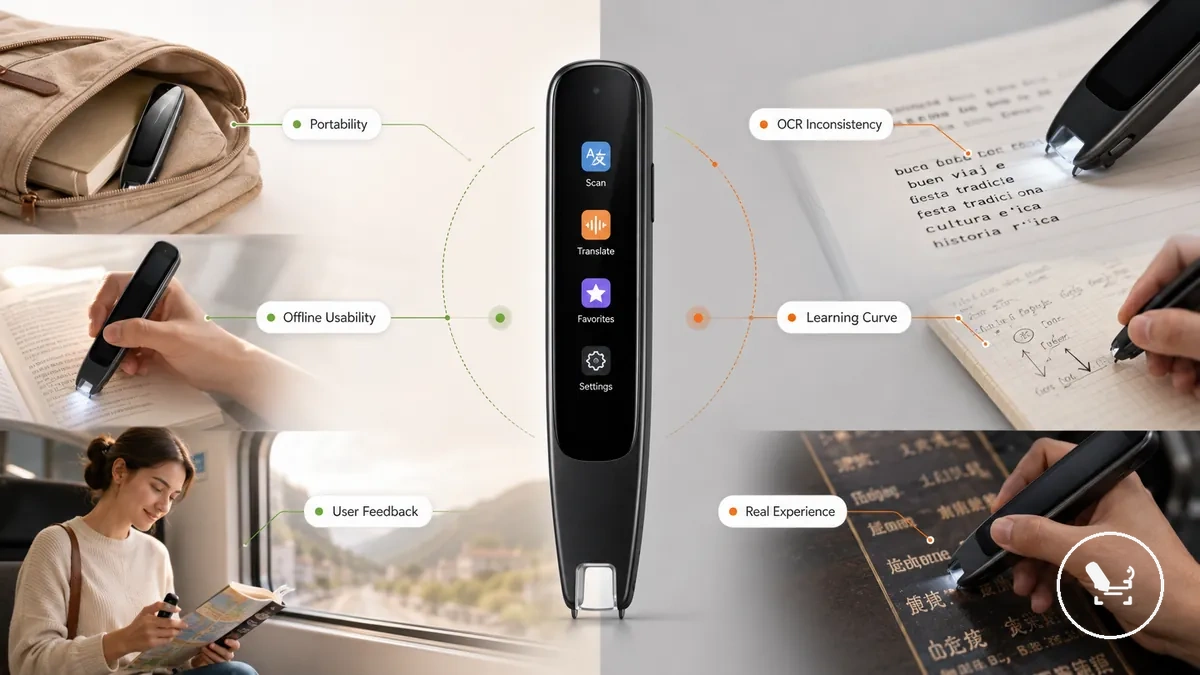
Translator pen pros and cons based on real user feedback depend on how users experience portability, offline usability, and OCR inconsistency across different real-world contexts. User feedback typically reflects a mixed experience where practical convenience is balanced against performance variability in scanning and interpretation tasks.
| Pros | Cons |
|---|---|
|
Portability: Enables easy use in travel and mobile learning contexts. Offline usability: Supports translation without stable internet access. Reading support: Helps interpret short printed text in real time. Workflow convenience: Reduces effort in basic translation tasks. |
OCR inconsistency: Recognition may vary depending on print quality and text format. Input sensitivity: Scanning results can shift with movement and angle. Learning curve: Some users may need time to adjust scanning technique. Context limits: Performance may reduce with complex or dense text. |
Overall user feedback suggests that pros such as portability and offline usability are most valuable in mobile or travel-focused scenarios, while cons like OCR inconsistency and input sensitivity tend to appear under less controlled conditions. The balance between these factors varies depending on usage frequency and how deeply the translation tool is integrated into daily workflows.
Best Use Cases for Translator Pens: Reading, Travel, and Study Scenarios
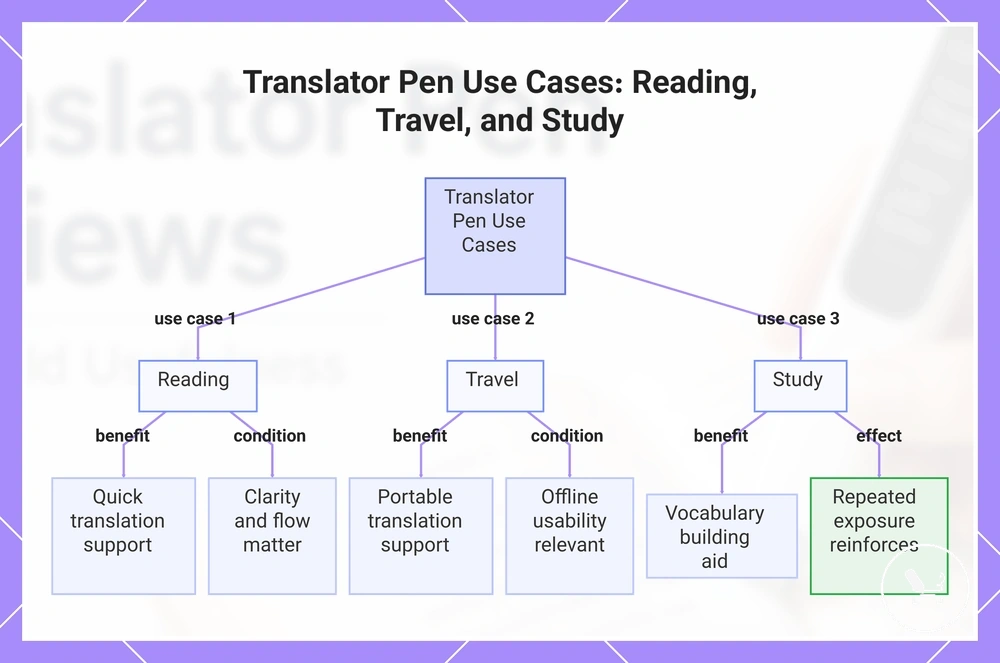
Translator pen use cases depend on context, environment, and user intent rather than a universal performance outcome, especially when applied across reading, travel, and study scenarios. These use cases include reading, travel, and study situations where translation support and portability influence how effectively the tool performs in real conditions, as explained in the translator pen guide and further considered when evaluating best translator pen choices.
- Reading: Supports comprehension of printed text by enabling quick translation support for short passages, where clarity of input and reading flow influence effectiveness.
- Travel: Provides portable translation support in real-world environments, where offline usability and portability become more relevant due to changing connectivity and language conditions.
- Study: Assists vocabulary building and learning tasks, where repeated exposure and structured use cases help reinforce language understanding over time.
This chart shows the main use cases for translator pens and the key factors that influence their effectiveness in each scenario.
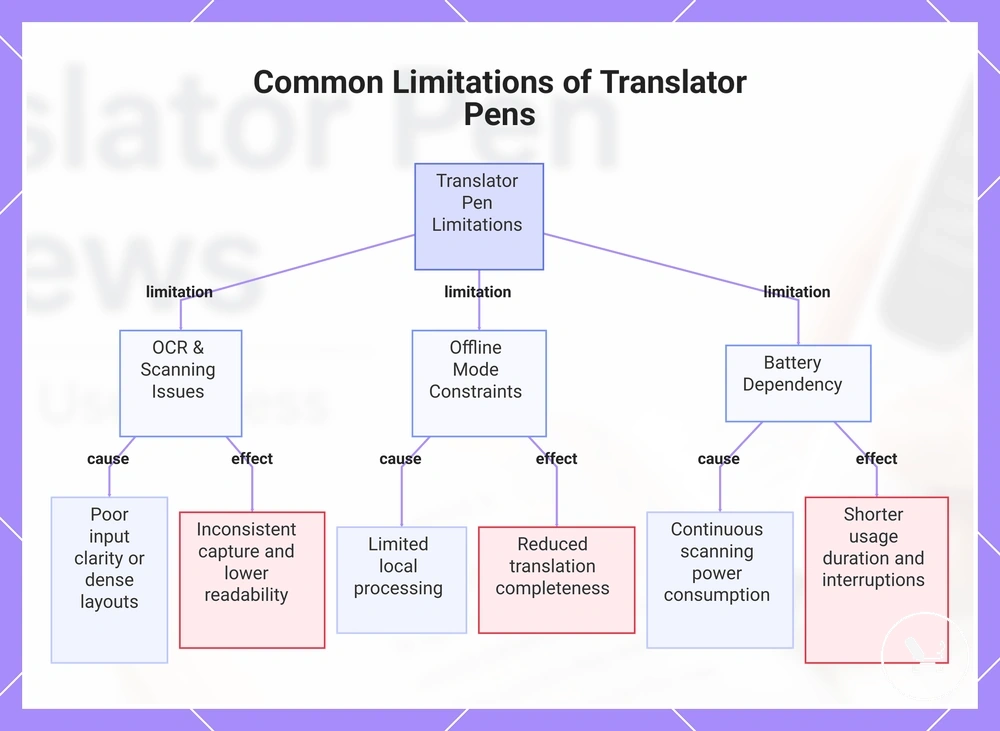
Common Limitations and Problems Reported in Translator Pen Reviews
Common limitations in translator pen reviews arise from environmental, linguistic, and technical constraints, where limitations are often reported through recurring issues such as OCR errors, offline mode restrictions, battery dependency, and readability variations. In user feedback, these limitations are not absolute failures but context-dependent outcomes shaped by text clarity, device conditions, and usage environments.
- OCR errors and scanning issues: Issue → OCR errors may occur when fonts, lighting, or alignment reduce readability. Cause → Poor input clarity or unstable scanning conditions. Effect → Inconsistent text capture and reduced translation stability.
- Offline mode constraints: Issue → Offline mode may reduce functionality in some language processing scenarios. Cause → Limited local processing compared to connected mode. Effect → Reduced translation completeness in offline environments.
- Battery dependency: Issue → Device usage is affected when battery levels decline. Cause → Continuous scanning and processing power consumption. Effect → Shorter usage duration and possible interruptions during extended sessions.
- Complex text handling: Issue → Dense layouts or mixed-language text may reduce processing reliability. Cause → Higher complexity in OCR interpretation. Effect → Lower readability and less consistent translation output.
:contentReference[oaicite:0]{index=0}
This chart shows the main limitations of translator pens as reported in reviews, organized by type with their causes and effects.
Who Should Buy a Translator Pen and Who Should Consider Alternatives
Suitability depends on how user profiles align with translation needs, reading dependency, and learning context, where outcomes vary based on travel frequency, study intensity, and daily exposure to foreign-language content. Translator pen suitability is therefore a match-based evaluation between user requirements and device strengths, rather than a universal recommendation, especially when considering translation support and portability across different real-world scenarios.
The suitability comparison also extends to alternative workflows such as a translator pen vs app, where flexibility, input method, and dependency on scanning influence how well each option aligns with different user contexts.
| Ideal Users (Higher Suitability) | Low-Fit Users (Consider Alternatives) |
|---|---|
|
Users with strong reading dependency on printed materials Travel users requiring portable translation support in varied environments Students and learners with active vocabulary-building or structured study contexts Users who frequently rely on quick OCR-based translation during reading tasks |
Users with occasional or low-frequency translation needs Users who prefer flexible app-based translation without dedicated scanning tools Users mainly working with long-form digital text instead of printed content Users who require minimal dependency on hardware-based translation workflows |
Frequently Asked Questions About Translator Pen Usefulness and Performance
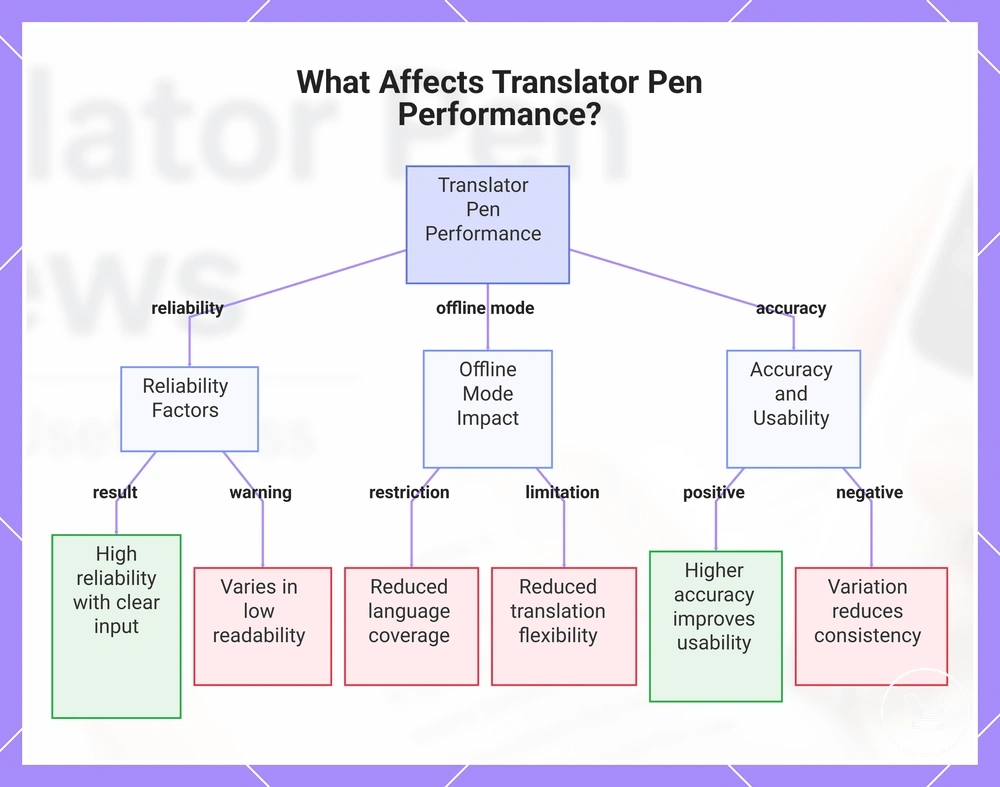
Q1: How reliable is a translator pen in everyday use?
Reliability of a translator pen can vary depending on text clarity, lighting, and scanning conditions. In most cases, translator pen reliability is higher with clear printed input, but it may vary in low-readability environments. This variation affects usability depending on context.
Q2: Does offline mode affect translator pen performance?
Offline mode in a translator pen can limit certain translation functions depending on the device configuration. While basic translation may still work, offline mode often reduces language coverage and overall translation flexibility. This can influence usability in low-connectivity situations.
Q3: How does accuracy relate to usability in a translator pen?
Accuracy in a translator pen directly affects usability because OCR performance determines how smoothly text is interpreted. Higher accuracy improves usability, while variation in scanning results can reduce consistency. This makes performance dependent on input conditions.
This chart summarizes the main factors influencing translator pen performance: reliability conditions, offline mode limitations, and the accuracy-usability connection.